Department of Biosciences, University of Oslo, Oslo, Norway.
Department of Biomedicine and Molecular Imaging Center, University of Bergen, Bergen, Norway.
Mol Microbiol. 2022 Jun;117(6):1308-1316. doi: 10.1111/mmi.14907. Epub 2022 May 4.
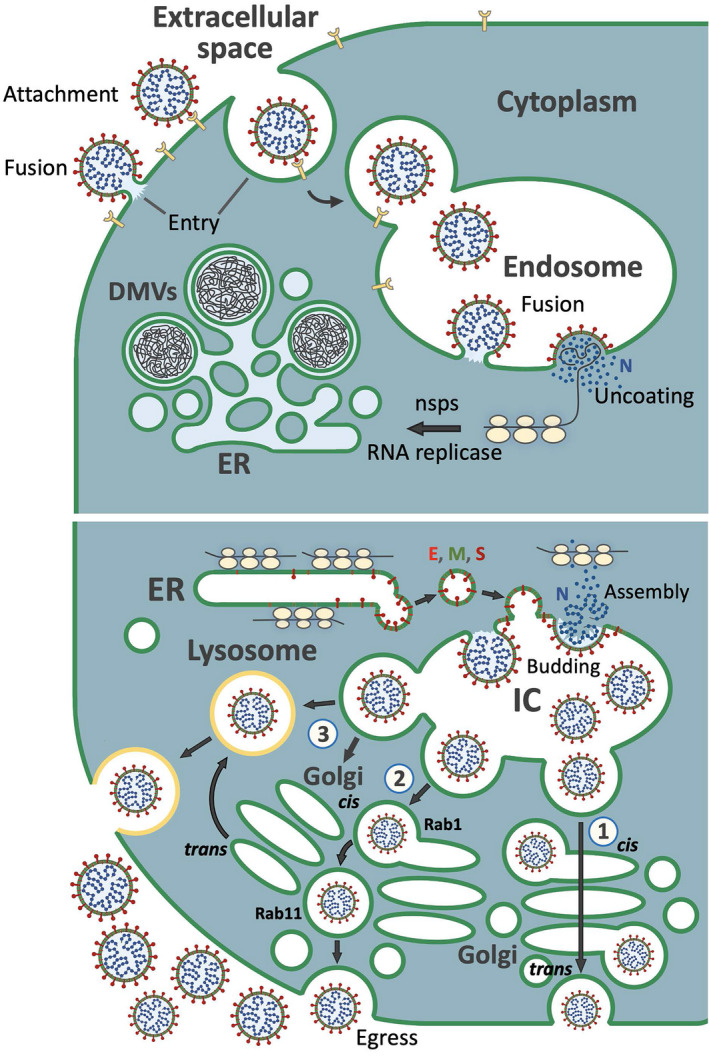
There has been considerable recent interest in the life cycle of Severe Acute Respiratory Syndrome Coronavirus-2 (SARS-CoV-2), the causative agent of the Covid-19 pandemic. Practically every step in CoV replication-from cell attachment and uptake via genome replication and expression to virion assembly has been considered as a specific event that potentially could be targeted by existing or novel drugs. Interference with cellular egress of progeny viruses could also be adopted as a possible therapeutic strategy; however, the situation is complicated by the fact that there is no broad consensus on how CoVs find their way out of their host cells. The viral nucleocapsid, consisting of the genomic RNA complexed with nucleocapsid proteins obtains a membrane envelope during virus budding into the lumen of the intermediate compartment (IC) at the endoplasmic reticulum (ER)-Golgi interface. From here, several alternative routes for CoV extracellular release have been proposed. Strikingly, recent studies have shown that CoV infection leads to the disassembly of the Golgi ribbon and the mobilization of host cell compartments and protein machineries that are known to promote Golgi-independent trafficking to the cell surface. Here, we discuss the life cycle of CoVs with a special focus on different possible pathways for virus egress.
最近人们对严重急性呼吸综合征冠状病毒 2(SARS-CoV-2)的生命周期产生了浓厚的兴趣,该病毒是导致 COVID-19 大流行的病原体。实际上,CoV 复制过程中的几乎每一步——从细胞附着和摄取到基因组复制和表达,再到病毒粒子组装——都被认为是一个潜在的特定靶点,可能成为现有或新型药物的靶点。干扰细胞内子代病毒的出芽也可以作为一种可能的治疗策略;然而,由于目前对于 CoV 如何离开宿主细胞尚无广泛共识,情况变得复杂。病毒核衣壳由与核衣壳蛋白结合的基因组 RNA 组成,在病毒进入内质网(ER)-高尔基体界面中间隔室(IC)的腔室时获得膜包膜。从这里,已经提出了几种 CoV 细胞外释放的替代途径。引人注目的是,最近的研究表明,CoV 感染导致高尔基带的解体以及宿主细胞区室和已知促进高尔基体非依赖性向细胞表面运输的蛋白质机器的动员。在这里,我们特别讨论 CoV 的生命周期以及病毒出芽的不同可能途径。