Institute of Medical Microbiology, College of Life Science and Technology, Jinan University, Guangzhou, China.
Key Laboratory of Viral Pathogenesis & Infection Prevention and Control (Jinan University), Ministry of Education, Guangzhou, China.
Front Cell Infect Microbiol. 2024 Jan 5;13:1309128. doi: 10.3389/fcimb.2023.1309128. eCollection 2023.
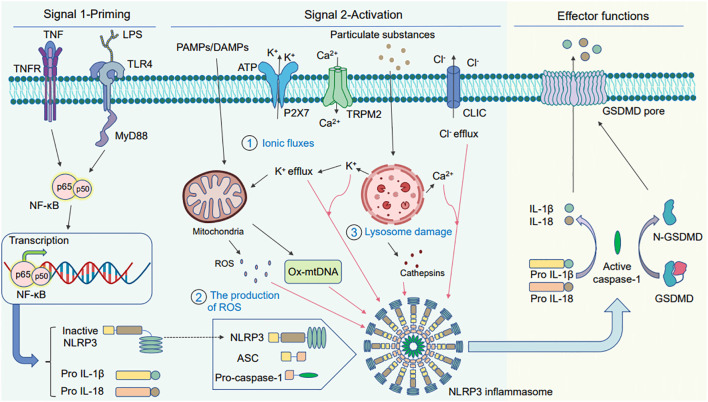
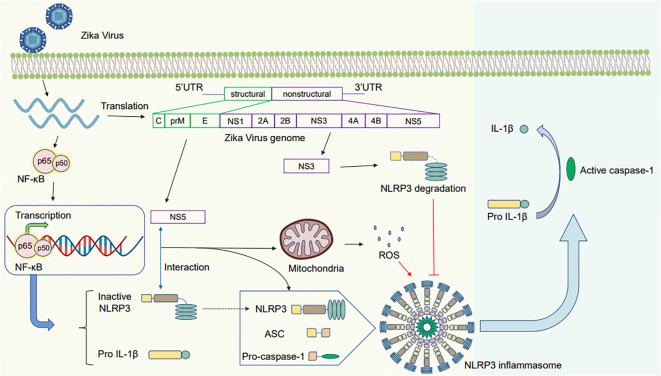
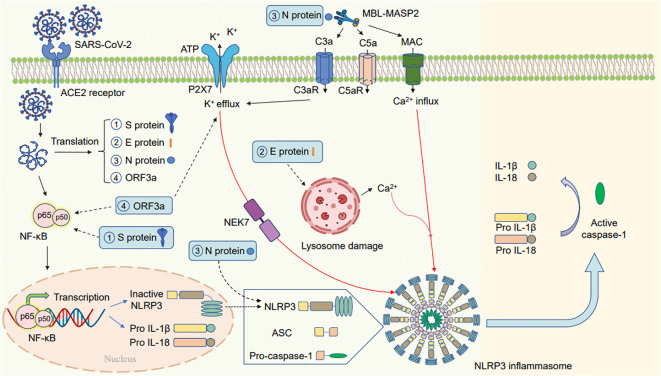
Virus infection is one of the greatest threats to human life and health. In response to viral infection, the host's innate immune system triggers an antiviral immune response mostly mediated by inflammatory processes. Among the many pathways involved, the nucleotide-binding oligomerization domain (NOD)-like receptor protein 3 (NLRP3) inflammasome has received wide attention in the context of viral infection. The NLRP3 inflammasome is an intracellular sensor composed of three components, including the innate immune receptor NLRP3, adaptor apoptosis-associated speck-like protein containing CARD (ASC), and the cysteine protease caspase-1. After being assembled, the NLRP3 inflammasome can trigger caspase-1 to induce gasdermin D (GSDMD)-dependent pyroptosis, promoting the maturation and secretion of proinflammatory cytokines such as interleukin-1 (IL-1β) and interleukin-18 (IL-18). Recent studies have revealed that a variety of viruses activate or inhibit the NLRP3 inflammasome via viral particles, proteins, and nucleic acids. In this review, we present a variety of regulatory mechanisms and functions of the NLRP3 inflammasome upon RNA viral infection and demonstrate multiple therapeutic strategies that target the NLRP3 inflammasome for anti-inflammatory effects in viral infection.
病毒感染是对人类生命和健康的最大威胁之一。针对病毒感染,宿主的先天免疫系统通过炎症过程引发抗病毒免疫反应。在涉及的众多途径中,核苷酸结合寡聚化结构域 (NOD)-样受体蛋白 3 (NLRP3) 炎性小体在病毒感染的背景下受到了广泛关注。NLRP3 炎性小体是一种由三个组成部分组成的细胞内传感器,包括先天免疫受体 NLRP3、衔接蛋白凋亡相关斑点样蛋白(ASC)和半胱氨酸蛋白酶 caspase-1。组装后,NLRP3 炎性小体可以触发 caspase-1 诱导 GSDMD 依赖性细胞焦亡,促进白细胞介素-1β (IL-1β) 和白细胞介素-18 (IL-18) 等促炎细胞因子的成熟和分泌。最近的研究表明,多种病毒通过病毒颗粒、蛋白质和核酸激活或抑制 NLRP3 炎性小体。在这篇综述中,我们展示了 RNA 病毒感染时 NLRP3 炎性小体的多种调节机制和功能,并展示了针对 NLRP3 炎性小体的多种治疗策略,以发挥抗病毒感染的抗炎作用。