Epidemiology Branch, National Institute of Environmental Health Sciences (NIEHS), Research Triangle Park, North Carolina, USA.
Department of Epidemiology, University of North Carolina at Chapel Hill, Chapel Hill, North Carolina, USA.
Environ Health Perspect. 2022 Apr;130(4):47006. doi: 10.1289/EHP10077. Epub 2022 Apr 22.
Prenatal phthalate exposure has been associated with lower birth weight but also higher weight in childhood. Few studies have examined weight or adiposity from birth to childhood and thus cannot assess growth trajectories associated with exposure.
We assessed associations between maternal phthalate exposures in pregnancy and child weight and adiposity measured prenatally through childhood (3-6 years of age).
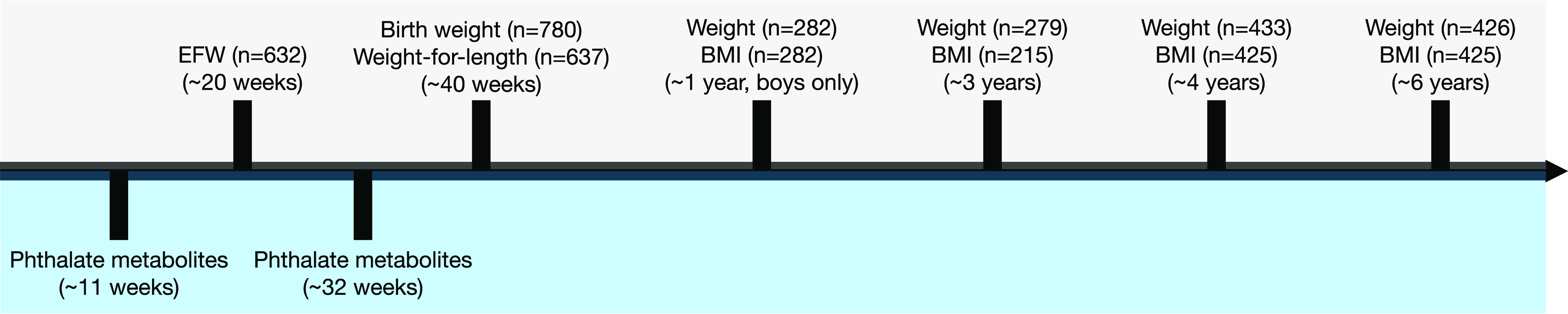
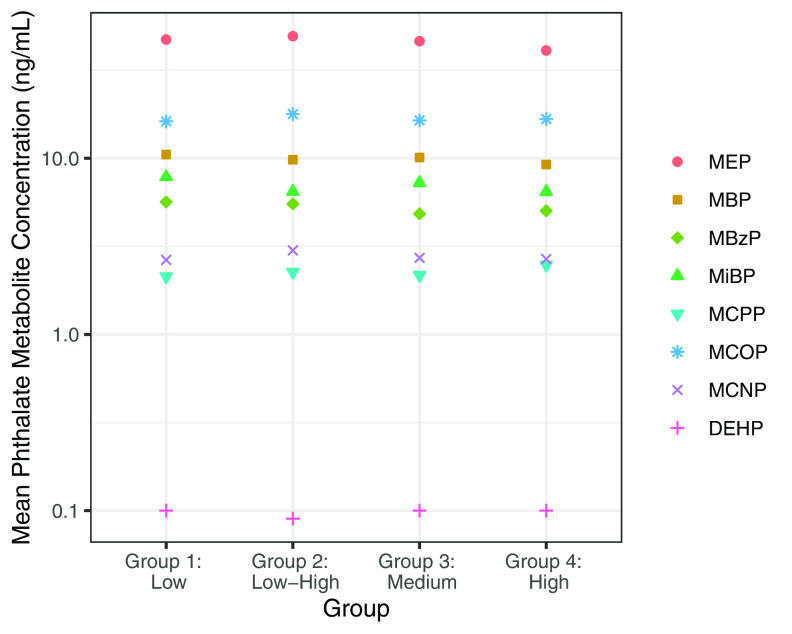
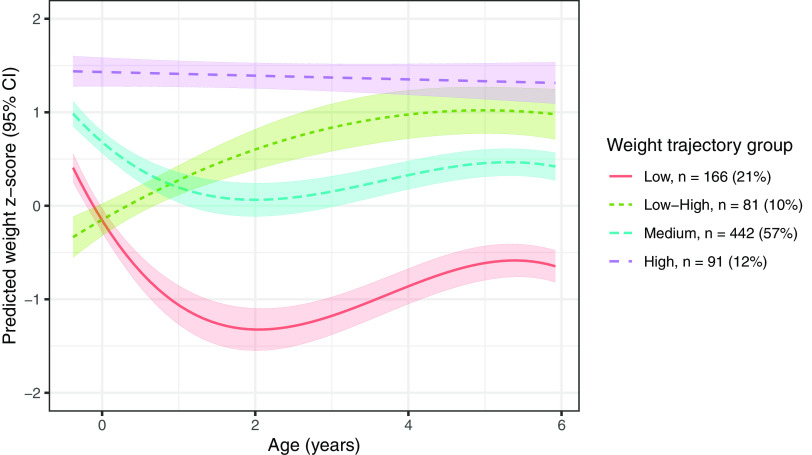
Within The Infant Development and the Environment Study (TIDES), a prospective pregnancy cohort, we analyzed a panel of phthalate metabolites in urine collected at two visits from early and late gestation (). We estimated average phthalate metabolite associations with child weight -scores from gestation (estimated by ultrasound), birth, and 1, 3, 4, and 6 years of age using linear mixed-effects (LME) models. We also modeled associations with adiposity -scores from birth (weight for length) and 1, 3, 4, and 6 years of age [body mass index (BMI)] using LME models.
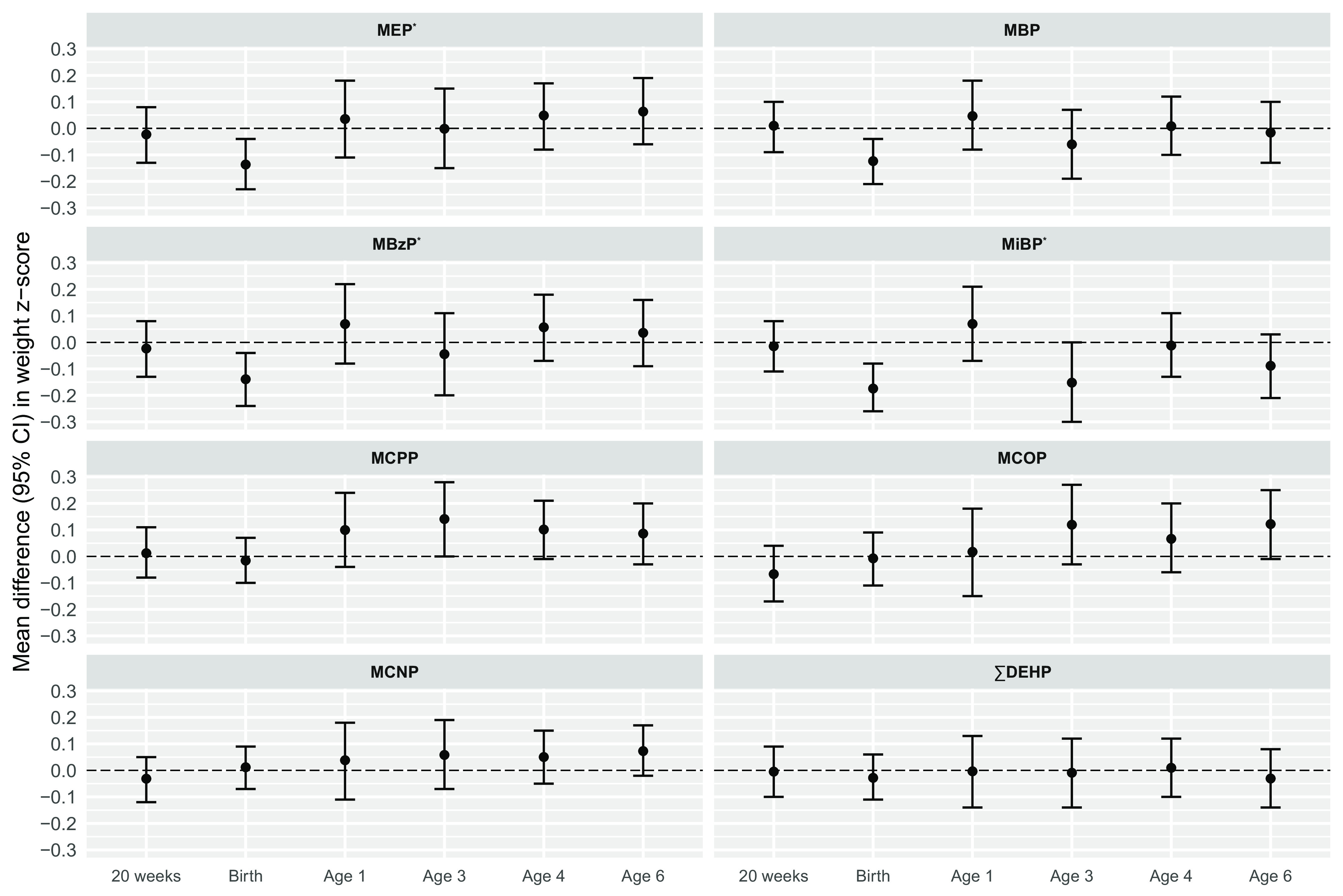
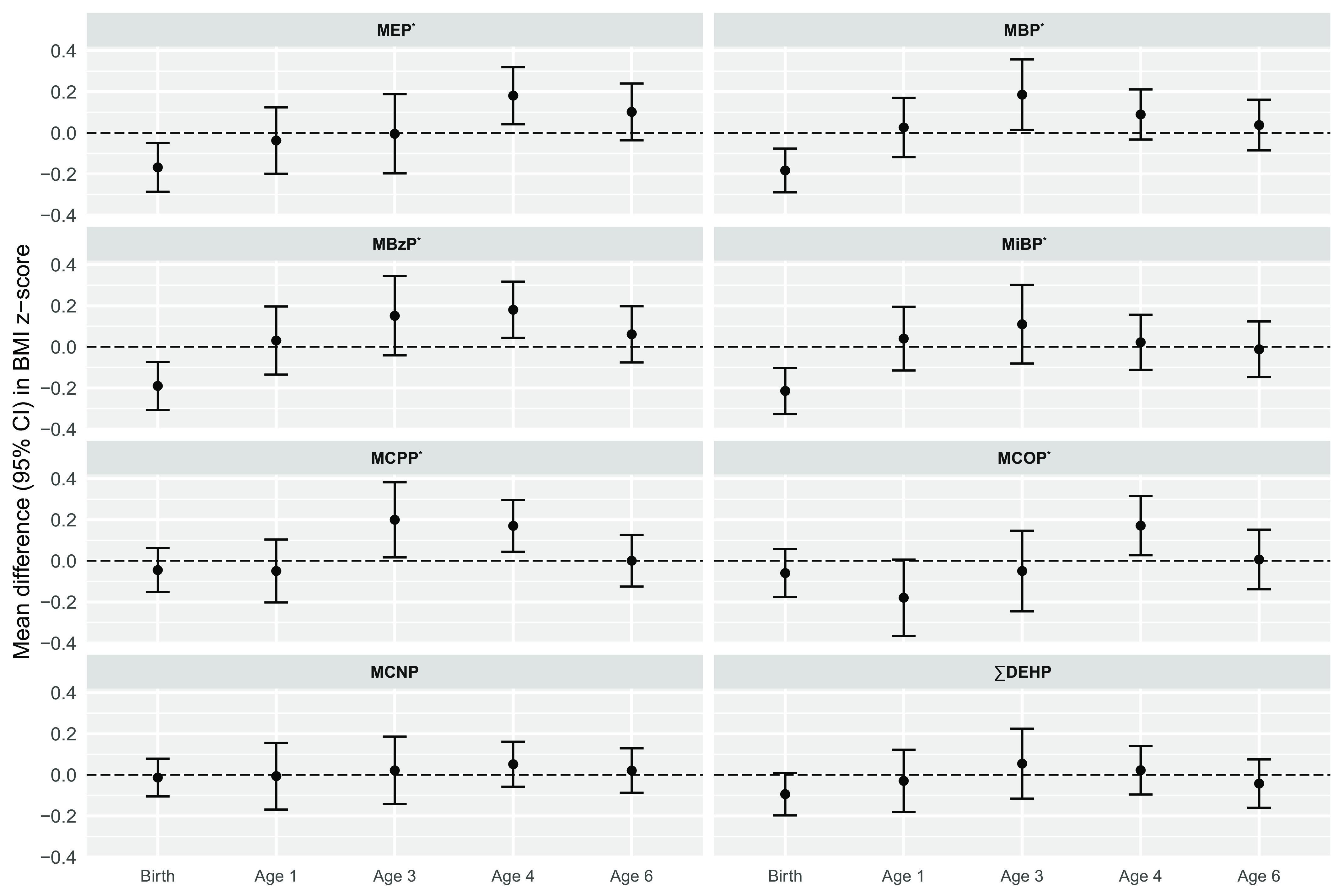
For weight, we observed inverse associations between several phthalate metabolites and birth weight -scores, but no associations were observed with postnatal weight -scores in LME models. Regarding adiposity, we observed inverse associations between phthalate metabolites and weight-for-length -scores at birth, but positive associations were observed with BMI -scores at 3-4 years of age in LME models. For example, mono-ethyl phthalate was associated with a 0.17-unit decrease in birth weight-for-length -score [95% confidence interval (CI): , ] and a 0.18-unit increase in 4-years-of-age BMI -score (95% CI: 0.04, 0.32).
We observed associations between prenatal exposure to phthalates and lower weight at birth but not at childhood follow-up visits. However, for adiposity, we observed an interesting pattern of association with low adiposity at delivery as well as high adiposity at 3-4 years of age. Although it is not clear from our results whether these associations occur within the same children, such a pattern of adiposity in early life has been linked to cardiometabolic disease in adulthood and deserves special attention as an outcome in the study of prenatal exposures in the developmental origins of health and disease. https://doi.org/10.1289/EHP10077.
产前邻苯二甲酸酯暴露与较低的出生体重有关,但也与儿童期较高的体重有关。很少有研究从出生到儿童期(3-6 岁)检查体重或肥胖,因此无法评估与暴露相关的生长轨迹。
我们评估了妊娠期间母体邻苯二甲酸酯暴露与通过儿童期(3-6 岁)产前测量的儿童体重和肥胖之间的关联。
在婴儿发育与环境研究(TIDES)中,我们分析了在妊娠早期和晚期两次就诊时收集的尿液中一组邻苯二甲酸酯代谢物。我们使用线性混合效应(LME)模型估计了妊娠(通过超声估计)、出生和 1、3、4 和 6 岁时的儿童体重评分与邻苯二甲酸酯代谢物的平均关联。我们还使用 LME 模型,对出生时(体重与身长比)和 1、3、4 和 6 岁时的肥胖评分[体重指数(BMI)]与邻苯二甲酸酯代谢物的关联进行了建模。
对于体重,我们观察到几种邻苯二甲酸酯代谢物与出生体重评分呈负相关,但在 LME 模型中,与产后体重评分无关联。关于肥胖,我们观察到邻苯二甲酸酯代谢物与出生时体重与身长比评分呈负相关,但在 LME 模型中,与 3-4 岁时 BMI 评分呈正相关。例如,单乙基邻苯二甲酸酯与出生时体重与身长比评分降低 0.17 个单位相关[95%置信区间(CI):0.06,0.28],与 4 岁时 BMI 评分增加 0.18 个单位相关(95%CI:0.04,0.32)。
我们观察到产前接触邻苯二甲酸酯与出生时体重较低有关,但与儿童期随访时无关。然而,对于肥胖,我们观察到一种有趣的关联模式,即分娩时低肥胖与 3-4 岁时高肥胖有关。尽管我们的结果尚不清楚这些关联是否发生在同一儿童中,但这种早期生命中的肥胖模式与成年人心血管疾病有关,值得特别关注,作为发育起源的健康和疾病中产前暴露研究的一个结果。https://doi.org/10.1289/EHP10077.