School of Computational Science and Engineering, Georgia Institute of Technology, Atlanta, GA 30332, USA.
Cell Rep Methods. 2021 Oct 25;1(6):100095. doi: 10.1016/j.crmeth.2021.100095.
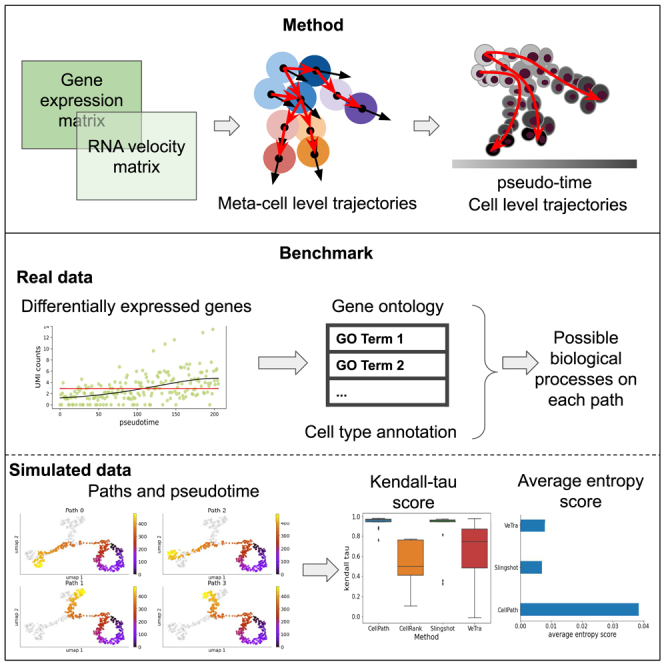
Trajectory inference (TI) methods infer cell developmental trajectory from single-cell RNA sequencing data. Current TI methods can be categorized into those using RNA velocity information and those using only single-cell gene expression data. The latter type of methods are restricted to certain trajectory structures, and cannot determine cell developmental direction. Recently proposed TI methods using RNA velocity information have limited accuracy. We present CellPath, a method that infers cell trajectories by integrating single-cell gene expression and RNA velocity information. CellPath overcomes the restrictions of TI methods that do not use RNA velocity information: it can find multiple high-resolution trajectories without constraints on the trajectory structure, and can automatically detect the direction of each trajectory path. We evaluate CellPath on both real and simulated datasets and show that CellPath finds more accurate and detailed trajectories than the state-of-the-art TI methods using or not using RNA velocity information.
轨迹推断 (TI) 方法从单细胞 RNA 测序数据中推断细胞发育轨迹。目前的 TI 方法可分为使用 RNA 速度信息的方法和仅使用单细胞基因表达数据的方法。后一类方法仅限于某些轨迹结构,并且无法确定细胞发育方向。最近提出的使用 RNA 速度信息的 TI 方法准确性有限。我们提出了 CellPath,这是一种通过整合单细胞基因表达和 RNA 速度信息来推断细胞轨迹的方法。CellPath 克服了不使用 RNA 速度信息的 TI 方法的限制:它可以找到多个高分辨率轨迹,而不受轨迹结构的限制,并且可以自动检测每个轨迹路径的方向。我们在真实和模拟数据集上评估了 CellPath,并表明 CellPath 比使用或不使用 RNA 速度信息的最先进 TI 方法找到更准确和详细的轨迹。