Li Fang, Lu De-Yun, Zhong Qiu, Tan Fang, Li Wenfeng, Liao Wei, Zhao Xin
Chongqing Collaborative Innovation Center for Functional Food, Chongqing University of Education Chongqing 400067 P. R. China
Chongqing Engineering Research Center of Functional Food, Chongqing University of Education Chongqing 400067 P. R. China.
RSC Adv. 2019 Dec 20;10(1):1-9. doi: 10.1039/c9ra08789c.
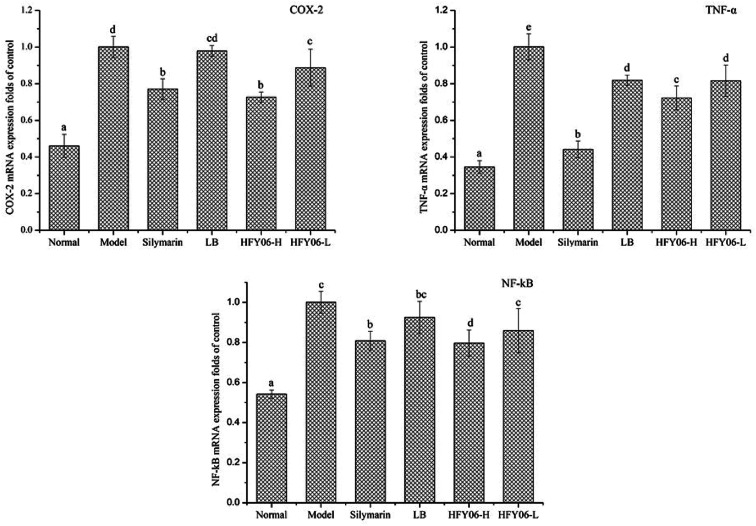
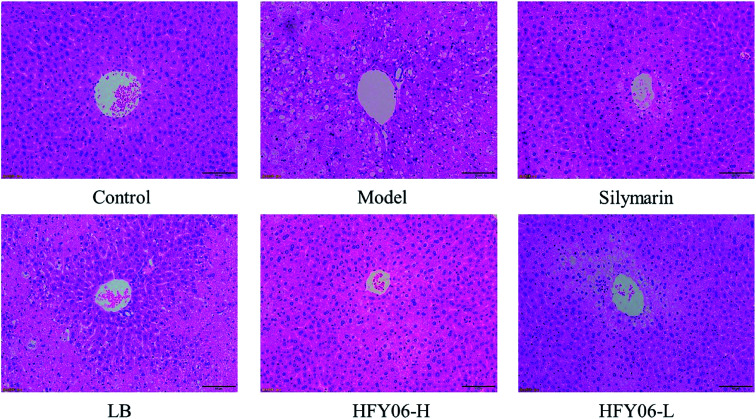
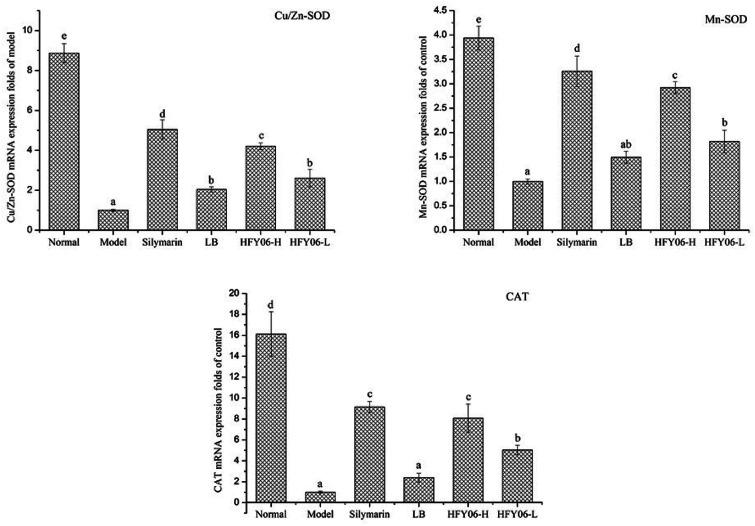
This study was conducted to investigate the preventative effect of HFY06 on carbon tetrachloride (CCl)-induced liver injury in Kunming mice. Mice were treated with HFY06, then liver damage was induced using CCl. Evaluation indicators included the activities of aspartate aminotransferase (AST), triglycerides (TG), superoxide dismutase (SOD), glutathione peroxidase (GSH-Px), and malondialdehyde (MDA) in serum; cytokines levels of interleukin-6 (IL-6), tumor necrosis factor-α (TNF-α) and interferon-γ (IFN-γ) in serum; and related gene expressions of nuclear factor-κB (NF-κB), TNF-α, cyclooxygenase-2 (COX-2), copper/zinc superoxide dismutase (Cu/Zn-SOD), manganese superoxide dismutase (Mn-SOD), and catalase (CAT). Liver tissue was stained with hematoxylin and eosin for pathological analysis. Compared with the model group, HFY06 reduced the liver index, increased the serum SOD and GSH-Px activities, and reduced the AST, TG, and MDA activities in the mice. Inflammation-related IL-6, TNF-α and IFN-γ levels were also reduced after treatment with a high dose of HFY06. Pathological observation showed that CCl damaged the mouse livers, which were significantly improved after treatment with silymarin and HFY06. qPCR also confirmed that the high dose of HFY06 (10 colony-forming units [CFU] per kg per day) upregulated the mRNA expression of the antioxidant genes, Cu/Zn-SOD, Mn-SOD, and CAT, in the liver tissue and downregulated the mRNA expression of the inflammatory factors, NF-κB, TNF-α and COX-2, but HFY06 was less effective than silymarin. These findings indicate that HFY06 prevented CCl-induced liver damage but was less effective than silymarin. Thus, HFY06 may have a potential role in treating liver diseases.
本研究旨在探讨HFY06对四氯化碳(CCl)诱导的昆明小鼠肝损伤的预防作用。小鼠经HFY06处理后,再用CCl诱导肝损伤。评价指标包括血清中天冬氨酸转氨酶(AST)、甘油三酯(TG)、超氧化物歧化酶(SOD)、谷胱甘肽过氧化物酶(GSH-Px)和丙二醛(MDA)的活性;血清中白细胞介素-6(IL-6)、肿瘤坏死因子-α(TNF-α)和干扰素-γ(IFN-γ)的细胞因子水平;以及核因子-κB(NF-κB)、TNF-α、环氧化酶-2(COX-2)、铜/锌超氧化物歧化酶(Cu/Zn-SOD)、锰超氧化物歧化酶(Mn-SOD)和过氧化氢酶(CAT)的相关基因表达。肝组织用苏木精和伊红染色进行病理分析。与模型组相比,HFY06降低了小鼠的肝指数,提高了血清SOD和GSH-Px活性,并降低了AST、TG和MDA活性。高剂量HFY06处理后,炎症相关的IL-6、TNF-α和IFN-γ水平也降低。病理观察表明,CCl损伤了小鼠肝脏,水飞蓟素和HFY06处理后肝脏损伤明显改善。qPCR也证实,高剂量的HFY06(每天每千克10个菌落形成单位[CFU])上调了肝组织中抗氧化基因Cu/Zn-SOD、Mn-SOD和CAT的mRNA表达,并下调了炎症因子NF-κB、TNF-α和COX-2的mRNA表达,但HFY06的效果不如水飞蓟素。这些发现表明,HFY06可预防CCl诱导的肝损伤,但效果不如水飞蓟素。因此,HFY06可能在治疗肝脏疾病方面具有潜在作用。