Institute of Physical Chemistry, Friedrich Schiller University Jena, Helmholtzweg 4, 07743, Jena, Germany.
Leibniz Institute of Photonic Technology Jena, Department Functional Interfaces, Albert-Einstein-Straße 9, 07745, Jena, Germany.
Nat Commun. 2022 May 9;13(1):2538. doi: 10.1038/s41467-022-30147-4.
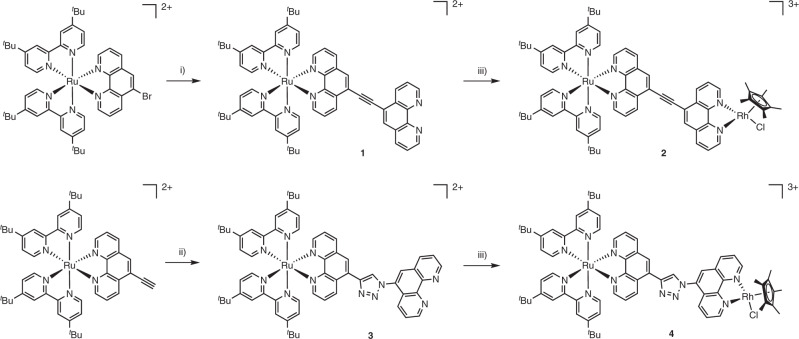
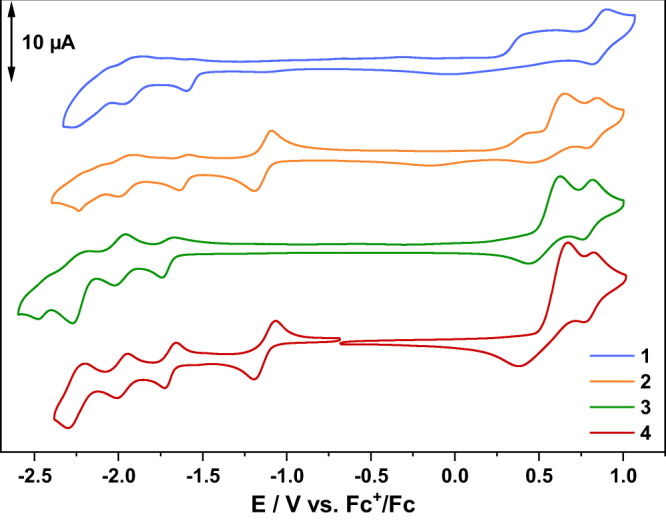
Unequivocal assignment of rate-limiting steps in supramolecular photocatalysts is of utmost importance to rationally optimize photocatalytic activity. By spectroscopic and catalytic analysis of a series of three structurally similar [(tbbpy)Ru-BL-Rh(Cp*)Cl] photocatalysts just differing in the central part (alkynyl, triazole or phenazine) of the bridging ligand (BL) we are able to derive design strategies for improved photocatalytic activity of this class of compounds (tbbpy = 4,4´-tert-butyl-2,2´-bipyridine, Cp* = pentamethylcyclopentadienyl). Most importantly, not the rate of the transfer of the first electron towards the Rh center but rather the rate at which a two-fold reduced Rh species is generated can directly be correlated with the observed photocatalytic formation of NADH from NAD. Interestingly, the complex which exhibits the fastest intramolecular electron transfer kinetics for the first electron is not the one that allows the fastest photocatalysis. With the photocatalytically most efficient alkynyl linked system, it is even possible to overcome the rate of thermal NADH formation by avoiding the rate-determining β-hydride elimination step. Moreover, for this photocatalyst loss of the alkynyl functionality under photocatalytic conditions is identified as an important deactivation pathway.
明确确定超分子光催化剂中的限速步骤对于合理优化光催化活性至关重要。通过对一系列三种结构相似的[(tbbpy)Ru-BL-Rh(Cp*)Cl]光催化剂进行光谱和催化分析,这些光催化剂仅在桥联配体(BL)的中心部分(炔基、三唑或吩嗪)有所不同,我们能够为这一类化合物的光催化活性的提高提供设计策略(tbbpy=4,4´-叔丁基-2,2´-联吡啶,Cp*=五甲基环戊二烯基)。最重要的是,不是第一个电子向 Rh 中心转移的速率,而是生成两倍还原的 Rh 物种的速率可以直接与观察到的从 NAD 形成 NADH 的光催化过程相关。有趣的是,对于第一个电子表现出最快的分子内电子转移动力学的络合物并不是允许最快光催化的络合物。对于光催化效率最高的炔基连接系统,甚至可以通过避免决定速率的β-氢化物消除步骤来克服热 NADH 形成的速率。此外,对于这种光催化剂,在光催化条件下炔基官能团的损失被确定为重要的失活途径。