Sanderson-Cimino Mark, Elman Jeremy A, Tu Xin M, Gross Alden L, Panizzon Matthew S, Gustavson Daniel E, Bondi Mark W, Edmonds Emily C, Eppig Joel S, Franz Carol E, Jak Amy J, Lyons Michael J, Thomas Kelsey R, Williams McKenna E, Kremen William S
University of California San Diego Joint Doctoral Program in Clinical Psychology, San Diego State University, San Diego, CA, United States.
Center for Behavior Genetics of Aging, University of California, San Diego, San Diego, CA, United States.
Front Aging Neurosci. 2022 Apr 25;14:847315. doi: 10.3389/fnagi.2022.847315. eCollection 2022.
Cognitive practice effects (PEs) can delay detection of progression from cognitively unimpaired to mild cognitive impairment (MCI). They also reduce diagnostic accuracy as suggested by biomarker positivity data. Even among those who decline, PEs can mask steeper declines by inflating cognitive scores. Within MCI samples, PEs may increase reversion rates and thus impede detection of further impairment. Within an MCI sample at baseline, we evaluated how PEs impact prevalence, reversion rates, and dementia progression after 1 year.
We examined 329 baseline Alzheimer's Disease Neuroimaging Initiative MCI participants (mean age = 73.1; = 7.4). We identified test-naïve participants who were demographically matched to returnees at their 1-year follow-up. Since the only major difference between groups was that one completed testing once and the other twice, comparison of scores in each group yielded PEs. PEs were subtracted from each test to yield PE-adjusted scores. Biomarkers included cerebrospinal fluid phosphorylated tau and amyloid beta. Cox proportional models predicted time until first dementia diagnosis using PE-unadjusted and PE-adjusted diagnoses.
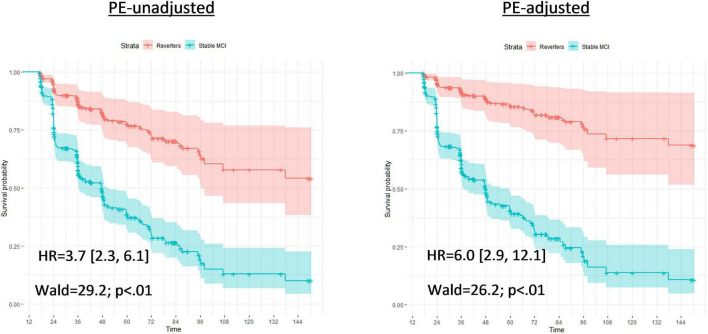
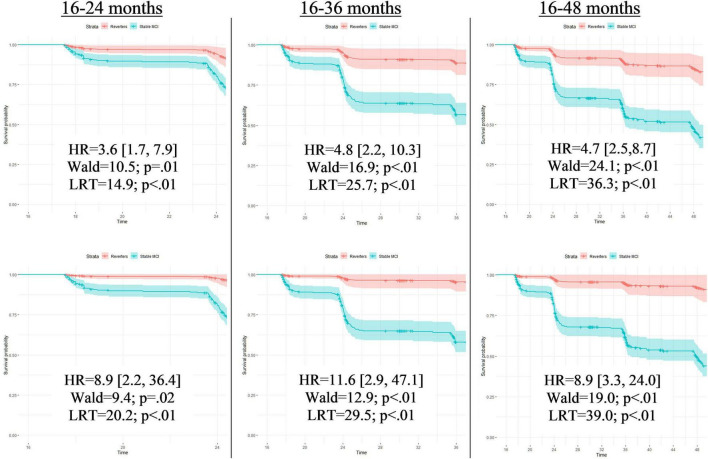
Accounting for PEs increased MCI prevalence at follow-up by 9.2% (272 vs. 249 MCI), and reduced reversion to normal by 28.8% (57 vs. 80 reverters). PEs also increased stability of single-domain MCI by 12.0% (164 vs. 147). Compared to PE-unadjusted diagnoses, use of PE-adjusted follow-up diagnoses led to a twofold increase in hazard ratios for incident dementia. We classified individuals as false reverters if they reverted to cognitively unimpaired status based on PE-unadjusted scores, but remained classified as MCI cases after accounting for PEs. When amyloid and tau positivity were examined together, 72.2% of these false reverters were positive for at least one biomarker.
Even when PEs are small, they can meaningfully change whether some individuals with MCI retain the diagnosis at a 1-year follow-up. Accounting for PEs resulted in increased MCI prevalence and altered stability/reversion rates. This improved diagnostic accuracy also increased the dementia-predicting ability of MCI diagnoses.
认知练习效应(PEs)会延迟对从认知未受损进展到轻度认知障碍(MCI)的检测。生物标志物阳性数据表明,它们还会降低诊断准确性。即使在那些病情恶化的人中,PEs也会通过提高认知分数掩盖更急剧的衰退。在MCI样本中,PEs可能会提高恢复率,从而阻碍对进一步损伤的检测。在基线时的一个MCI样本中,我们评估了PEs对1年后患病率、恢复率和痴呆症进展的影响。
我们检查了329名阿尔茨海默病神经影像学计划的基线MCI参与者(平均年龄 = 73.1岁;标准差 = 7.4)。我们确定了在人口统计学上与1年随访时的回访者相匹配的未接受过测试的参与者。由于两组之间唯一的主要差异是一组完成了一次测试,另一组完成了两次测试,因此比较每组的分数得出了PEs。从每次测试中减去PEs以得出经PE调整的分数。生物标志物包括脑脊液磷酸化tau蛋白和淀粉样β蛋白。Cox比例模型使用未经PE调整和经PE调整的诊断预测首次痴呆症诊断的时间。
考虑到PEs,随访时MCI患病率增加了9.2%(272例对249例MCI),恢复到正常的比例降低了28.8%(57例恢复者对80例)。PEs还使单领域MCI的稳定性提高了12.0%(164例对147例)。与未经PE调整的诊断相比,使用经PE调整的随访诊断使新发痴呆症的风险比增加了两倍。如果个体根据未经PE调整的分数恢复到认知未受损状态,但在考虑PEs后仍被归类为MCI病例,我们将其归类为假恢复者。当一起检查淀粉样蛋白和tau蛋白阳性时,这些假恢复者中有72.2%至少有一种生物标志物呈阳性。
即使PEs很小,它们也能显著改变一些MCI个体在1年随访时是否仍保留该诊断。考虑到PEs会导致MCI患病率增加,并改变稳定性/恢复率。这种提高的诊断准确性也增强了MCI诊断对痴呆症的预测能力。