Bruntha P Malin, Pandian S Immanuel Alex, Anitha J, Abraham Siril Sam, Kumar S Niranjan
Department of Electronics and Communication Engineering, Karunya Institute of Technology and Sciences, Coimbatore, Tamil Nadu, India.
Department of Computer Science Engineering, Karunya Institute of Technology and Sciences, Coimbatore, Tamil Nadu, India.
J Med Phys. 2022 Jan-Mar;47(1):1-9. doi: 10.4103/jmp.jmp_61_21. Epub 2022 Mar 31.
In the field of medical diagnosis, deep learning-based computer-aided detection of diseases will reduce the burden of physicians in the diagnosis of diseases especially in the case of lung cancer nodule classification.
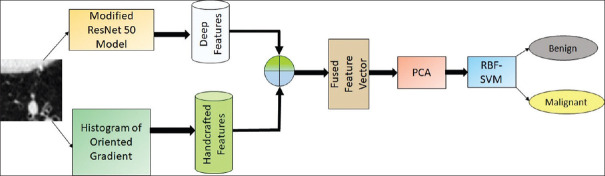
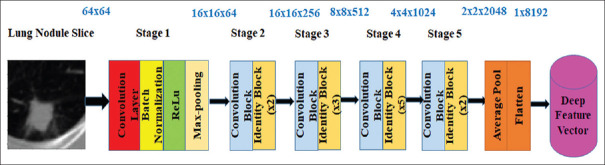
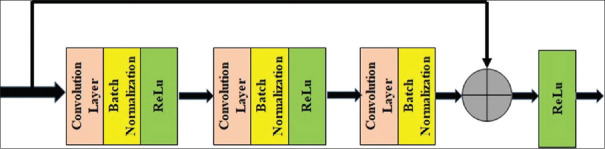
A hybridized model which integrates deep features from Residual Neural Network using transfer learning and handcrafted features from the histogram of oriented gradients feature descriptor is proposed to classify the lung nodules as benign or malignant. The intrinsic convolutional neural network (CNN) features have been incorporated and they can resolve the drawbacks of handcrafted features that do not completely reflect the specific characteristics of a nodule. In the meantime, they also reduce the need for a large-scale annotated dataset for CNNs. For classifying malignant nodules and benign nodules, radial basis function support vector machine is used. The proposed hybridized model is evaluated on the LIDC-IDRI dataset.
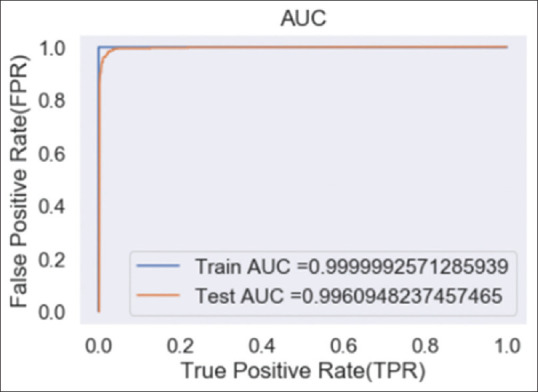
It has achieved an accuracy of 97.53%, sensitivity of 98.62%, specificity of 96.88%, precision of 95.04%, F score of 0.9679, false-positive rate of 3.117%, and false-negative rate of 1.38% and has been compared with other state of the art techniques.
The performance of the proposed hybridized feature-based classification technique is better than the deep features-based classification technique in lung nodule classification.
在医学诊断领域,基于深度学习的疾病计算机辅助检测将减轻医生的疾病诊断负担,尤其是在肺癌结节分类方面。
提出一种混合模型,该模型整合了使用迁移学习从残差神经网络提取的深度特征以及从定向梯度直方图特征描述符提取的手工特征,用于将肺结节分类为良性或恶性。已纳入内在卷积神经网络(CNN)特征,它们可以解决手工特征不能完全反映结节特定特征的缺点。同时,它们也减少了对用于CNN的大规模标注数据集的需求。对于恶性结节和良性结节的分类,使用径向基函数支持向量机。在LIDC-IDRI数据集上对所提出的混合模型进行评估。
该模型实现了97.53%的准确率、98.62%的灵敏度、96.88%的特异性、95.04%的精度、0.9679的F分数、3.117%的假阳性率和1.38%的假阴性率,并与其他现有技术进行了比较。
在肺结节分类中,所提出的基于混合特征的分类技术的性能优于基于深度特征的分类技术。