Ramzi Amal, El Ouali Lalami Abdelhakim, Ez Zoubi Yassine, Assouguem Amine, Almeer Rafa, Najda Agnieszka, Ullah Riaz, Ercisli Sezai, Farah Abdellah
Laboratory of Applied Organic Chemistry, Faculty of Sciences and Technologies, Sidi Mohamed Ben Abdellah University, Imouzzer Street, Fez 2202, Morocco.
Higher Institute of Nursing Professions and Health Techniques, Regional Health Directorate, EL Ghassani Hospital, Fez 30000, Morocco.
Plants (Basel). 2022 Apr 28;11(9):1193. doi: 10.3390/plants11091193.
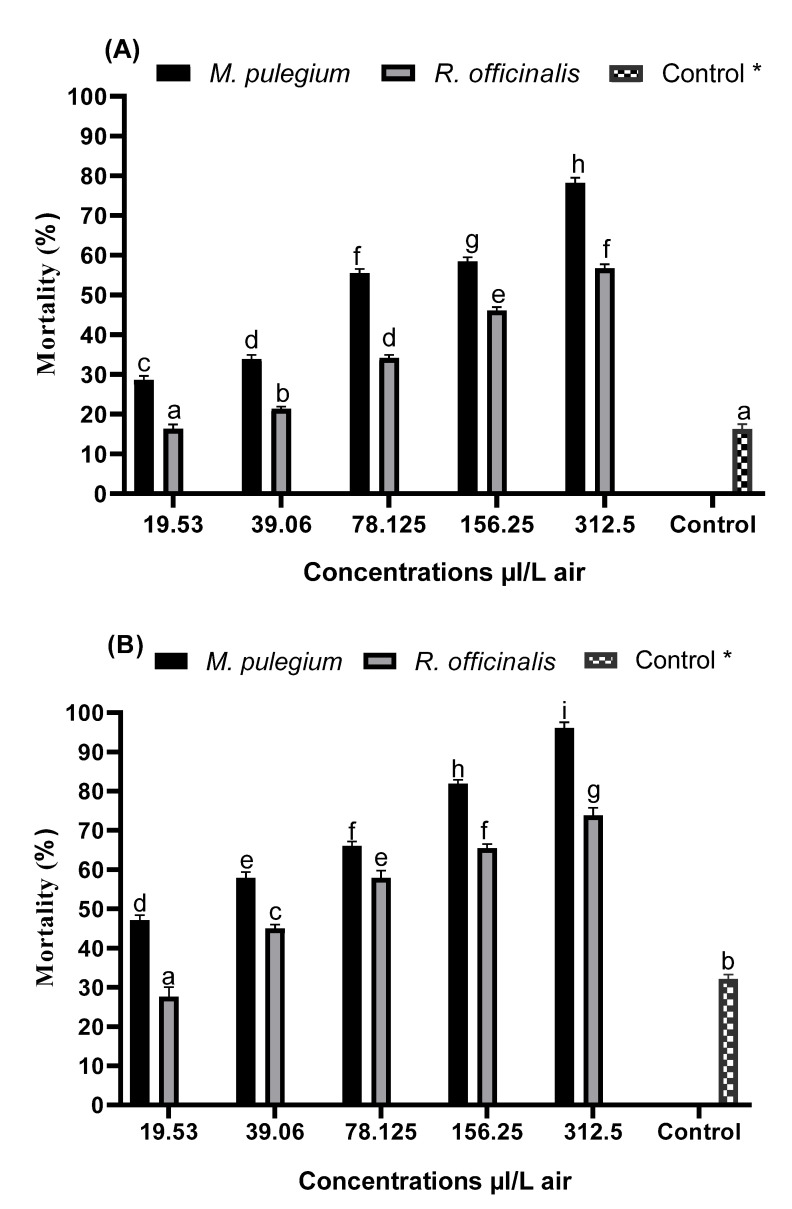
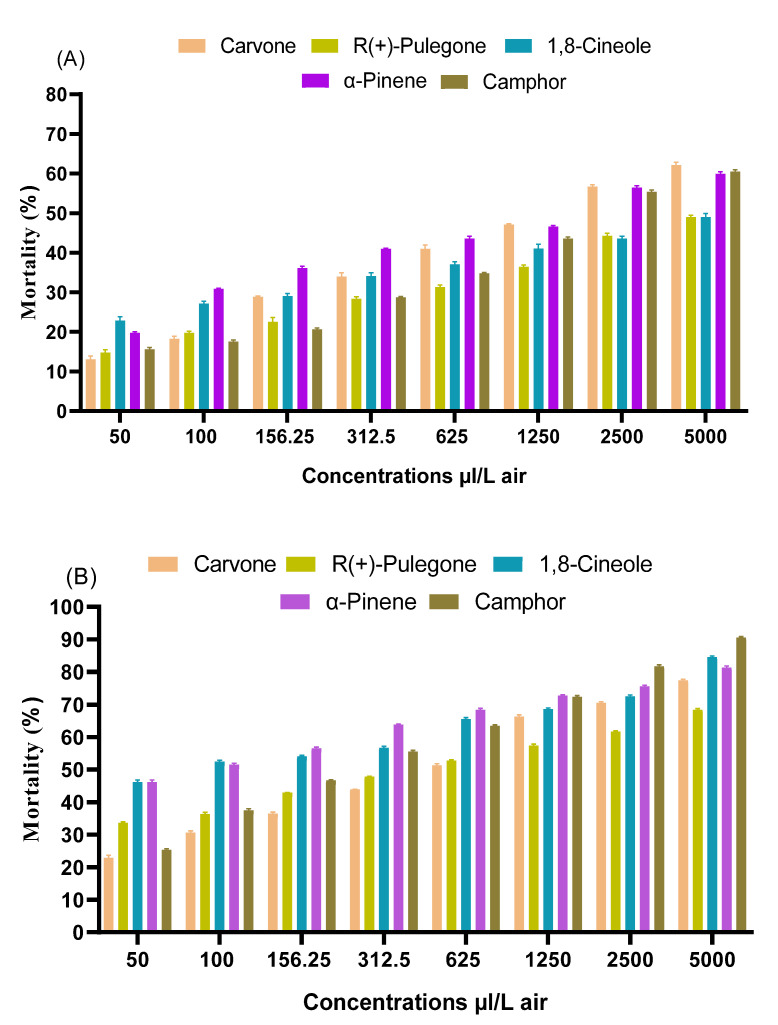
The present study investigates the insecticidal effect of plant extract such as and essential oils and some of their major compounds; these plants are well known for their many biological activities. The fumigant toxicity was evaluated, using glass jars, against female adults of that constitute a mosquito vector of important diseases such as the West Nile virus. The adulticidal test showed that both essential oils and monoterpenes presented an insecticidal effect better than the chemical insecticide (Deltamethrin). The highest mortality percentages for the two essential oils have occurred at 312.5 µL/L air (between 56.14 ± 1.7% and 97.71 ± 3.03% after 24 h and 48 h of treatment). Moreover, all tested monoterpenes (carvone, R(+)-pulegone, 1,8-cineole, camphor and α-pinene) have produced high mortalities that varied depending on the time of the treatment and the concentrations used. Lethal concentrations (LC) obtained for the essential oils and the main compounds have also varied according to the exposure time. and essential oil exhibited the lowest LC values after 24 h (72.94 and 222.82 µL/L air, respectively) and after 48 h (25.43 and 55.79 µL/L air, respectively) while the pure molecules revealed the lowest LC values after 48 h (between 84.96 and 578.84 µL/L air). This finding proves that the two essential oils and their main compounds have an insecticidal potential, which could help to develop natural toxic fumigants that may be used as an eco-friendly alternative in integrated and sustainable vector management.
本研究调查了植物提取物(如[具体植物提取物名称1]和[具体植物提取物名称2])精油及其一些主要化合物的杀虫效果;这些植物因其多种生物活性而闻名。使用玻璃罐评估了对构成重要疾病(如西尼罗河病毒)蚊媒的[蚊子种类名称]雌成虫的熏蒸毒性。成虫杀灭试验表明,精油和单萜类化合物均表现出比化学杀虫剂(溴氰菊酯)更好的杀虫效果。两种精油在空气浓度为312.5 µL/L时死亡率最高(处理24小时和48小时后,死亡率分别在56.14 ± 1.7%和97.71 ± 3.03%之间)。此外,所有测试的单萜类化合物(香芹酮、R(+)-长叶薄荷酮、1,8-桉叶素、樟脑和α-蒎烯)都产生了高死亡率,死亡率因处理时间和使用浓度而异。精油和主要化合物的致死浓度(LC)也因暴露时间而有所不同。[具体植物提取物名称1]和[具体植物提取物名称2]精油在24小时后(分别为72.94和222.82 µL/L空气)和48小时后(分别为25.43和55.79 µL/L空气)表现出最低的LC值,而纯分子在48小时后表现出最低的LC值(在84.96和578.84 µL/L空气之间)。这一发现证明,这两种精油及其主要化合物具有杀虫潜力,有助于开发天然有毒熏蒸剂,可作为综合和可持续病媒管理中的环保替代品。