Centre for Population Health Sciences, Usher Institute, University of Edinburgh, Edinburgh, Scotland, UK.
Asthma UK Centre for Applied Research, University of Edinburgh, Edinburgh, Scotland UK.
J Glob Health. 2022 Apr 14;12:05012. doi: 10.7189/jogh.12.05012.
In November 2020, the World Health Organization (WHO) created interim guidance on how to integrate testing for SARS-CoV-2 into existing influenza surveillance systems. Influenza-like illness (ILI) and severe acute respiratory illness (SARI) case definitions have been used to specify the case definition of COVID-19 for surveillance purposes. This review aims to assess whether the common clinical features of COVID-19 have changed to the point that the criteria used to identify both COVID-19 and influenza in surveillance programs needs to be altered.
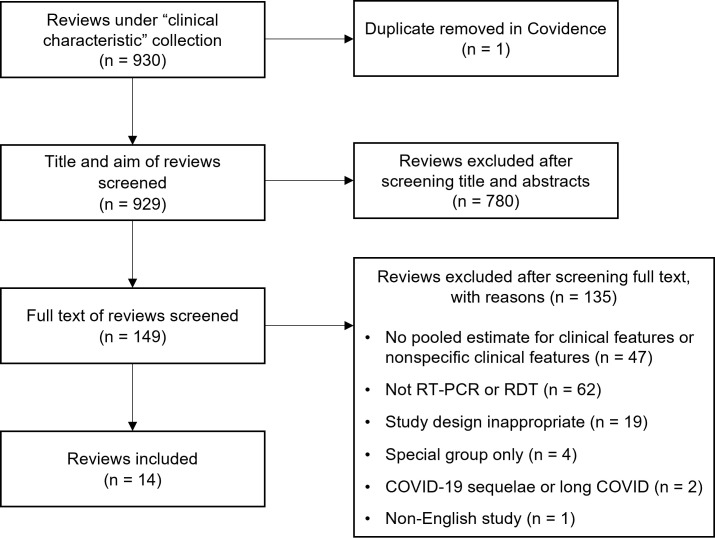
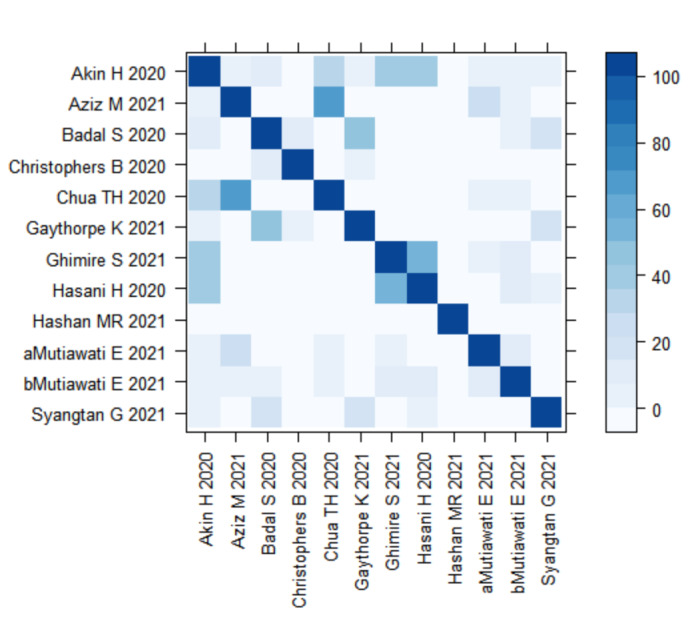
A systematic review of reviews following PRISMA-P guidelines was conducted using the "COVID-19 evidence review" database from August 19, 2020, to August 19, 2021. Reviews providing pooled estimates of the prevalence of clinical features of COVID-19 within the general population, diagnosed by polymerase chain reaction or rapid diagnostic test, were included. These were critically appraised and sensitivity analysis was undertaken to examine potential causes of bias.
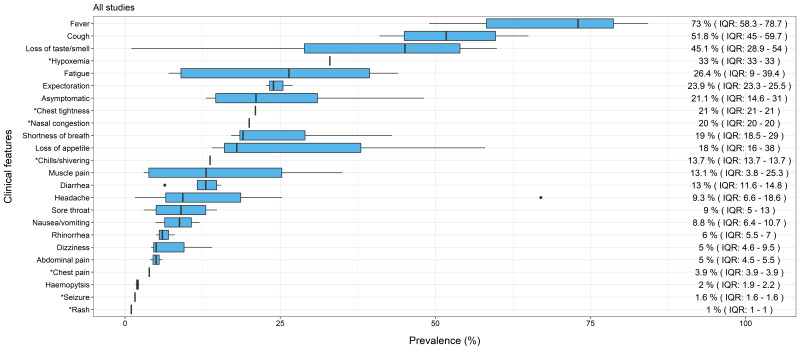
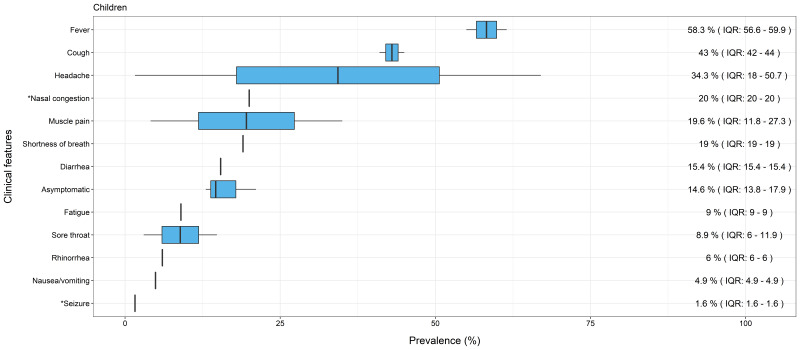
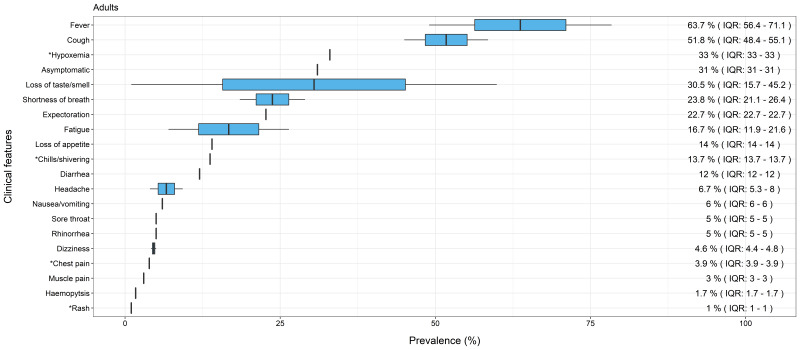
Fourteen reviews were identified, including three on adults only and three on children only. For all reviews, combined fever (median prevalence = 73.0%, IQR = 58.3-78.7) and cough (45.1%, IQR = 28.9-54.0) were the most common features. These were followed by loss of taste or smell (45.1%, IQR = 28.9-54.0), hypoxemia (33%, one review), fatigue (26.4%, IQR = 9.0-39.4) and expectoration (23.9%, IQR = 23.3-25.5). Fever and cough continued to be the most prevalent features for adults and children, with subsequent symptoms being similar for adults only. However, the pattern differed for children, with headache (34.3%, IQR = 18-50.7) and nasal congestion (20%, one review) being the third and fourth commonest symptoms.
The prevalent features found in this recent review were the same as the ones identified at the beginning of the pandemic. Therefore, the current approach of using the ILI and SARI criteria which incorporate fever and cough will identify COVID-19 cases in addition to influenza. Interestingly, children may present with different features, as headaches and nasal congestion were more common in this group. Future research could examine this further and investigate whether symptomology changes with new variants of COVID-19.
2020 年 11 月,世界卫生组织(WHO)制定了关于如何将 SARS-CoV-2 检测纳入现有流感监测系统的临时指南。流感样疾病(ILI)和严重急性呼吸道感染(SARI)的病例定义已被用于为监测目的指定 COVID-19 的病例定义。本综述旨在评估 COVID-19 的常见临床特征是否已发生变化,以至于需要改变监测计划中用于识别 COVID-19 和流感的标准。
根据 PRISMA-P 指南,使用 2020 年 8 月 19 日至 2021 年 8 月 19 日的“COVID-19 证据综述”数据库进行了系统综述。纳入了提供聚合聚合聚合聚合聚合聚合聚合聚合聚合聚合聚合聚合聚合聚合聚合聚合聚合聚合聚合聚合聚合聚合聚合聚合聚合聚合聚合聚合聚合聚合聚合聚合聚合聚合聚合聚合聚合聚合聚合聚合聚合聚合聚合聚合聚合聚合聚合聚合聚合聚合聚合聚合聚合聚合聚合聚合聚合聚合聚合聚合聚合聚合聚合聚合聚合聚合聚合聚合聚合聚合聚合聚合聚合聚合聚合聚合聚合聚合聚合聚合聚合聚合聚合聚合聚合聚合聚合聚合聚合聚合聚合聚合聚合聚合聚合聚合聚合聚合聚合聚合聚合聚合聚合聚合聚合聚合聚合聚合聚合聚合聚合聚合聚合聚合聚合聚合聚合聚合聚合聚合聚合聚合聚合聚合聚合聚合聚合聚合聚合聚合聚合聚合聚合聚合聚合/快速诊断测试来诊断 COVID-19 的临床特征的综述。这些综述对聚合的患病率进行了评估。对这些综述进行了批判性评价,并进行了敏感性分析,以检查潜在的偏倚源。
确定了 14 项研究,其中包括 3 项仅针对成年人和 3 项仅针对儿童的研究。对于所有综述,发烧(中位数患病率=73.0%,IQR=58.3-78.7)和咳嗽(45.1%,IQR=28.9-54.0)是最常见的特征。其次是味觉或嗅觉丧失(45.1%,IQR=28.9-54.0)、低氧血症(33%,1 项综述)、疲劳(26.4%,IQR=9.0-39.4)和咳痰(23.9%,IQR=23.3-25.5)。发烧和咳嗽仍然是成人和儿童最常见的特征,随后的症状对于成人来说是相似的。然而,对于儿童来说,症状模式有所不同,头痛(34.3%,IQR=18-50.7)和鼻塞(20%,1 项综述)是第三和第四常见的症状。
本综述发现的常见特征与疫情早期确定的特征相同。因此,目前使用包含发烧和咳嗽的 ILI 和 SARI 标准来识别 COVID-19 的方法将除流感外还能识别 COVID-19 病例。有趣的是,儿童可能会出现不同的症状,因为头痛和鼻塞在该人群中更为常见。未来的研究可以进一步研究这一点,并调查 COVID-19 新变体是否会导致症状发生变化。