Shahzad Muhammad, Ali Farman, Shirazi Syed Hamad, Rasheed Assad, Ahmad Awais, Shah Babar, Kwak Daehan
Department of Computer Science and Information Technology, Hazara University, Mansehra, Pakistan.
Department of Computer Science and Engineering, School of Convergence, Sungkyunkwan University, Seoul, South Korea.
PeerJ Comput Sci. 2024 Feb 2;10:e1813. doi: 10.7717/peerj-cs.1813. eCollection 2024.
Blood diseases such as leukemia, anemia, lymphoma, and thalassemia are hematological disorders that relate to abnormalities in the morphology and concentration of blood elements, specifically white blood cells (WBC) and red blood cells (RBC). Accurate and efficient diagnosis of these conditions significantly depends on the expertise of hematologists and pathologists. To assist the pathologist in the diagnostic process, there has been growing interest in utilizing computer-aided diagnostic (CAD) techniques, particularly those using medical image processing and machine learning algorithms. Previous surveys in this domain have been narrowly focused, often only addressing specific areas like segmentation or classification but lacking a holistic view like segmentation, classification, feature extraction, dataset utilization, evaluation matrices, .
This survey aims to provide a comprehensive and systematic review of existing literature and research work in the field of blood image analysis using deep learning techniques. It particularly focuses on medical image processing techniques and deep learning algorithms that excel in the morphological characterization of WBCs and RBCs. The review is structured to cover four main areas: segmentation techniques, classification methodologies, descriptive feature selection, evaluation parameters, and dataset selection for the analysis of WBCs and RBCs.
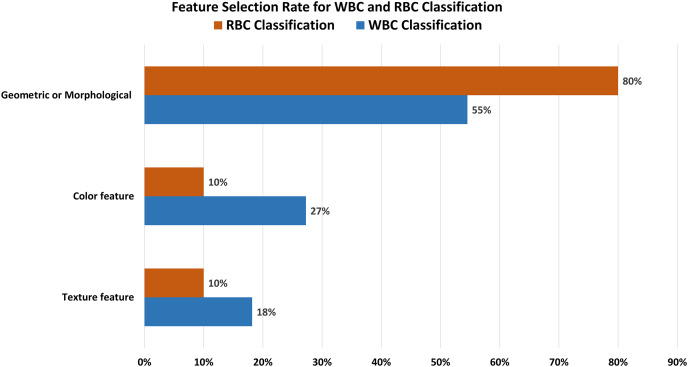
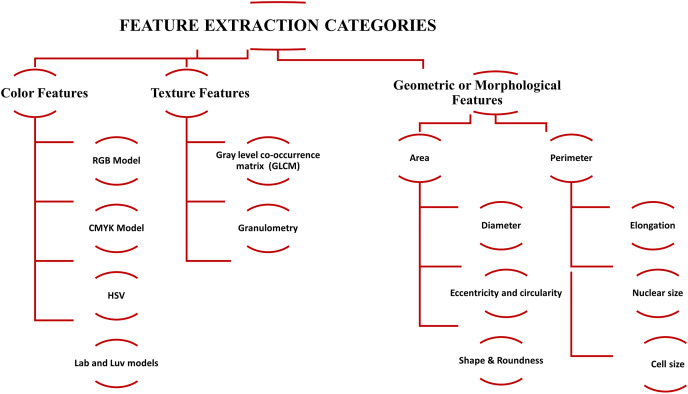
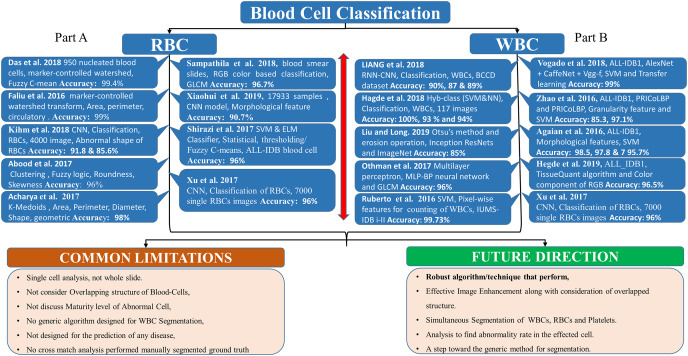
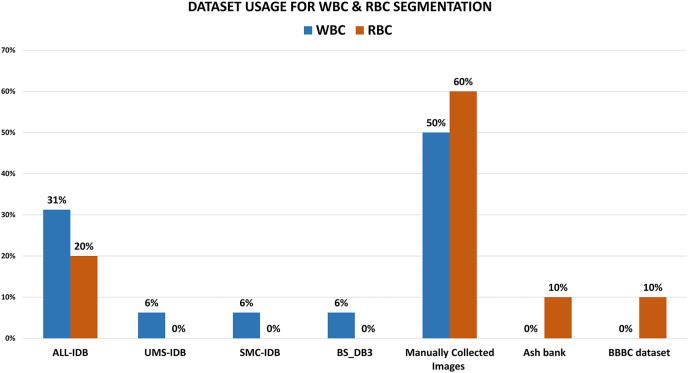
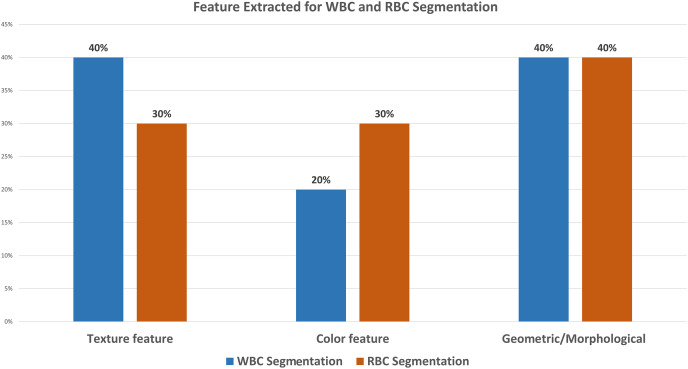
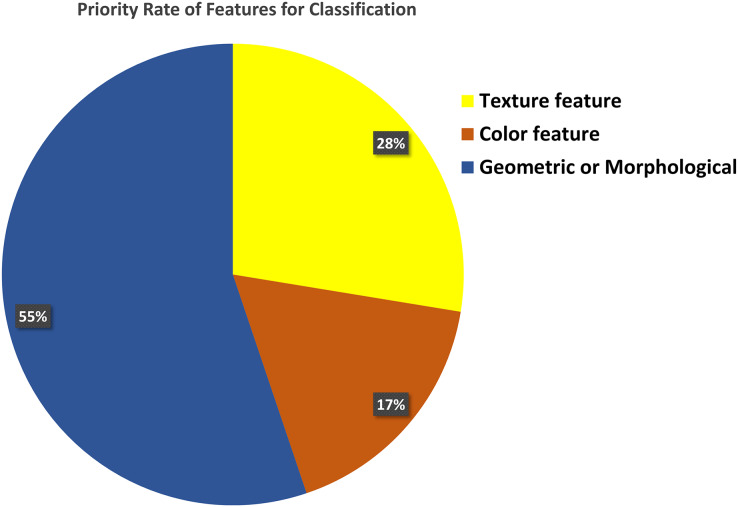
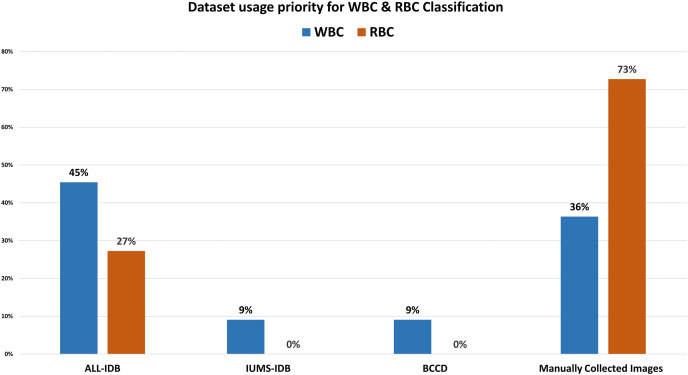
Our analysis reveals several interesting trends and preferences among researchers. Regarding dataset selection, approximately 50% of research related to WBC segmentation and 60% for RBC segmentation opted for manually obtaining images rather than using a predefined dataset. When it comes to classification, 45% of the previous work on WBCs chose the ALL-IDB dataset, while a significant 73% of researchers focused on RBC classification decided to manually obtain images from medical institutions instead of utilizing predefined datasets. In terms of feature selection for classification, morphological features were the most popular, being chosen in 55% and 80% of studies related to WBC and RBC classification, respectively.
The diagnostic accuracy for blood-related diseases like leukemia, anemia, lymphoma, and thalassemia can be significantly enhanced through the effective use of CAD techniques, which have evolved considerably in recent years. This survey provides a broad and in-depth review of the techniques being employed, from image segmentation to classification, feature selection, utilization of evaluation matrices, and dataset selection. The inconsistency in dataset selection suggests a need for standardized, high-quality datasets to strengthen the diagnostic capabilities of these techniques further. Additionally, the popularity of morphological features indicates that future research could further explore and innovate in this direction.
白血病、贫血、淋巴瘤和地中海贫血等血液疾病是血液系统疾病,与血液成分,特别是白细胞(WBC)和红细胞(RBC)的形态和浓度异常有关。这些疾病的准确有效诊断很大程度上依赖于血液学家和病理学家的专业知识。为了在诊断过程中协助病理学家,人们越来越关注利用计算机辅助诊断(CAD)技术,特别是那些使用医学图像处理和机器学习算法的技术。该领域以前的调查范围较窄,通常只涉及分割或分类等特定领域,而缺乏像分割、分类、特征提取、数据集利用、评估矩阵这样的整体视角。
本次调查旨在对使用深度学习技术的血液图像分析领域的现有文献和研究工作进行全面系统的综述。它特别关注在白细胞和红细胞形态特征表征方面表现出色的医学图像处理技术和深度学习算法。综述结构涵盖四个主要领域:白细胞和红细胞分析的分割技术、分类方法、描述性特征选择、评估参数和数据集选择。
我们的分析揭示了研究人员之间的几个有趣趋势和偏好。在数据集选择方面,大约50%与白细胞分割相关的研究和60%与红细胞分割相关的研究选择手动获取图像,而不是使用预定义数据集。在分类方面,之前关于白细胞的工作中有45%选择了ALL-IDB数据集,而在专注于红细胞分类的研究人员中,有73%的人决定从医疗机构手动获取图像,而不是使用预定义数据集。在分类的特征选择方面,形态特征最受欢迎,在与白细胞和红细胞分类相关的研究中,分别有55%和80%的研究选择了形态特征。
通过有效使用近年来有了很大发展的CAD技术,可以显著提高白血病、贫血、淋巴瘤和地中海贫血等血液相关疾病的诊断准确性。本次调查对从图像分割到分类、特征选择、评估矩阵利用和数据集选择等所采用的技术进行了广泛而深入的综述。数据集选择的不一致表明需要标准化的高质量数据集,以进一步加强这些技术的诊断能力。此外,形态特征的受欢迎程度表明未来的研究可以在这个方向上进一步探索和创新。