Lichand Guilherme, Doria Carlos Alberto, Leal-Neto Onicio, Fernandes João Paulo Cossi
Department of Economics, University of Zurich, Zurich, Switzerland.
Department of Economics, University of Brasília, Brasília, Brazil.
Nat Hum Behav. 2022 Aug;6(8):1079-1086. doi: 10.1038/s41562-022-01350-6. Epub 2022 May 26.
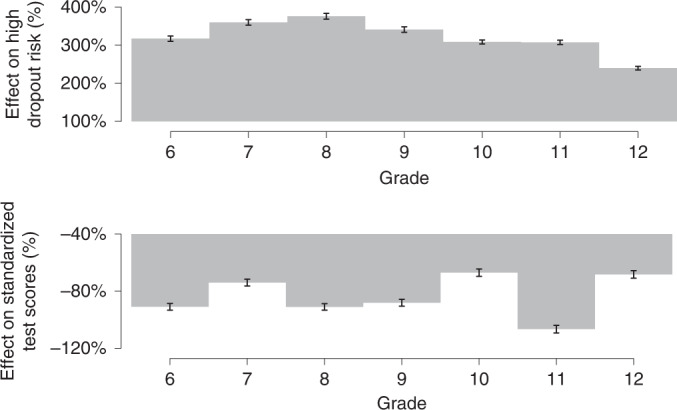
The transition to remote learning in the context of coronavirus disease 2019 (COVID-19) might have led to dramatic setbacks in education. Taking advantage of the fact that São Paulo State featured in-person classes for most of the first school quarter of 2020 but not thereafter, we estimate the effects of remote learning in secondary education using a differences-in-differences strategy that contrasts variation in students' outcomes across different school quarters, before and during the pandemic. We also estimate intention-to-treat effects of reopening schools in the pandemic through a triple-differences strategy, contrasting changes in educational outcomes across municipalities and grades that resumed in-person classes or not over the last school quarter in 2020. We find that, under remote learning, dropout risk increased by 365% while test scores decreased by 0.32 s.d., as if students had only learned 27.5% of the in-person equivalent. Partially resuming in-person classes increased test scores by 20% relative to the control group.
2019冠状病毒病(COVID-19)背景下向远程学习的转变可能给教育带来了巨大挫折。利用圣保罗州在2020年第一学期大部分时间进行面授课程、此后不再进行面授课程这一事实,我们使用一种差分策略估计远程学习对中等教育的影响,该策略对比了疫情之前和期间不同学期学生成绩的变化。我们还通过三重差分策略估计了疫情期间学校重新开学的意向性治疗效果,对比了2020年最后一个学期恢复或未恢复面授课程的各市和各年级教育成果的变化。我们发现,在远程学习模式下,辍学风险增加了365%,而考试成绩下降了0.32个标准差,就好像学生只学到了面授课程等效内容的27.5%。相对于对照组,部分恢复面授课程使考试成绩提高了20%。