State Key Laboratory of Ophthalmology, Zhongshan Ophthalmic Center, Sun Yat-sen University, Guangdong Provincial Key Laboratory of Ophthalmology and Visual Science, Guangdong Provincial Clinical Research Center for Ocular Diseases, Guangzhou, China.
State Key Laboratory of Biotherapy and Center for Translational Innovations, West China Hospital and Sichuan University, Chengdu, China.
J Clin Invest. 2022 Jun 1;132(11). doi: 10.1172/JCI157968.
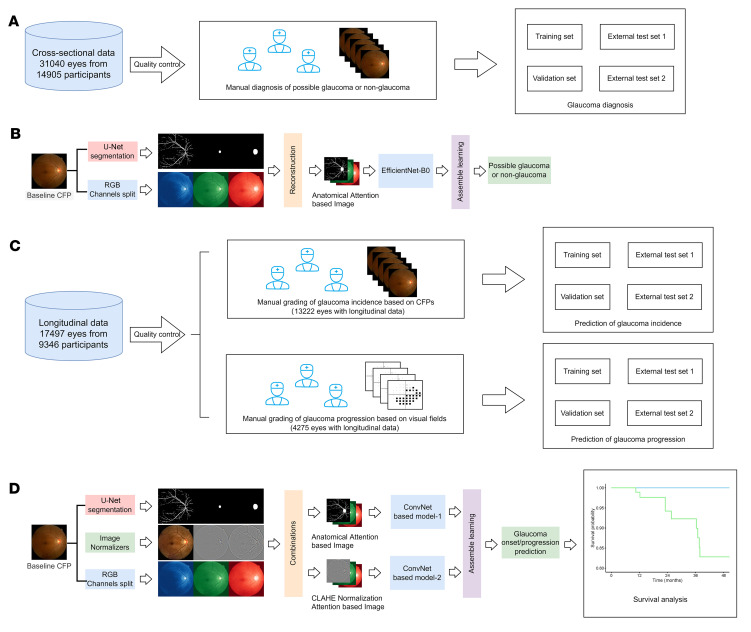
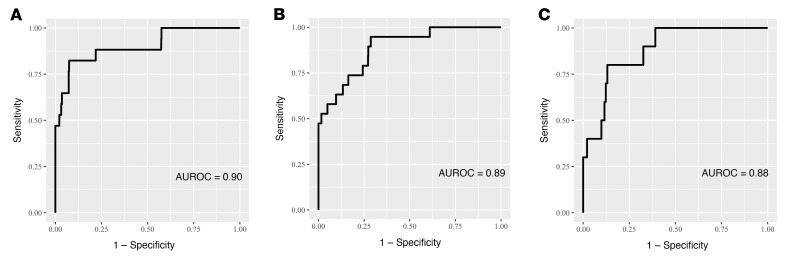
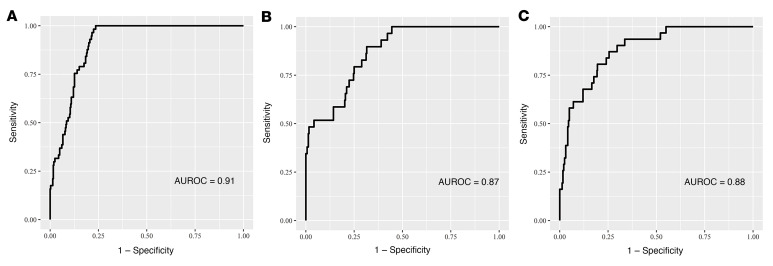
BackgroundDeep learning has been widely used for glaucoma diagnosis. However, there is no clinically validated algorithm for glaucoma incidence and progression prediction. This study aims to develop a clinically feasible deep-learning system for predicting and stratifying the risk of glaucoma onset and progression based on color fundus photographs (CFPs), with clinical validation of performance in external population cohorts.MethodsWe established data sets of CFPs and visual fields collected from longitudinal cohorts. The mean follow-up duration was 3 to 5 years across the data sets. Artificial intelligence (AI) models were developed to predict future glaucoma incidence and progression based on the CFPs of 17,497 eyes in 9346 patients. The area under the receiver operating characteristic (AUROC) curve, sensitivity, and specificity of the AI models were calculated with reference to the labels provided by experienced ophthalmologists. Incidence and progression of glaucoma were determined based on longitudinal CFP images or visual fields, respectively.ResultsThe AI model to predict glaucoma incidence achieved an AUROC of 0.90 (0.81-0.99) in the validation set and demonstrated good generalizability, with AUROCs of 0.89 (0.83-0.95) and 0.88 (0.79-0.97) in external test sets 1 and 2, respectively. The AI model to predict glaucoma progression achieved an AUROC of 0.91 (0.88-0.94) in the validation set, and also demonstrated outstanding predictive performance with AUROCs of 0.87 (0.81-0.92) and 0.88 (0.83-0.94) in external test sets 1 and 2, respectively.ConclusionOur study demonstrates the feasibility of deep-learning algorithms in the early detection and prediction of glaucoma progression.FUNDINGNational Natural Science Foundation of China (NSFC); the High-level Hospital Construction Project, Zhongshan Ophthalmic Center, Sun Yat-sen University; the Science and Technology Program of Guangzhou, China (2021), the Science and Technology Development Fund (FDCT) of Macau, and FDCT-NSFC.
背景
深度学习已广泛应用于青光眼诊断。然而,目前尚无经过临床验证的算法可用于预测青光眼的发病和进展。本研究旨在开发一种基于眼底彩照(CFPs)的临床可行的深度学习系统,用于预测和分层青光眼发病和进展的风险,并在外部人群队列中对其性能进行临床验证。
方法
我们建立了来自纵向队列的 CFPs 和视野数据集合。在数据集中,平均随访时间为 3 至 5 年。基于 9346 名患者的 17497 只眼的 CFPs,开发人工智能(AI)模型来预测未来青光眼的发病和进展。根据经验丰富的眼科医生提供的标签,计算 AI 模型的接收者操作特征(ROC)曲线下面积(AUROC)、敏感性和特异性。青光眼的发病和进展分别基于纵向 CFP 图像或视野来确定。
结果
用于预测青光眼发病的 AI 模型在验证集中的 AUROC 为 0.90(0.81-0.99),具有良好的泛化能力,在外部测试集 1 和 2 中的 AUROC 分别为 0.89(0.83-0.95)和 0.88(0.79-0.97)。用于预测青光眼进展的 AI 模型在验证集中的 AUROC 为 0.91(0.88-0.94),在外部测试集 1 和 2 中的 AUROC 分别为 0.87(0.81-0.92)和 0.88(0.83-0.94),具有出色的预测性能。
结论
本研究证明了深度学习算法在青光眼早期检测和进展预测中的可行性。
资助
国家自然科学基金(NSFC);中山大学中山眼科中心高水平医院建设项目;中国广州市科技计划(2021 年)、澳门科学技术发展基金(FDCT)和 FDCT-NSFC。