Lyall Donald M, Quinn Terry, Lyall Laura M, Ward Joey, Anderson Jana J, Smith Daniel J, Stewart William, Strawbridge Rona J, Bailey Mark E S, Cullen Breda
Institute of Health and Wellbeing, University of Glasgow, 1 Lilybank Gardens, Scotland G12 8RZ, UK.
Institute of Cardiovascular and Medical Sciences, University of Glasgow, Scotland, UK.
Brain Commun. 2022 May 9;4(3):fcac119. doi: 10.1093/braincomms/fcac119. eCollection 2022.
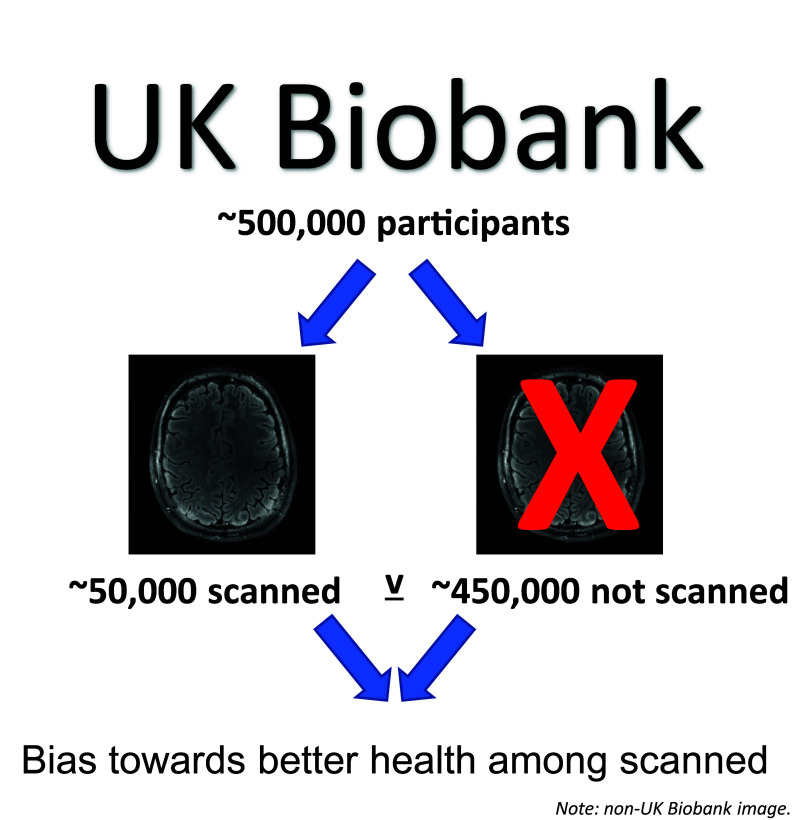
UK Biobank is a prospective cohort study of around half-a-million general population participants, recruited between 2006 and 2010, with baseline studies at recruitment and multiple assessments since. From 2014 to date, magnetic resonance imaging (MRI) has been pursued in a participant sub-sample, with the aim to scan around = 100k. This sub-sample is studied widely and therefore understanding its relative characteristics is important for future reports. We aimed to quantify psychological and physical health in the UK Biobank imaging sub-sample, compared with the rest of the cohort. We used -tests and χ for continuous/categorical variables, respectively, to estimate average differences on a range of cognitive, mental and physical health phenotypes. We contrasted baseline values of participants who attended imaging (versus had not), and compared their values at the imaging visit versus baseline values of participants who were not scanned. We also tested the hypothesis that the associations of established risk factors with worse cognition would be underestimated in the (hypothesized) healthier imaging group compared with the full cohort. We tested these interactions using linear regression models. On a range of cognitive, mental health, cardiometabolic, inflammatory and neurological phenotypes, we found that 47 920 participants who were scanned by January 2021 showed consistent statistically significant 'healthy' bias compared with the ∼450 000 who were not scanned. These effect sizes were small to moderate based on Cohen's /Cramer's metrics (range = 0.02 to -0.21 for Townsend, the largest effect size). We found evidence of interaction, where stratified analysis demonstrated that associations of established cognitive risk factors were smaller in the imaging sub-sample compared with the full cohort. Of the ∼100 000 participants who ultimately will undergo MRI assessment within UK Biobank, the first ∼50 000 showed some 'healthy' bias on a range of metrics at baseline. Those differences largely remained at the subsequent (first) imaging visit, and we provide evidence that testing associations in the imaging sub-sample alone could lead to potential underestimation of exposure/outcome estimates.
英国生物银行是一项针对约50万普通人群参与者的前瞻性队列研究,参与者于2006年至2010年间招募,招募时进行了基线研究,此后进行了多次评估。从2014年至今,对一部分参与者子样本进行了磁共振成像(MRI)检查,目标是扫描约10万人。该子样本得到了广泛研究,因此了解其相对特征对未来报告很重要。我们旨在量化英国生物银行成像子样本中的心理和身体健康状况,并与队列中的其他人群进行比较。我们分别使用t检验和卡方检验来分析连续/分类变量,以估计一系列认知、心理和身体健康表型的平均差异。我们对比了接受成像检查的参与者(与未接受检查者相比)的基线值,并将他们在成像检查时的值与未接受扫描的参与者的基线值进行比较。我们还检验了一个假设,即与整个队列相比,在(假设)更健康的成像组中,既定风险因素与较差认知之间的关联会被低估。我们使用线性回归模型检验了这些相互作用。在一系列认知、心理健康、心脏代谢、炎症和神经表型方面,我们发现,与未接受扫描的约45万人相比,截至2021年1月接受扫描的47920名参与者表现出一致的具有统计学意义的“健康”偏差。根据科恩d值/克莱默V系数衡量,这些效应大小为小到中等(汤森德效应大小范围为0.02至0.21)。我们发现了相互作用的证据,分层分析表明,与整个队列相比,既定认知风险因素在成像子样本中的关联较小。在英国生物银行最终将接受MRI评估的约10万名参与者中,最初的约5万人在一系列指标的基线时表现出一些“健康”偏差。这些差异在随后的(首次)成像检查时基本仍然存在,并且我们提供了证据表明仅在成像子样本中测试关联可能会导致对暴露/结果估计的潜在低估。