
骨组织工程椎间融合的生物材料
Biomaterials for Interbody Fusion in Bone Tissue Engineering.
作者信息
Zhang Han, Wang Zhonghan, Wang Yang, Li Zuhao, Chao Bo, Liu Shixian, Luo Wangwang, Jiao Jianhang, Wu Minfei
机构信息
Department of Orthopedics, The Second Hospital of Jilin University, Changchun, China.
Orthopaedic Research Institute of Jilin Province, Changchun, China.
出版信息
Front Bioeng Biotechnol. 2022 May 17;10:900992. doi: 10.3389/fbioe.2022.900992. eCollection 2022.
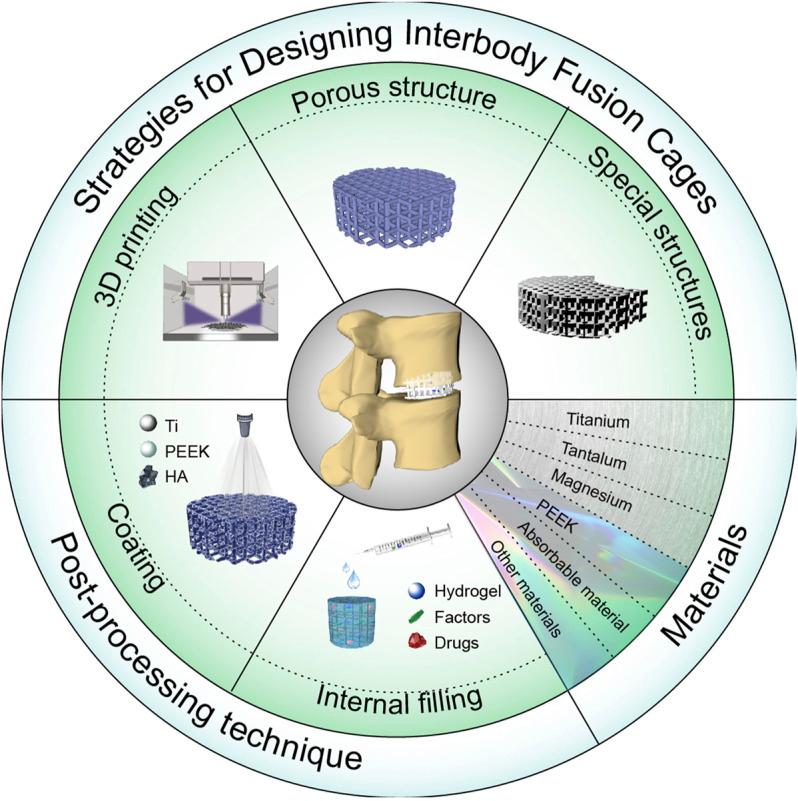
In recent years, interbody fusion cages have played an important role in interbody fusion surgery for treating diseases like disc protrusion and spondylolisthesis. However, traditional cages cannot achieve satisfactory results due to their unreasonable design, poor material biocompatibility, and induced osteogenesis ability, limiting their application. There are currently 3 ways to improve the fusion effect, as follows. First, the interbody fusion cage is designed to facilitate bone ingrowth through the preliminary design. Second, choose interbody fusion cages made of different materials to meet the variable needs of interbody fusion. Finally, complete post-processing steps, such as coating the designed cage, to achieve a suitable osseointegration microstructure, and add other bioactive materials to achieve the most suitable biological microenvironment of bone tissue and improve the fusion effect. The focus of this review is on the design methods of interbody fusion cages, a comparison of the advantages and disadvantages of various materials, the influence of post-processing techniques and additional materials on interbody fusion, and the prospects for the future development of interbody fusion cages.
近年来,椎间融合器在治疗椎间盘突出症和腰椎滑脱症等疾病的椎间融合手术中发挥了重要作用。然而,传统的椎间融合器由于设计不合理、材料生物相容性差和诱导成骨能力不足,无法取得令人满意的效果,限制了它们的应用。目前有3种方法可以提高融合效果,具体如下。第一,通过初步设计使椎间融合器便于骨长入。第二,选择由不同材料制成的椎间融合器,以满足椎间融合的各种需求。最后,完成后处理步骤,如对设计好的椎间融合器进行涂层处理,以实现合适的骨整合微观结构,并添加其他生物活性材料,以实现骨组织最合适的生物微环境并提高融合效果。本文综述的重点是椎间融合器的设计方法、各种材料优缺点的比较、后处理技术和添加材料对椎间融合的影响以及椎间融合器未来的发展前景。



 Zotero 插件