Flanagan Emma, Cameron Donnie, Sobhan Rashed, Wong Chloe, Pontifex Matthew G, Tosi Nicole, Mena Pedro, Del Rio Daniele, Sami Saber, Narbad Arjan, Müller Michael, Hornberger Michael, Vauzour David
Norwich Medical School, Faculty of Medicine and Health Sciences, Norwich, United Kingdom.
Department of Radiology, C.J. Gorter Center for High Field MRI, Leiden University Medical Center, Leiden, Netherlands.
Front Nutr. 2022 May 19;9:849902. doi: 10.3389/fnut.2022.849902. eCollection 2022.
Ageing is highly associated with cognitive decline and modifiable risk factors such as diet are believed to protect against this process. Specific dietary components and in particular, (poly)phenol-rich fruits such as berries have been increasingly recognised for their protection against age-related neurodegeneration. However, the impact of cranberries on cognitive function and neural functioning in older adults remains unclear.
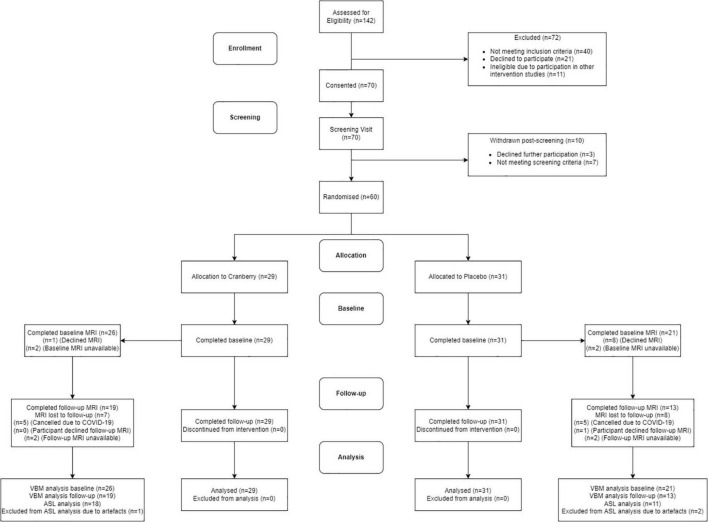
A 12-week parallel randomised placebo-controlled trial of freeze-dried cranberry powder was conducted in 60 older adults aged between 50 and 80 years. Cognitive assessment, including memory and executive function, neuroimaging and blood sample collection were conducted before and after the intervention to assess the impact of daily cranberry consumption on cognition, brain function and biomarkers of neuronal signalling.
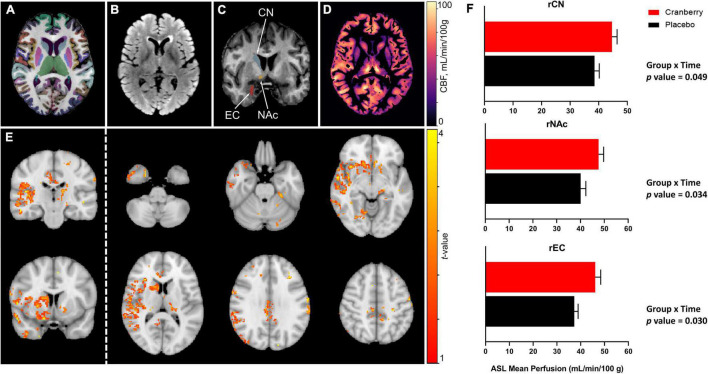
Cranberry supplementation for 12 weeks was associated with improvements in visual episodic memory in aged participants when compared to placebo. Mechanisms of action may include increased regional perfusion in the right entorhinal cortex, the accumbens area and the caudate in the cranberry group. Significant decrease in low-density lipoprotein (LDL) cholesterol during the course of the intervention was also observed. No significant differences were, however, detected for BDNF levels between groups.
The results of this study indicate that daily cranberry supplementation (equivalent to 1 small cup of cranberries) over a 12-week period improves episodic memory performance and neural functioning, providing a basis for future investigations to determine efficacy in the context of neurological disease. This trial was registered at clinicaltrials.gov as NCT03679533 and at ISRCTN as ISRCTN76069316.
衰老与认知能力下降密切相关,人们认为饮食等可改变的风险因素能预防这一过程。特定的饮食成分,特别是富含(多)酚类的水果,如浆果,因其对与年龄相关的神经退行性变具有保护作用而日益受到认可。然而,蔓越莓对老年人认知功能和神经功能的影响仍不明确。
对60名年龄在50至80岁之间的老年人进行了一项为期12周的平行随机安慰剂对照试验,试验对象为冻干蔓越莓粉。在干预前后进行认知评估,包括记忆和执行功能、神经影像学检查和血样采集,以评估每日食用蔓越莓对认知、脑功能和神经元信号生物标志物的影响。
与安慰剂相比,补充蔓越莓12周可使老年参与者的视觉情景记忆得到改善。作用机制可能包括蔓越莓组右侧内嗅皮质、伏隔核区域和尾状核的局部灌注增加。在干预过程中还观察到低密度脂蛋白(LDL)胆固醇显著降低。然而,两组之间的脑源性神经营养因子(BDNF)水平没有显著差异。
本研究结果表明,在12周内每日补充蔓越莓(相当于1小杯蔓越莓)可改善情景记忆表现和神经功能,为未来在神经疾病背景下确定其疗效的研究提供了依据。该试验已在clinicaltrials.gov上注册,注册号为NCT03679533,在ISRCTN上注册,注册号为ISRCTN76069316。