Department of Exercise Physiology, University of Isfahan, Isfahan, Iran.
Department of Health Sciences and Biostatistics, Swinburne University, Room SPW224, Mail H21, PO Box 218, Hawthorn, VIC, 3122, Australia.
Sports Med. 2022 Nov;52(11):2713-2732. doi: 10.1007/s40279-022-01707-x. Epub 2022 Jun 8.
Systematic investigation of muscle protein synthesis (MPS) responses with or without protein ingestion has been largely limited to resistance training.
This systematic review determined the capacity for aerobic-based exercise or high-intensity interval training (HIIT) to stimulate post-exercise rates of MPS and whether protein ingestion further significantly increases MPS compared with placebo.
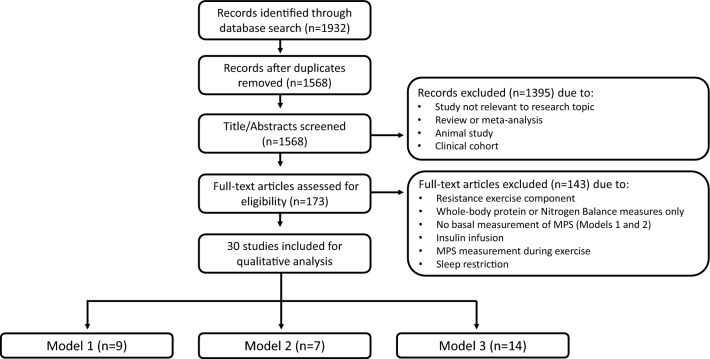
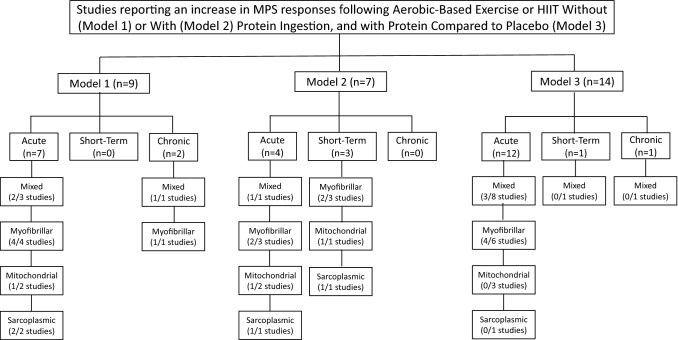
Three separate models analysed rates of either mixed, myofibrillar, sarcoplasmic, or mitochondrial protein synthesis (PS) following aerobic-based exercise or HIIT: Model 1 (n = 9 studies), no protein ingestion; Model 2 (n = 7 studies), peri-exercise protein ingestion with no placebo comparison; Model 3 (n = 14 studies), peri-exercise protein ingestion with placebo comparison.
Eight of nine studies and all seven studies in Models 1 and 2, respectively, demonstrated significant post-exercise increases in either mixed or a specific muscle protein pool. Model 3 observed significantly greater MPS responses with protein compared with placebo in either mixed or a specific muscle fraction in 7 of 14 studies. Seven studies showed no difference in MPS between protein and placebo, while three studies reported no significant increases in mitochondrial PS with protein compared with placebo.
Most studies reporting significant increases in MPS were confined to mixed and myofibrillar PS that may facilitate power generating capacity of working skeletal muscle with aerobic-based exercise and HIIT. Only three of eight studies demonstrated significant increases in mitochondrial PS post-exercise, with no further benefits of protein ingestion. This lack of change may be explained by the acute analysis window in most studies and apparent latency in exercise-induced stimulation of mitochondrial PS.
系统研究肌肉蛋白质合成(MPS)的反应,无论是有蛋白质摄入还是没有蛋白质摄入,主要局限于抗阻训练。
本系统综述旨在确定有氧基础运动或高强度间歇训练(HIIT)是否能刺激运动后 MPS 率,以及与安慰剂相比,蛋白质摄入是否能进一步显著增加 MPS。
通过三种不同的模型分析有氧基础运动或 HIIT 后混合、肌原纤维、肌浆网或线粒体蛋白质合成(PS)的速率:模型 1(n=9 项研究),无蛋白质摄入;模型 2(n=7 项研究),运动前后进行蛋白质摄入,无安慰剂对照;模型 3(n=14 项研究),运动前后进行蛋白质摄入,并用安慰剂进行对照。
9 项研究中的 8 项和模型 1 和 2 中的 7 项研究分别表明,在混合或特定肌肉蛋白池中,运动后蛋白质合成显著增加。在模型 3 中,与安慰剂相比,14 项研究中的 7 项研究观察到运动前后蛋白质摄入引起的 MPS 反应显著增加,无论是在混合或特定肌肉亚群中。7 项研究显示蛋白质与安慰剂之间 MPS 无差异,而 3 项研究报告与安慰剂相比,蛋白质摄入后线粒体 PS 没有显著增加。
大多数报告 MPS 显著增加的研究仅限于混合和肌原纤维 PS,这可能有助于有氧基础运动和 HIIT 增加工作骨骼肌的发电能力。只有 8 项研究中的 3 项显示运动后线粒体 PS 显著增加,而蛋白质摄入没有进一步的益处。这种变化的缺乏可能是由于大多数研究的急性分析窗口和运动诱导的线粒体 PS 刺激的明显潜伏期。