Waseda Bioscience Research Institute in Singapore (WABIOS), Singapore 138667, Singapore.
Institute for Protein Research, Osaka University, 3-2 Yamadaoka, Suita, Osaka 565-0871, Japan.
ACS Nano. 2022 Jun 28;16(6):9004-9018. doi: 10.1021/acsnano.2c00285. Epub 2022 Jun 8.
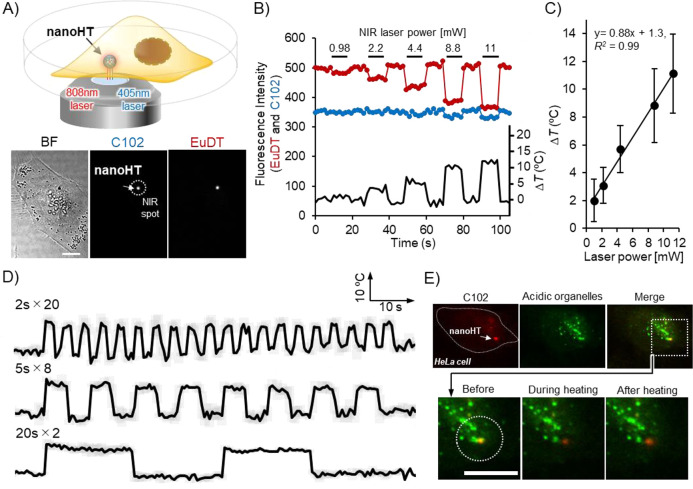
Thermal engineering at the microscale, such as the regulation and precise evaluation of the temperature within cellular environments, is a major challenge for basic biological research and biomaterials development. We engineered a polymeric nanoparticle having a fluorescent temperature sensory dye and a photothermal dye embedded in the polymer matrix, named nanoheater-thermometer (). When is illuminated with a near-infrared laser at 808 nm, a subcellular-sized heat spot is generated in a live cell. Fluorescence thermometry allows the temperature increment to be read out concurrently at individual heat spots. Within a few seconds of an increase in temperature by approximately 11.4 °C from the base temperature (37 °C), we observed the death of HeLa cells. The cell death was observed to be triggered from the exact local heat spot at the subcellular level under the fluorescence microscope. Furthermore, we demonstrate the application of for the induction of muscle contraction in C2C12 myotubes by heat release. We successfully showed heat-induced contraction to occur in a limited area of a single myotube based on the alteration of protein-protein interactions related to the contraction event. These results demonstrate that even a single heat spot provided by a photothermal material can be extremely effective in altering cellular functions.
微尺度热工程,如细胞环境内温度的调节和精确评估,是基础生物学研究和生物材料开发的主要挑战。我们设计了一种聚合物纳米粒子,其中嵌入了荧光温度感应染料和光热染料,命名为纳米加热器-温度计()。当用 808nm 的近红外激光照射时,在活细胞中会产生亚细胞大小的热斑。荧光测温法允许在单个热斑上同时读取温度增量。在从基础温度(37°C)升高约 11.4°C 后几秒钟内,我们观察到 HeLa 细胞死亡。在荧光显微镜下,可以观察到细胞死亡是从亚细胞水平的确切局部热斑触发的。此外,我们还展示了通过释放热量来诱导 C2C12 肌管收缩的应用。我们成功地表明,基于与收缩事件相关的蛋白质-蛋白质相互作用的改变,基于光热材料的热诱导收缩可以在单个肌管的有限区域内发生。这些结果表明,即使是由光热材料提供的单个热斑也可以非常有效地改变细胞功能。