Vasyukova Inna A, Zakharova Olga V, Kuznetsov Denis V, Gusev Alexander A
Technopark "Derzhavinsky", Derzhavin Tambov State University, 392000 Tambov, Russia.
Department of Functional Nanosystems and High-Temperature Materials, National University of Science and Technology "MISIS", 119991 Moscow, Russia.
Nanomaterials (Basel). 2022 May 24;12(11):1797. doi: 10.3390/nano12111797.
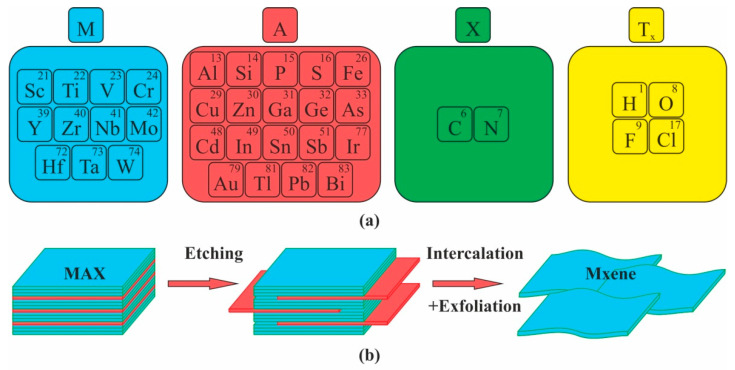
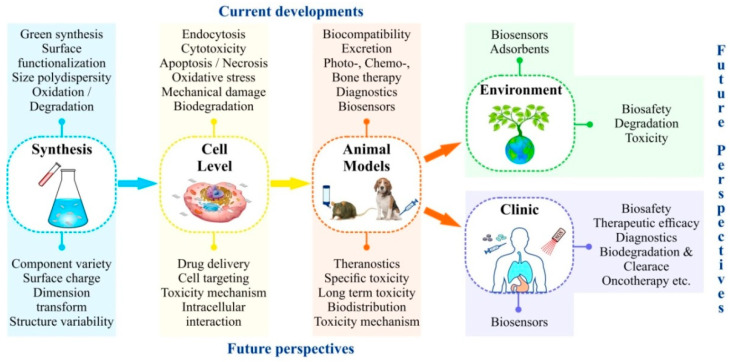
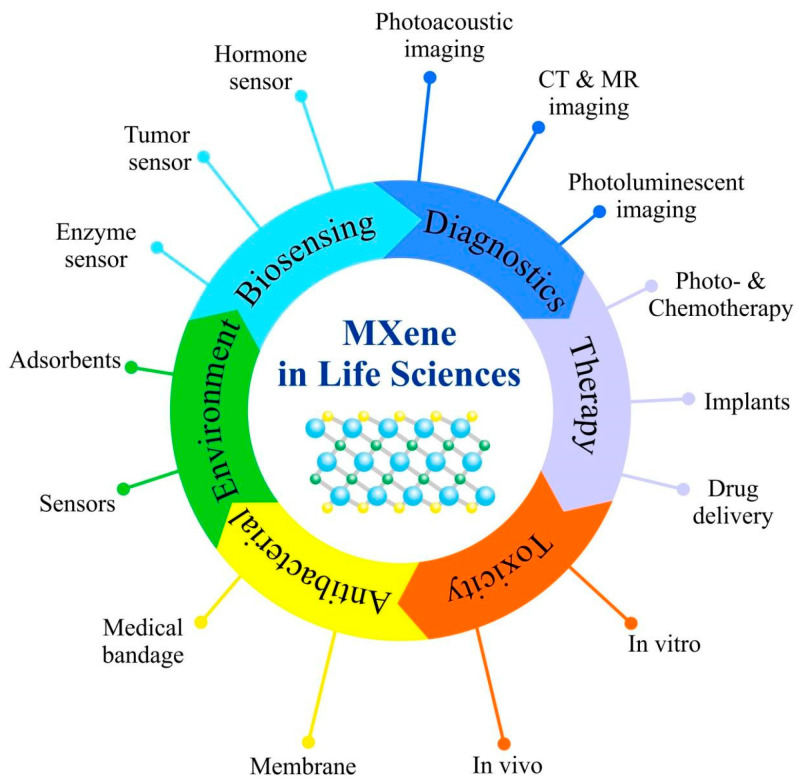
MXenes are a family of two-dimensional (2D) composite materials based on transition metal carbides, nitrides and carbonitrides that have been attracting attention since 2011. Combination of electrical and mechanical properties with hydrophilicity makes them promising materials for biomedical applications. This review briefly discusses methods for the synthesis of MXenes, their potential applications in medicine, ranging from sensors and antibacterial agents to targeted drug delivery, cancer photo/chemotherapy, tissue engineering, bioimaging, and environmental applications such as sensors and adsorbents. We focus on in vitro and in vivo toxicity and possible mechanisms. We discuss the toxicity analogies of MXenes and other 2D materials such as graphene, mentioning the greater biocompatibility of MXenes. We identify existing barriers that hinder the formation of objective knowledge about the toxicity of MXenes. The most important of these barriers are the differences in the methods of synthesis of MXenes, their composition and structure, including the level of oxidation, the number of layers and flake size; functionalization, test concentrations, duration of exposure, and individual characteristics of biological test objects Finally, we discuss key areas for further research that need to involve new methods of nanotoxicology, including predictive computational methods. Such studies will bring closer the prospect of widespread industrial production and safe use of MXene-based products.
MXenes是一类基于过渡金属碳化物、氮化物和碳氮化物的二维(2D)复合材料,自2011年以来一直备受关注。电学和力学性能与亲水性的结合使其成为生物医学应用的有前景的材料。本文综述简要讨论了MXenes的合成方法、它们在医学中的潜在应用,范围从传感器、抗菌剂到靶向药物递送、癌症光/化疗、组织工程、生物成像,以及在环境应用如传感器和吸附剂方面的应用。我们重点关注体外和体内毒性以及可能的机制。我们讨论了MXenes与其他二维材料如石墨烯的毒性类比,提及了MXenes具有更高的生物相容性。我们确定了阻碍形成关于MXenes毒性的客观知识的现有障碍。这些障碍中最重要的是MXenes合成方法、其组成和结构的差异,包括氧化水平、层数和薄片尺寸;功能化、测试浓度、暴露持续时间以及生物测试对象的个体特征。最后,我们讨论了需要涉及纳米毒理学新方法(包括预测计算方法)的进一步研究的关键领域。此类研究将使基于MXene的产品广泛工业生产和安全使用的前景更近一步。