
多囊卵巢综合征妇女卵泡液中雄激素浓度升高。
High androgen concentrations in follicular fluid of polycystic ovary syndrome women.
机构信息
UMR 85 Physiology of Reproduction and Behaviour, National Research Institute for Agriculture, Food and Environment (INRAE) Centre Val de Loire, 37380, Nouzilly, France.
Molecular Endocrinology and Rare Diseases, University Hospital, Claude Bernard Lyon 1 University, 69677, Bron, France.
出版信息
Reprod Biol Endocrinol. 2022 Jun 14;20(1):88. doi: 10.1186/s12958-022-00959-6.
BACKGROUND
According to current definitions of Polycystic Ovary Syndrome (PCOS), hyperandrogenism is considered as a key element in the pathogenesis of this common endocrinopathy. However, until now, studies about ovarian androgen profile in women are very rare. Our aim was then to characterise the expression profile of the androgens in follicular fluid of 30 PCOS patients, and compare it to those of 47 Control women and 29 women with only polycystic ovary morphology on ultrasounds (ECHO group).
METHODS
A retrospective, single-centre cohort study was performed. The intrafollicular concentrations of the key androgens were assessed and correlated with the intrafollicular levels of some adipokines of interest. Androgens were quantified by mass spectrophotometry combined with ultra-high-performance liquid chromatography, while adipokine concentrations were measured by ELISA assays.
RESULTS
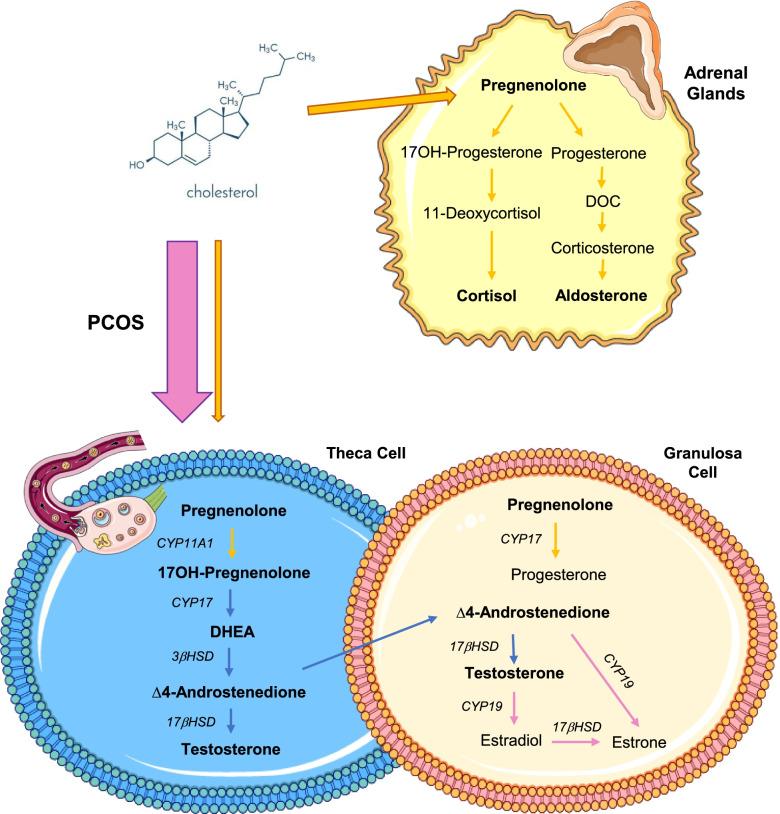
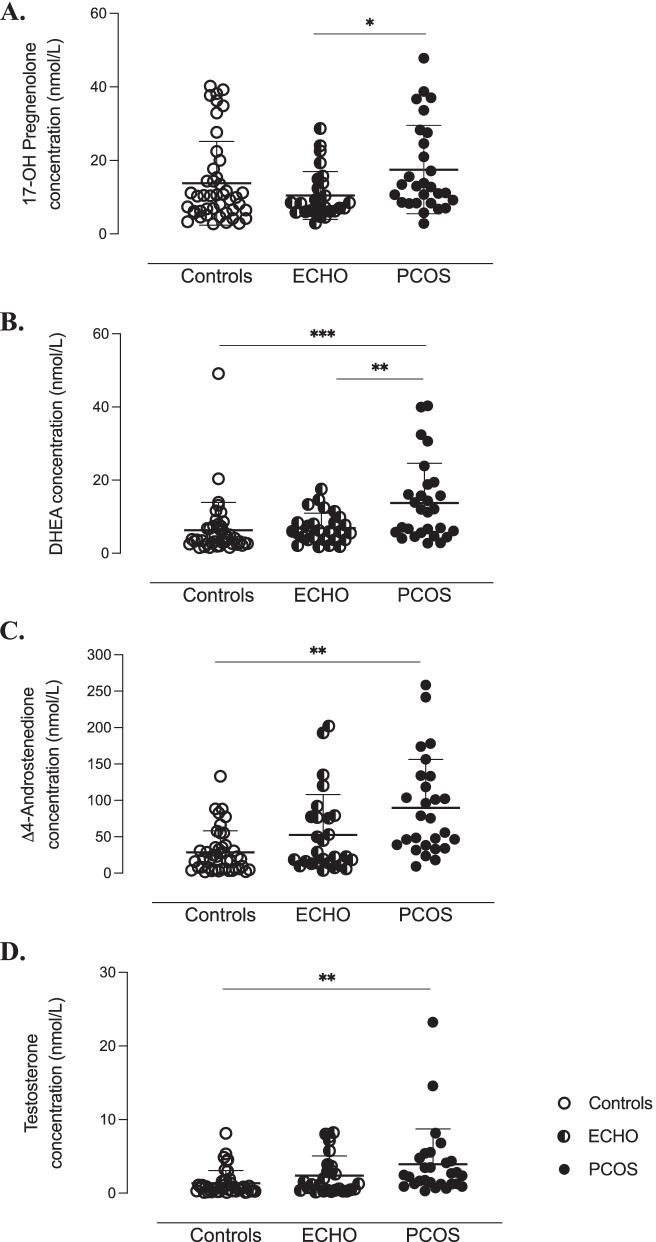
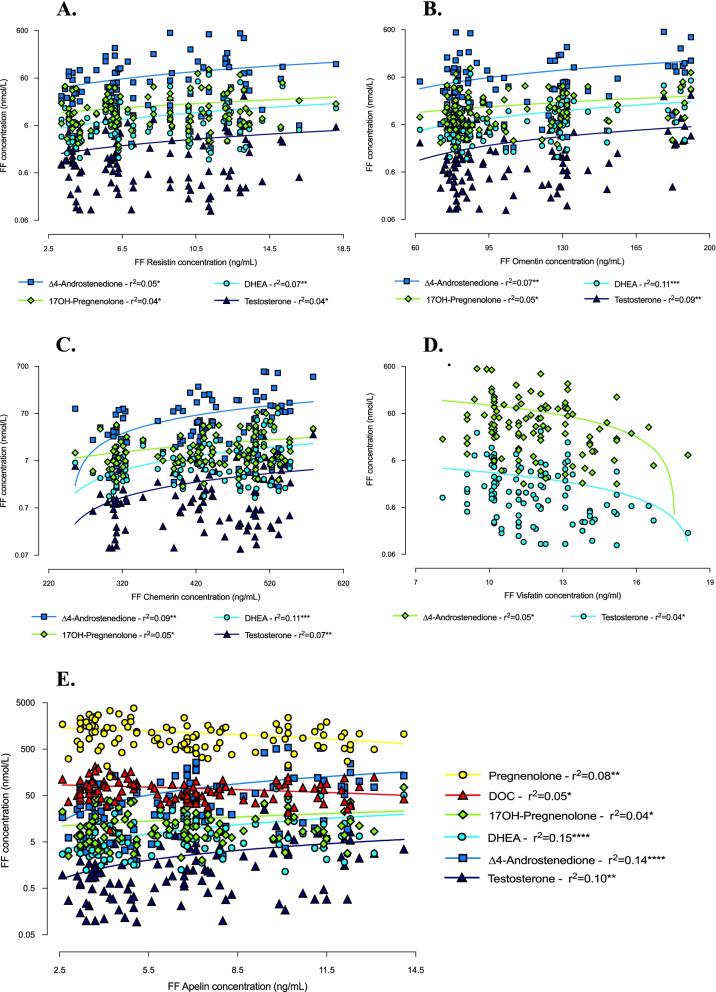
In PCOS patients, the intrafollicular concentrations of the androgens synthesised by ovarian theca cells, i.e., 17OH-pregnenolone, dehydroepiandrosterone, Δ4-androstenedione and testosterone, were significantly higher than those of the androgens of adrenal origin, and positively correlated with the main PCOS clinical and biological features, as well as with the adipokines mostly expressed in the follicular fluid of PCOS patients, i.e. resistin, omentin, chemerin and apelin. Conversely, Control women showed the highest levels of 17OH-progesterone, deoxycorticosterone and 11-deoxycortisol. Confirming these results, apelin levels were negatively associated with pregnenolone and deoxycorticosterone concentrations, while visfatin levels, which were higher in the Control group, negatively correlated with the Δ4-androstenedione and testosterone ones.
CONCLUSIONS
PCOS is characterised by a selective increase in the intrafollicular levels of the androgens synthesised by theca cells, strengthening the hypothesis that ovarian hyperandrogenism plays a central role in its pathogenesis. Further, the significant correlation between the intrafollicular concentrations of the androgens and most of the adipokines of interest, including apelin, chemerin, resistin and omentin, confirms the existence of a close relationship between these two hormonal systems, which appear deeply involved in ovarian physiology and PCOS physiopathology.
背景
根据多囊卵巢综合征(PCOS)的现行定义,高雄激素血症被认为是这种常见内分泌疾病发病机制的关键因素。然而,到目前为止,关于卵泡液中雄激素谱的研究非常少见。因此,我们的目的是描述 30 例 PCOS 患者卵泡液中雄激素的表达谱,并将其与 47 例对照妇女和 29 例仅在超声检查中出现多囊卵巢形态的妇女(ECHO 组)进行比较。
方法
这是一项回顾性的单中心队列研究。评估关键雄激素的卵泡内浓度,并将其与感兴趣的一些脂肪因子的卵泡内水平相关联。雄激素采用质量分光光度法结合超高效液相色谱法进行定量,而脂肪因子浓度则采用 ELISA 测定。
结果
在 PCOS 患者中,由卵巢间质细胞合成的雄激素,即 17-羟孕烯醇酮、脱氢表雄酮、Δ4-雄烯二酮和睾酮的卵泡内浓度明显高于肾上腺源性雄激素,且与 PCOS 的主要临床和生物学特征呈正相关,也与 PCOS 患者卵泡液中主要表达的脂肪因子呈正相关,即抵抗素、网膜素、趋化素和 Apelin。相反,对照组妇女的 17-羟孕酮、脱氧皮质酮和 11-脱氧皮质醇水平最高。这些结果得到了证实,Apelin 水平与孕烯醇酮和脱氧皮质酮浓度呈负相关,而对照组中较高的 Visfatin 水平与 Δ4-雄烯二酮和睾酮水平呈负相关。
结论
PCOS 的特征是卵泡内合成的细胞雄激素水平选择性升高,这进一步强化了卵巢高雄激素血症在其发病机制中起核心作用的假说。此外,雄激素与大多数感兴趣的脂肪因子(包括 Apelin、Chemerin、Resistin 和 Omentin)的卵泡内浓度之间存在显著相关性,证实了这两个激素系统之间存在密切关系,这两个系统似乎都深深涉及到卵巢生理学和 PCOS 病理生理学。


 Zotero 插件