Wang Jiaxin, Zhao Yan, Li Peng, Zhang Shutian
Department of Gastroenterology, Beijing Friendship Hospital, Capital Medical University, National Clinical Research Center for Digestive Diseases, Beijing Digestive Disease Center, Beijing 10050, China.
J Transl Int Med. 2022 Apr 2;10(1):28-35. doi: 10.2478/jtim-2022-0011. eCollection 2022 Mar.
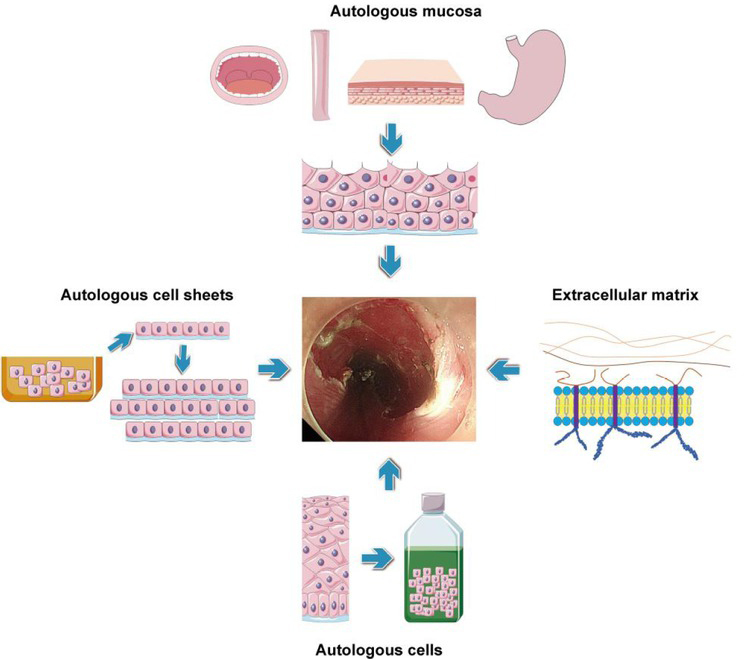
Endoscopic submucosal dissection (ESD) is a curative treatment for superficial esophageal cancer with distinct advantages. However, esophageal stenosis after ESD remains a tough problem, especially after large circumferential proportion of esophageal mucosa is removed, which limits the wide use of ESD, especially in circumferential lesions. In this scenario, preventive procedures are highly recommended against post-ESD esophageal stenosis. However, the efficacy and safety of traditional prophylactic methods (steroids, metal and biodegradable stents, balloon dilation, radial incision, .) are not satisfactory and novel strategies need to be developed. Regenerative medicine has been showing enormous potential in the reconstruction of organs including the esophagus. In this review, we aimed to describe the current status of regenerative medicine in prevention of post-ESD esophageal stenosis. Cell injection, cell sheet transplantation, and extracellular matrix implantation have been proved effective. However, numerous obstacles still exist and further studies are necessary.
内镜黏膜下剥离术(ESD)是一种治疗浅表性食管癌的有效方法,具有明显优势。然而,ESD术后食管狭窄仍然是一个棘手的问题,尤其是在食管黏膜大部分被环形切除后,这限制了ESD的广泛应用,特别是在环形病变中。在这种情况下,强烈建议采取预防措施以防止ESD术后食管狭窄。然而,传统预防方法(类固醇、金属和可生物降解支架、球囊扩张、放射状切口等)的疗效和安全性并不令人满意,需要开发新的策略。再生医学在包括食管在内的器官重建中已显示出巨大潜力。在本综述中,我们旨在描述再生医学在预防ESD术后食管狭窄方面的现状。细胞注射、细胞片移植和细胞外基质植入已被证明是有效的。然而,仍然存在许多障碍,需要进一步研究。