Sue & Bill Gross School of Nursing, University of California, Irvine.
Program in Public Health, University of California, Irvine.
JAMA Netw Open. 2022 Jun 1;5(6):e2217251. doi: 10.1001/jamanetworkopen.2022.17251.
During the past century, more than 100 catastrophic hurricanes have impacted the Florida coast; climate change will likely be associated with increases in the intensity of future storms. Despite these annual threats to residents, to our knowledge, no longitudinal studies of representative samples at risk of hurricane exposure have examined psychological outcomes associated with repeated exposure.
To assess psychosocial and mental health outcomes and functional impairment associated with repeated hurricane exposure.
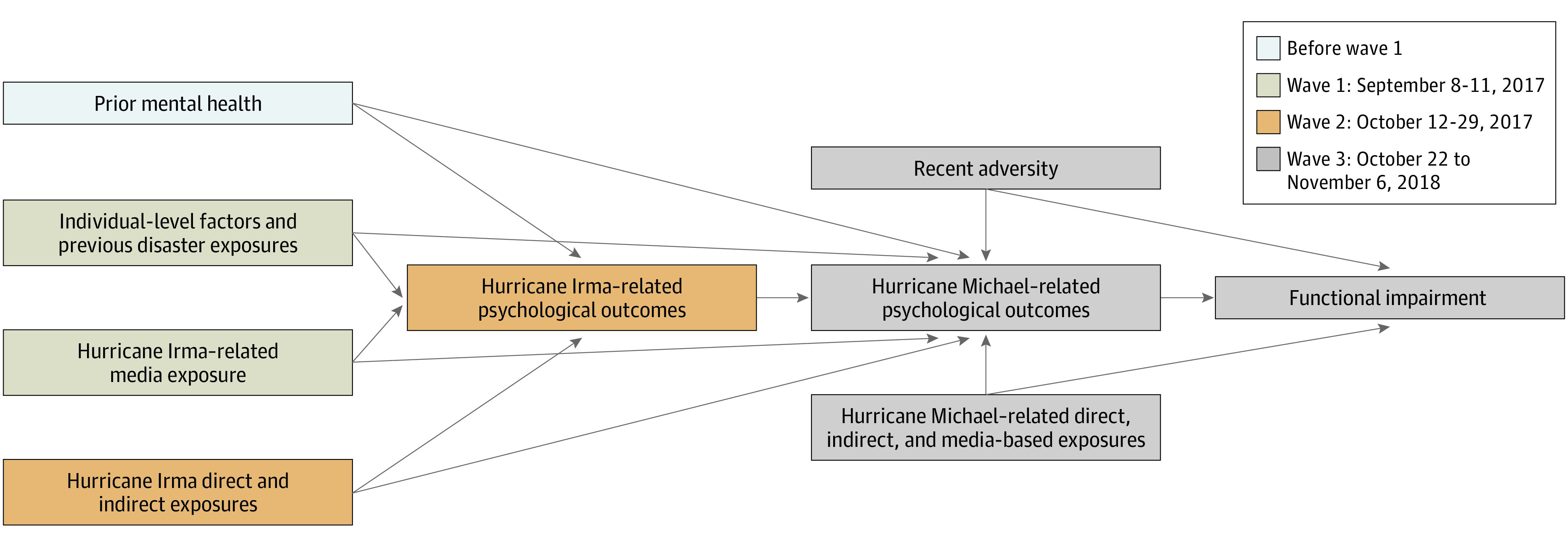
DESIGN, SETTING, AND PARTICIPANTS: In this survey study, a demographically representative sample of Florida residents was assessed in the 60 hours prior to Hurricane Irma (wave 1: September 8-11, 2017). A second survey was administered 1 month after Hurricane Irma (wave 2: October 12-29, 2017), and a third survey was administered after Hurricane Michael (wave 3: October 22 to November 6, 2018). Data were analyzed from July 19 to 23, 2021.
Hurricanes Irma and Michael.
The main outcomes were posttraumatic stress symptoms (PTSS), global distress, worry about future events (generalized worries), and functional impairment. Path models were used to assess associations of individual-level factors (prior mental health, recent adversity), prior storm exposures (loss and/or injury, evacuation), and direct, indirect, and media-based exposures to hurricanes Irma and Michael with those outcomes. Poststratification weights were applied to facilitate population-based inferences.
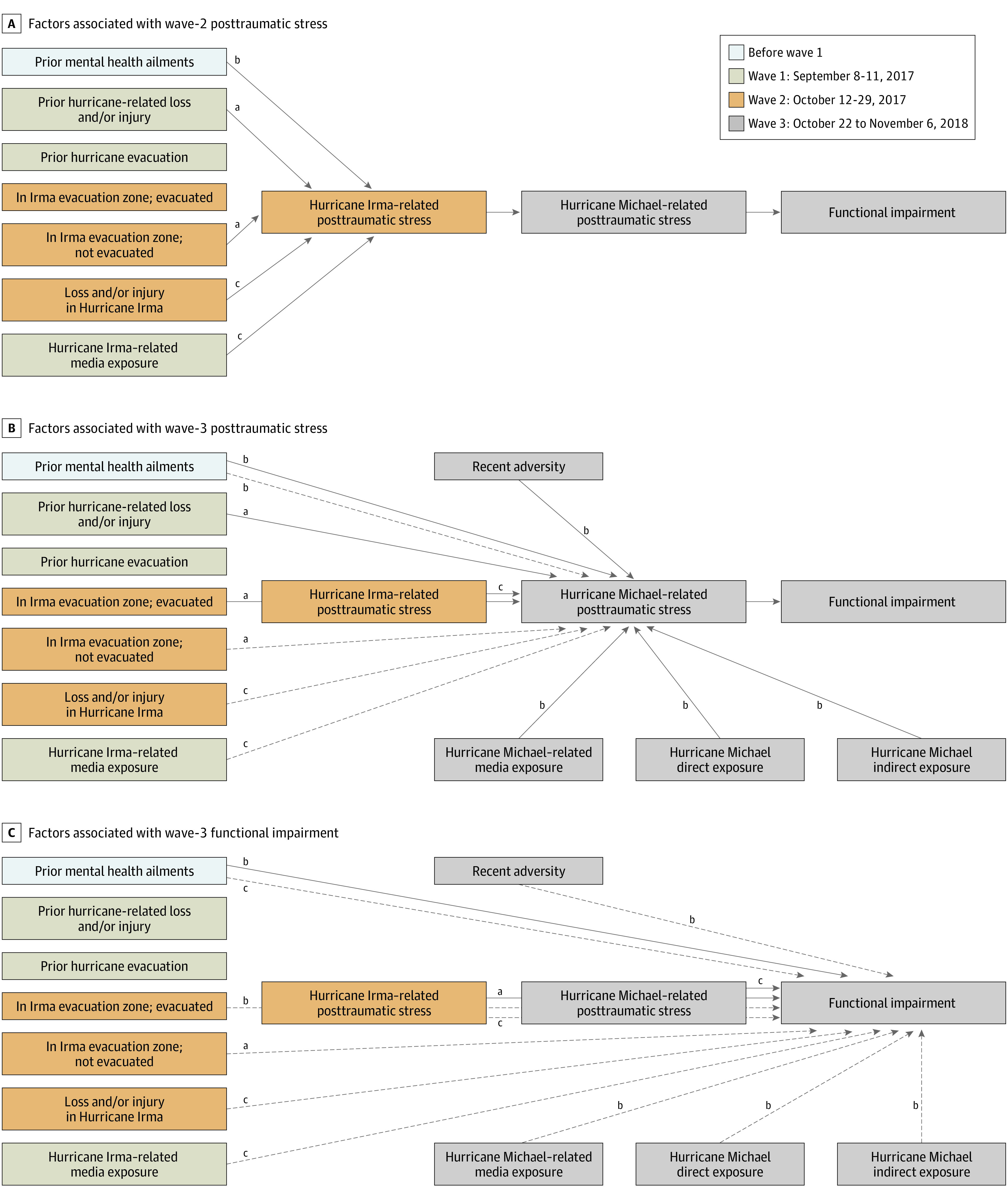
Of 2873 individuals administered the survey in wave 1, 1637 responded (57.0% completion rate) (894 [54.6%, weighted] women; mean [SD] age, 51.31 [17.50] years); 1478 in wave 2 (90.3% retention from wave 1) and 1113 in wave 3 (75.3% retention from wave 2) responded. Prior mental health ailments (b, 0.18; 95% CI, 0.07-0.28), prior hurricane-related loss and/or injury (b, 0.09; 95% CI, 0.02-0.17), hours of Hurricane Irma-related media exposure (b, 0.03; 95% CI, 0.02-0.04), being in an evacuation zone during Hurricane Irma and not evacuating (b, 0.14; 95% CI, 0.02-0.27), and loss and/or injury in Hurricane Irma (b, 0.35; 95% CI, 0.25-0.44) were positively associated with PTSS after Hurricane Irma; most associations persisted and were associated with responses to Hurricane Michael. Prior mental health ailments (b, 0.10; 95% CI, 0.03-0.17), hours of Hurricane Michael-related media exposure (b, 0.01; 95% CI, 0.003-0.02), hurricane Irma-related PTSS (b, 0.42; 95% CI, 0.34-0.50), recent individual-level adversity (b, 0.03; 95% CI, 0.005-0.05), being in an evacuation zone during Hurricane Irma and evacuating (b, 0.10; 95% CI, 0.002-0.19), and direct (b, 0.36; 95% CI, 0.16-0.55) and indirect (b, 0.12; 95% CI, 0.05-0.18) Hurricane Michael-related exposures were directly associated with Hurricane Michael-related PTSS. After Hurricane Michael, prior mental health ailments (b, 0.17; 95% CI, 0.06-0.28), and PTSS related to hurricanes Irma (b, 0.11; 95% CI, 0.001-0.22) and Michael (b, 0.58; 95% CI, 0.47-0.69) were associated with respondents' functional impairment. Analogous analyses using global distress and generalized worries as mediators of functional impairment yielded a similar pattern of results.
In this survey study, repeated direct, indirect, and media-based exposures to hurricanes were associated with increased mental health symptoms among Florida residents who experienced hurricanes Irma and Michael, suggesting that people were sensitized to respond with more psychological symptoms over time. These results may inform targeted public health intervention efforts for natural disasters.
在过去的一个世纪里,已有超过 100 场灾难性飓风袭击了佛罗里达州海岸;气候变化可能与未来风暴的强度增加有关。尽管居民每年都面临这些威胁,但据我们所知,没有针对有飓风暴露风险的代表性样本进行的纵向研究,来评估与反复暴露相关的心理结果。
评估与反复飓风暴露相关的社会心理和心理健康结果以及功能障碍。
设计、设置和参与者:在这项调查研究中,对佛罗里达州居民进行了人口统计学代表性样本的评估,评估时间在飓风伊尔玛(第 1 波:2017 年 9 月 8 日至 11 日)之前的 60 小时内。在飓风伊尔玛之后 1 个月(第 2 波:2017 年 10 月 12 日至 29 日)进行了第二次调查,并在飓风迈克尔之后(第 3 波:2018 年 10 月 22 日至 11 月 6 日)进行了第三次调查。数据分析于 2021 年 7 月 19 日至 23 日进行。
飓风伊尔玛和迈克尔。
主要结果是创伤后应激症状(PTSS)、总体困扰、对未来事件的担忧(普遍担忧)和功能障碍。路径模型用于评估个体水平因素(先前的心理健康状况、近期逆境)、先前的风暴暴露(损失和/或伤害、疏散)以及对飓风伊尔玛和迈克尔的直接、间接和媒体暴露与这些结果的关联。应用了后分层权重,以促进基于人群的推断。
在第 1 波调查中,共有 2873 人接受了调查,其中 1637 人(57.0%的完成率)做出了回应(894 名[54.6%,加权]女性;平均[标准差]年龄为 51.31[17.50]岁);1478 人在第 2 波(第 1 波的 90.3%保留率)和 1113 人在第 3 波(第 2 波的 75.3%保留率)做出了回应。先前的心理健康问题(b,0.18;95%置信区间,0.07-0.28)、与飓风相关的先前损失和/或伤害(b,0.09;95%置信区间,0.02-0.17)、与飓风伊尔玛相关的媒体暴露时间(b,0.03;95%置信区间,0.02-0.04)、在飓风伊尔玛期间处于疏散区但未疏散(b,0.14;95%置信区间,0.02-0.27)和飓风伊尔玛中的损失和/或伤害(b,0.35;95%置信区间,0.25-0.44)与飓风伊尔玛后创伤后应激症状呈正相关;大多数关联仍然存在,并与对飓风迈克尔的反应相关。先前的心理健康问题(b,0.10;95%置信区间,0.03-0.17)、与飓风迈克尔相关的媒体暴露时间(b,0.01;95%置信区间,0.003-0.02)、与飓风伊尔玛相关的创伤后应激症状(b,0.42;95%置信区间,0.34-0.50)、近期个人逆境(b,0.03;95%置信区间,0.005-0.05)、在飓风伊尔玛期间处于疏散区并疏散(b,0.10;95%置信区间,0.002-0.19)以及直接(b,0.36;95%置信区间,0.16-0.55)和间接(b,0.12;95%置信区间,0.05-0.18)与飓风迈克尔相关的暴露与飓风迈克尔相关的创伤后应激症状直接相关。在经历了飓风迈克尔之后,先前的心理健康问题(b,0.17;95%置信区间,0.06-0.28)和与飓风伊尔玛(b,0.11;95%置信区间,0.001-0.22)和迈克尔(b,0.58;95%置信区间,0.47-0.69)相关的创伤后应激症状与受访者的功能障碍相关。使用全球困扰和普遍担忧作为功能障碍的中介物进行类似的分析,得出了类似的结果模式。
在这项调查研究中,佛罗里达州居民反复直接、间接和基于媒体的暴露于飓风与经历过飓风伊尔玛和迈克尔的居民的心理健康症状增加有关,这表明人们随着时间的推移对心理症状的反应更加敏感。这些结果可能为自然灾害的针对性公共卫生干预措施提供信息。