Spiliotis Konstantinos, Koutsoumaris Constantinos Chr, Reppas Andreas I, Papaxenopoulou Lito A, Starke Jens, Hatzikirou Haralampos
Institute of Mathematics, University of Rostock, 18057 Rostock, Germany.
Department of Research, Development and Innovation Statistics, National Documentation Centre, 48 Vas. Konstantinou St, Athens 11635, Greece.
iScience. 2022 Jul 15;25(7):104575. doi: 10.1016/j.isci.2022.104575. Epub 2022 Jun 15.
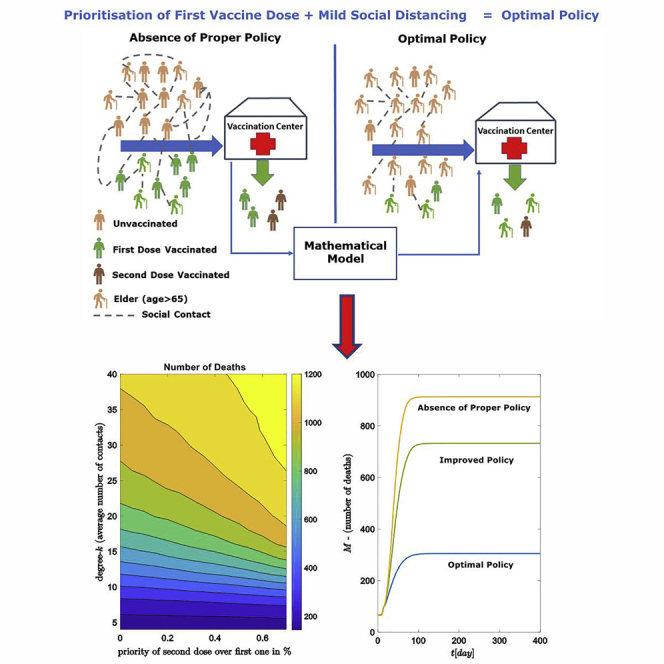
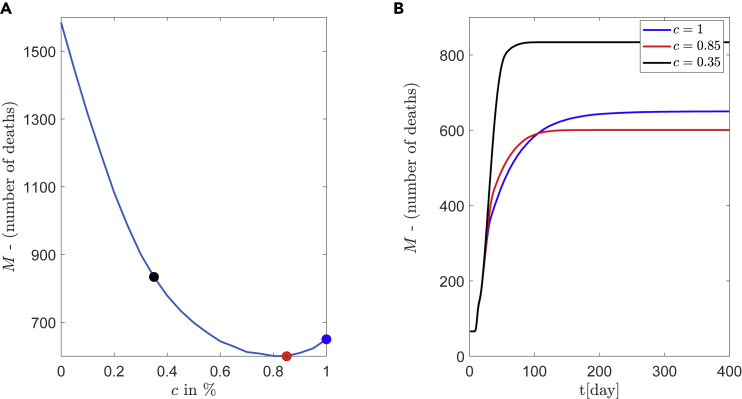
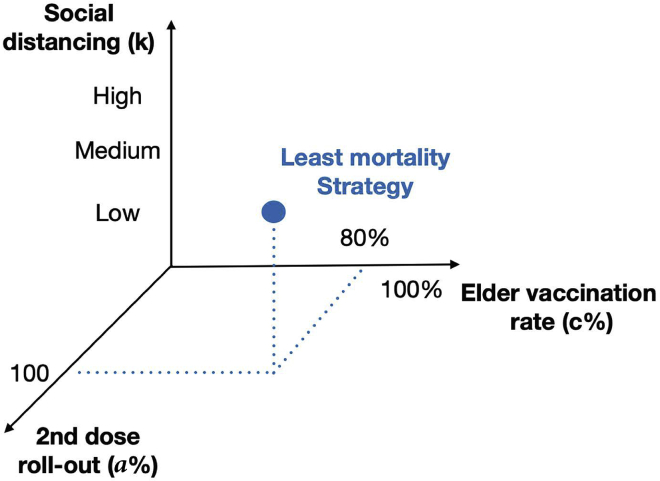
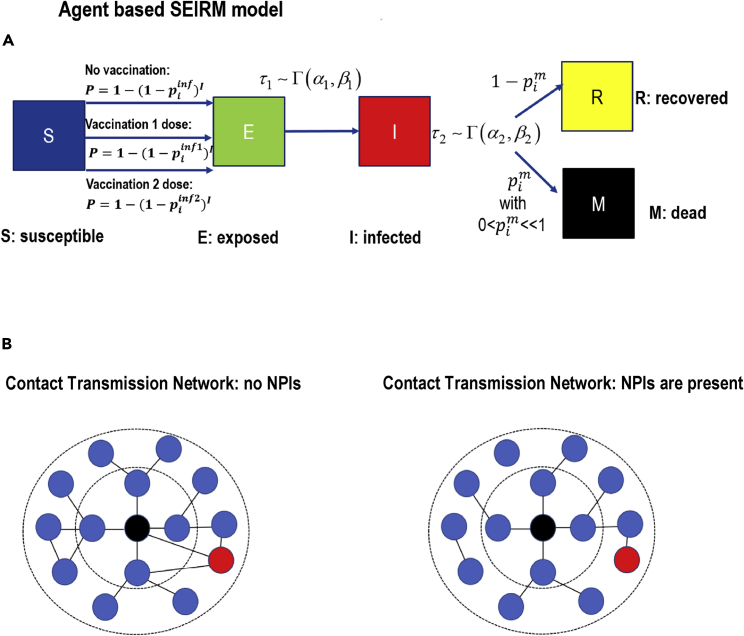
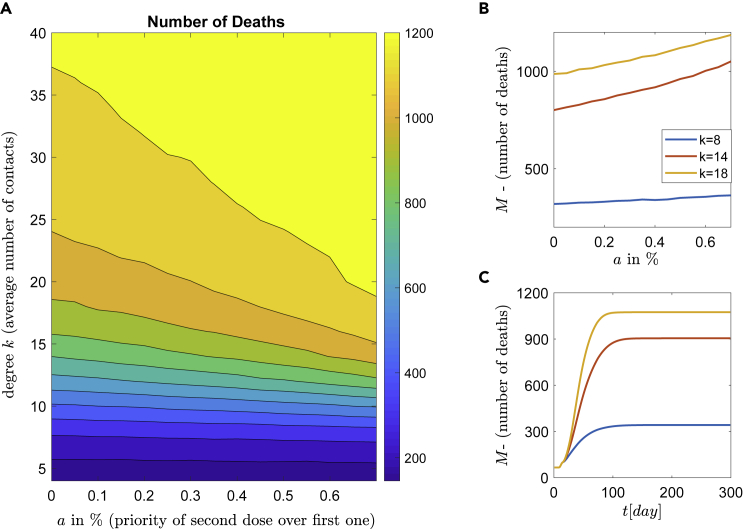
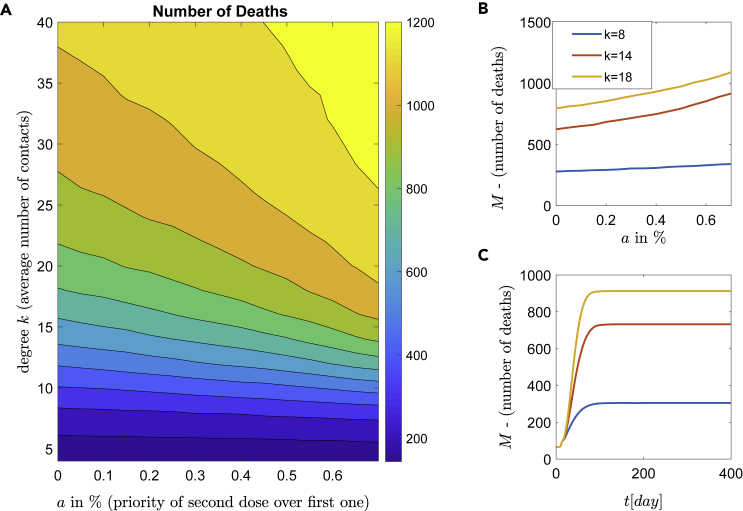
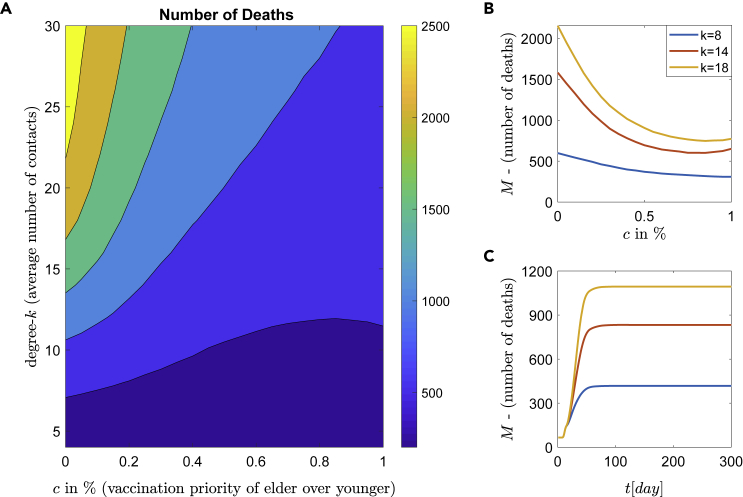
Non-pharmacological interventions (NPIs), principally social distancing, in combination with effective vaccines, aspire to develop a protective immunity shield against pandemics and particularly against the COVID-19 pandemic. In this study, an agent-based network model with small-world topology is employed to find optimal policies against pandemics, including social distancing and vaccination strategies. The agents' states are characterized by a variation of the SEIR model (susceptible, exposed, infected, recovered). To explore optimal policies, an equation-free method is proposed to solve the inverse problem of calibrating an agent's infection rate with respect to the vaccination efficacy. The results show that prioritizing the first vaccine dose in combination with mild social restrictions, is sufficient to control the pandemic, with respect to the number of deaths. Moreover, for the same mild number of social contacts, we find an optimal vaccination ratio of 0.85 between older people of ages compared to younger ones.
非药物干预措施(NPIs),主要是社交距离措施,与有效的疫苗相结合,旨在建立一个针对大流行,特别是针对新冠疫情的保护性免疫屏障。在本研究中,采用了具有小世界拓扑结构的基于主体的网络模型来寻找应对大流行的最优策略,包括社交距离措施和疫苗接种策略。主体的状态由SEIR模型(易感、暴露、感染、康复)的变体来表征。为了探索最优策略,提出了一种无方程方法来解决根据疫苗接种效果校准主体感染率的反问题。结果表明,就死亡人数而言,优先接种第一剂疫苗并结合适度的社会限制,足以控制疫情。此外,对于相同适度数量的社会接触,我们发现在老年人与年轻人之间,最优疫苗接种率为0.85。