Carpouron Julia Eva, de Hoog Sybren, Gentekaki Eleni, Hyde Kevin David
Center of Excellence in Fungal Research, Mae Fah Luang University, Chiang Rai 57100, Thailand.
School of Science, Mae Fah Luang University, Chiang Rai 57100, Thailand.
J Fungi (Basel). 2022 Jun 8;8(6):611. doi: 10.3390/jof8060611.
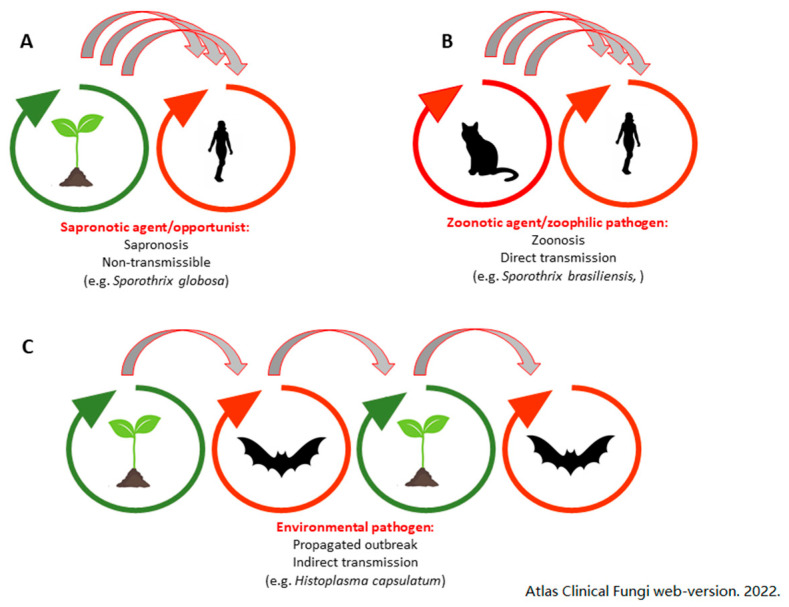
The Global Action Fund for Fungal Infections (GAFFI) estimates that fungal diseases kill around 150 people each hour, and yet they are globally overlooked and neglected. and , which are associated with wildlife, cause systemic infections that are often lethal in patients with impaired cellular immunity. Dermatophytes that cause outbreaks in human hosts are often associated with domesticated animals. Changes in human behavior have been identified as a main cause of the emergence of animal-associated fungal diseases in humans, sometimes caused by the disturbance of natural habitats. An understanding of ecology and the transmission modes of causative agents is therefore essential. Here, we focus on fungal diseases contracted from wildlife and domesticated animals, their habitats, feces and carcasses. We discuss some basic fungal lifestyles and the risk of transmission to humans and illustrate these with examples from emerging and established diseases.
全球真菌感染行动基金(GAFFI)估计,真菌疾病每小时导致约150人死亡,但它们在全球范围内被忽视。与野生动物相关的真菌会引发系统性感染,这在细胞免疫受损的患者中往往是致命的。在人类宿主中引发疫情的皮肤癣菌通常与家畜有关。人类行为的改变已被确定为人类中出现与动物相关的真菌疾病的主要原因,有时是由自然栖息地的干扰引起的。因此,了解生态学和病原体的传播模式至关重要。在这里,我们关注从野生动物和家畜及其栖息地、粪便和尸体感染的真菌疾病。我们讨论了一些基本的真菌生活方式以及传播给人类的风险,并通过新出现和已有的疾病实例进行说明。