Zoetmulder Riaan, Bruggeman Agnetha A E, Išgum Ivana, Gavves Efstratios, Majoie Charles B L M, Beenen Ludo F M, Dippel Diederik W J, Boodt Nikkie, den Hartog Sanne J, van Doormaal Pieter J, Cornelissen Sandra A P, Roos Yvo B W E M, Brouwer Josje, Schonewille Wouter J, Pirson Anne F V, van Zwam Wim H, van der Leij Christiaan, Brans Rutger J B, van Es Adriaan C G M, Marquering Henk A
Department of Biomedical Engineering and Physics, Amsterdam University Medical Centers, Location AMC, 1105 AZ Amsterdam, The Netherlands.
Department of Radiology and Nuclear Medicine, Amsterdam University Medical Centers, Location AMC, 1105 AZ Amsterdam, The Netherlands.
Diagnostics (Basel). 2022 Jun 6;12(6):1400. doi: 10.3390/diagnostics12061400.
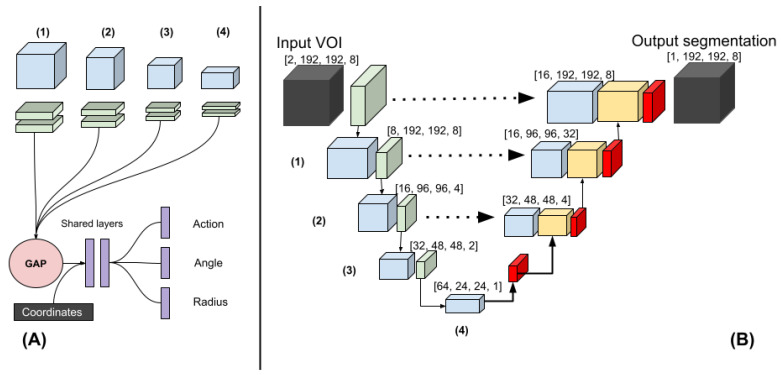
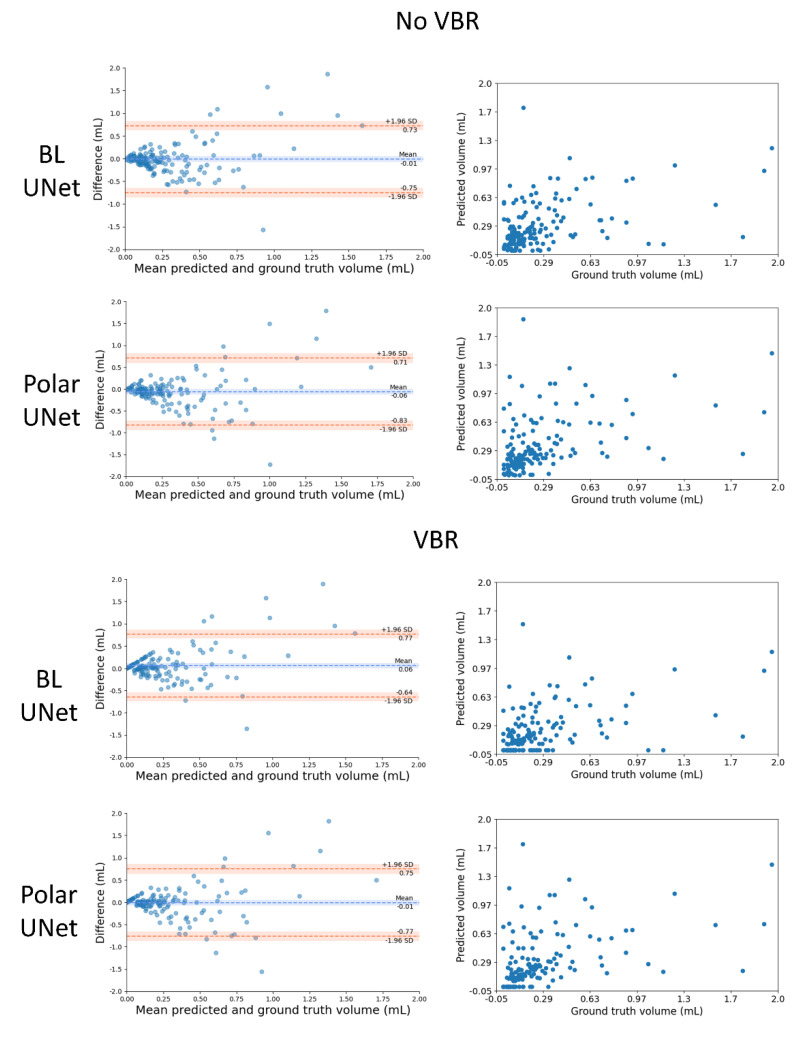
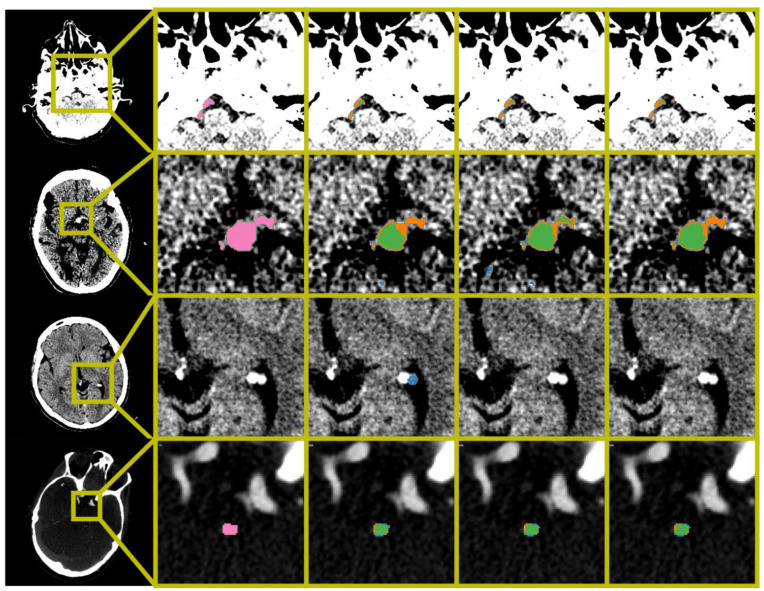
Thrombus volume in posterior circulation stroke (PCS) has been associated with outcome, through recanalization. Manual thrombus segmentation is impractical for large scale analysis of image characteristics. Hence, in this study we develop the first automatic method for thrombus localization and segmentation on CT in patients with PCS. In this multi-center retrospective study, 187 patients with PCS from the MR CLEAN Registry were included. We developed a convolutional neural network (CNN) that segments thrombi and restricts the volume-of-interest (VOI) to the brainstem (Polar-UNet). Furthermore, we reduced false positive localization by removing small-volume objects, referred to as volume-based removal (VBR). Polar-UNet is benchmarked against a CNN that does not restrict the VOI (BL-UNet). Performance metrics included the intra-class correlation coefficient (ICC) between automated and manually segmented thrombus volumes, the thrombus localization precision and recall, and the Dice coefficient. The majority of the thrombi were localized. Without VBR, Polar-UNet achieved a thrombus localization recall of 0.82, versus 0.78 achieved by BL-UNet. This high recall was accompanied by a low precision of 0.14 and 0.09. VBR improved precision to 0.65 and 0.56 for Polar-UNet and BL-UNet, respectively, with a small reduction in recall to 0.75 and 0.69. The Dice coefficient achieved by Polar-UNet was 0.44, versus 0.38 achieved by BL-UNet with VBR. Both methods achieved ICCs of 0.41 (95% CI: 0.27-0.54). Restricting the VOI to the brainstem improved the thrombus localization precision, recall, and segmentation overlap compared to the benchmark. VBR improved thrombus localization precision but lowered recall.
后循环卒中(PCS)中的血栓体积通过再通与预后相关。手动血栓分割对于大规模图像特征分析不切实际。因此,在本研究中,我们开发了首个用于PCS患者CT上血栓定位和分割的自动方法。在这项多中心回顾性研究中,纳入了来自MR CLEAN注册研究的187例PCS患者。我们开发了一种卷积神经网络(CNN),其可分割血栓并将感兴趣体积(VOI)限制在脑干(Polar-UNet)。此外,我们通过去除小体积物体(即基于体积的去除,VBR)减少了假阳性定位。将Polar-UNet与不限制VOI的CNN(BL-UNet)进行基准测试。性能指标包括自动分割和手动分割的血栓体积之间的类内相关系数(ICC)、血栓定位精度和召回率以及Dice系数。大多数血栓被定位。在没有VBR的情况下,Polar-UNet的血栓定位召回率为0.82,而BL-UNet为0.78。这种高召回率伴随着低精度,分别为0.14和0.09。VBR分别将Polar-UNet和BL-UNet的精度提高到0.65和0.56,召回率略有降低,分别为0.75和0.69。Polar-UNet获得的Dice系数为0.44,而采用VBR的BL-UNet为0.38。两种方法的ICC均为0.41(95%CI:0.27 - 0.54)。与基准相比,将VOI限制在脑干可提高血栓定位精度、召回率和分割重叠度。VBR提高了血栓定位精度但降低了召回率。