Menéndez López-Mateos Cristina, Menéndez López-Mateos María Luisa, Aguilar-Salvatierra Antonio, Gómez-Moreno Gerardo, Carreño Javier Carreño, Khaldy Hoda, Menéndez-Núñez Mario
Department of Stomatology IV, Faculty of Odontology, Complutense University, Plaza de Ramón y Cajal s/n, 28040 Madrid, Spain.
Faculty of Dentistry, University of Granada, Colegio Máximo de Cartuja s/n, 18071 Granada, Spain.
J Clin Med. 2022 Jun 20;11(12):3531. doi: 10.3390/jcm11123531.
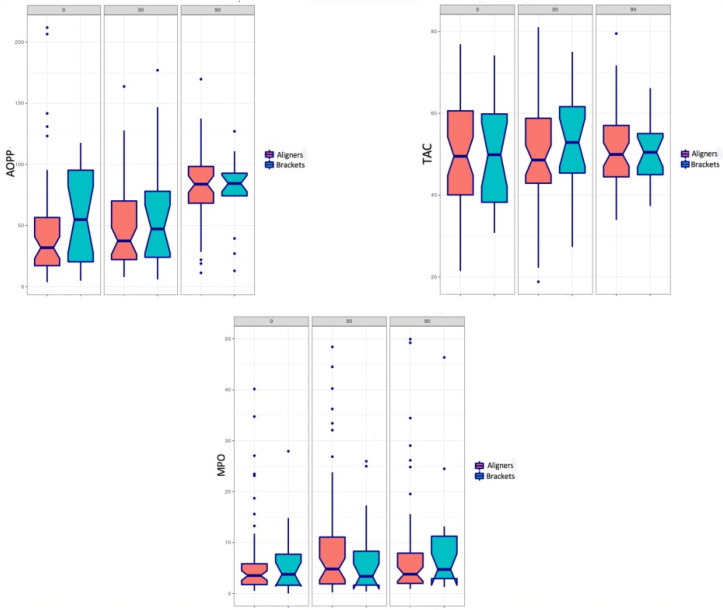
The aim of this work was to determine advanced the oxidative protein products (AOPPs), total antioxidant capacity (TAC), and myeloperoxidase activity (MPO) in the saliva of patients undergoing orthodontic treatment with clear removable aligners in comparison with another group in treatment with fixed passive self-ligating brackets applying light forces, before treatment, after 30 days, and after 90 days of treatment. This non-randomized clinical trial recruited patients consecutively, all of which were over 18 years of age and due to undergo orthodontic treatment. They were divided into two groups according to treatment type: Group A, 48 patients treated with clear aligners (Invisalign); and Group B, 19 patients treated with Damon System 0.22″ self-ligating brackets applying light forces. Saliva samples were collected by a single clinician following the same protocol and underwent three analyses-AOPPs, TAC, and MPO levels-at baseline before placing the apparatus, after 30 days, and after 90 days treatment. Orthodontic treatment, whether with clear aligners or fixed self-ligating brackets and light forces, increased AOPPs after the first 30 days of treatment. During the initial phases of orthodontic treatment, neither clear aligners nor fixed self-ligating brackets applying light forces showed changes in TAC and MPO. Orthodontic treatment with both clear aligners and fixed apparatus self-ligating brackets applying light forces increases oxidative stress (AOPPs) after the first 30 days of treatment. There are no differences in AOPP levels between treatment with clear aligners and self-ligating brackets during the first 90 days of treatment. The antioxidative capacity of saliva during the initial phases of orthodontic treatment, whether with self-ligating brackets or clear aligners, does not undergo significant changes. With either orthodontic technique, the patients' salivary antioxidant capacity is similar.
本研究旨在比较使用透明可摘矫治器进行正畸治疗的患者与使用轻力固定被动自结扎托槽治疗的另一组患者在治疗前、治疗30天后和治疗90天后唾液中晚期氧化蛋白产物(AOPPs)、总抗氧化能力(TAC)和髓过氧化物酶活性(MPO)的情况。这项非随机临床试验连续招募患者,所有患者均年满18岁且即将接受正畸治疗。根据治疗类型将他们分为两组:A组,48例患者使用透明矫治器(隐适美)治疗;B组,19例患者使用Damon System 0.22英寸轻力自结扎托槽治疗。唾液样本由一名临床医生按照相同方案采集,并在放置矫治器前的基线、治疗30天后和治疗90天后进行三项分析——AOPPs、TAC和MPO水平分析。正畸治疗,无论是使用透明矫治器还是固定自结扎托槽并施加轻力,在治疗的前30天后AOPPs都会增加。在正畸治疗的初始阶段,使用透明矫治器或固定自结扎托槽并施加轻力均未显示TAC和MPO有变化。使用透明矫治器和固定器械自结扎托槽并施加轻力的正畸治疗在治疗的前30天后都会增加氧化应激(AOPPs)。在治疗的前90天内,使用透明矫治器和自结扎托槽治疗的AOPP水平没有差异。在正畸治疗的初始阶段,无论使用自结扎托槽还是透明矫治器,唾液的抗氧化能力都没有显著变化。无论采用哪种正畸技术,患者的唾液抗氧化能力相似。