Department of Biomedical Sciences, Microbiology and Virology Unit, University of Cagliari, 09042 Monserrato, Italy.
Department of Medical Sciences and Public Health, University of Cagliari, 09124 Cagliari, Italy.
Nutrients. 2022 Jun 12;14(12):2436. doi: 10.3390/nu14122436.
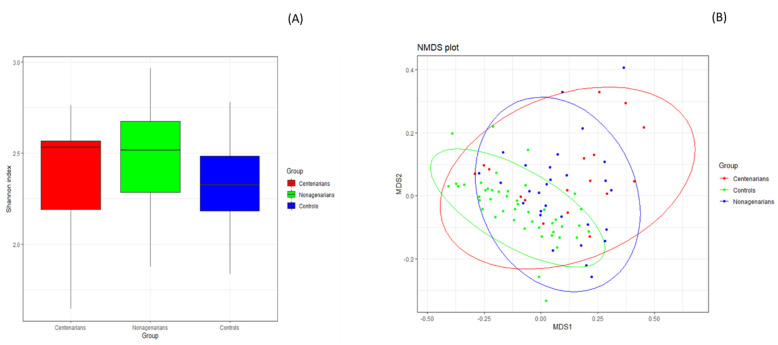
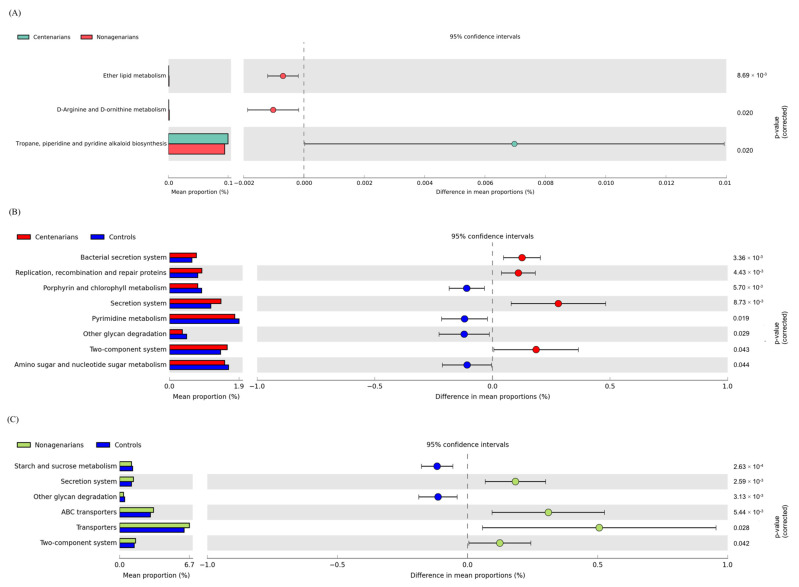
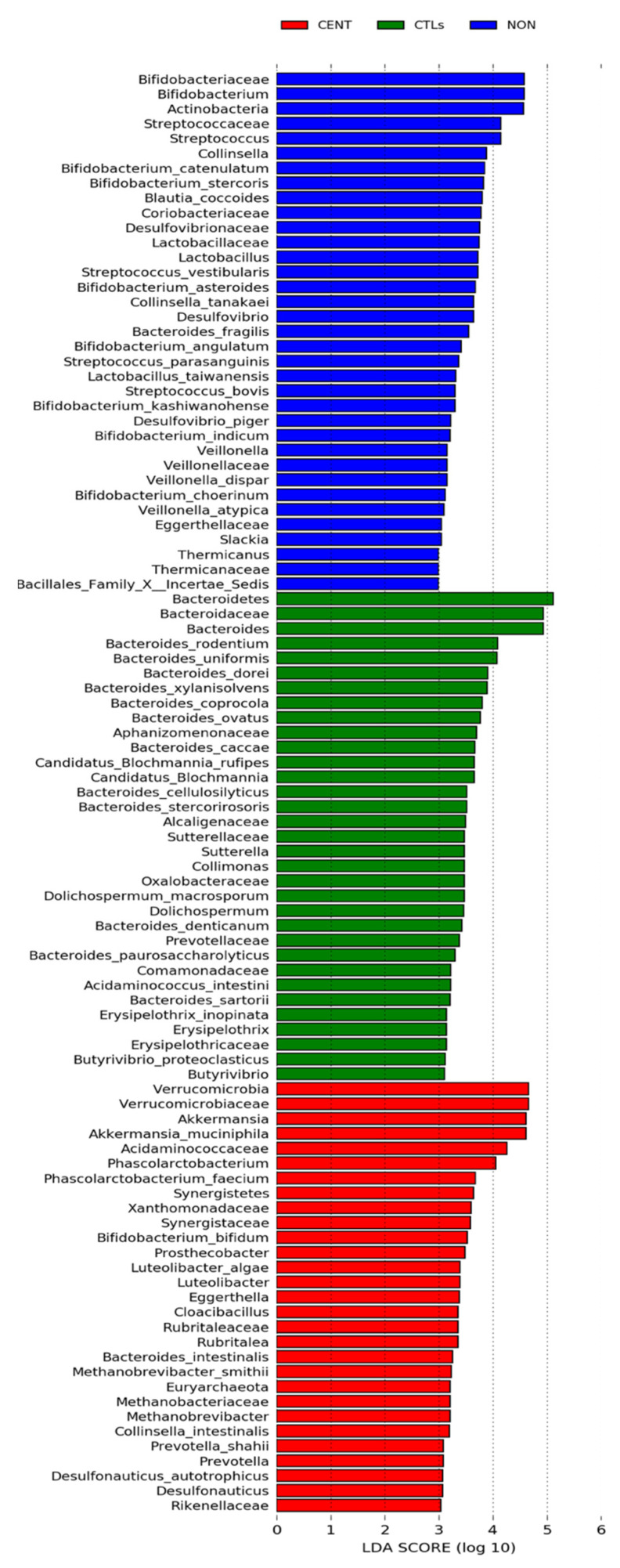
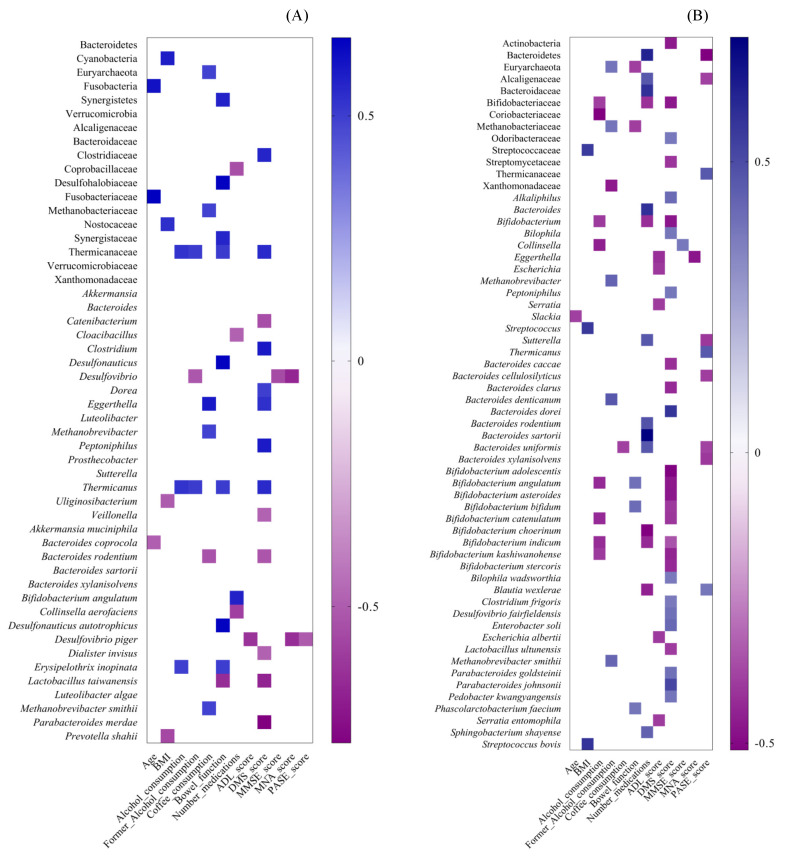
This study was aimed at characterizing the gut microbiota (GM) and its functional profile in two groups of Sardinian subjects with a long healthy life expectancy, overall named Long-Lived Subjects (LLS) [17 centenarians (CENT) and 29 nonagenarians (NON)] by comparing them to 46 healthy younger controls (CTLs). In addition, the contribution of genetics and environmental factors to the GM phenotype was assessed by comparing a subgroup of seven centenarian parents (CPAR) with a paired cohort of centenarians' offspring (COFF). The analysis was performed through Next Generation Sequencing (NGS) of the V3 and V4 hypervariable region of the 16S rRNA gene on the MiSeq Illumina platform. The Verrucomicrobia phylum was identified as the main biomarker in CENT, together with its members , and . In NON, the strongest associations concern Actinobacteria phylum, Bifidobacteriaceae and , while in CTLs were related to the Bacteroidetes phylum, Bacteroidaceae, and spp. Intestinal microbiota of CPAR and COFF did not differ significantly from each other. Significant correlations between bacterial taxa and clinical and lifestyle data, especially with Mediterranean diet adherence, were observed. We observed a harmonically balanced intestinal community structure in which the increase in taxa associated with intestinal health would limit and counteract the action of potentially pathogenic bacterial species in centenarians. The GM of long-lived individuals showed an intrinsic ability to adapt to changing environmental conditions, as confirmed by functional analysis. The GM analysis of centenarians' offspring suggest that genetics and environmental factors act synergistically as a multifactorial cause in the modulation of GM towards a phenotype similar to that of centenarians, although these findings need to be confirmed by larger study cohorts and by prospective studies.
本研究旨在通过比较两组具有长寿预期的撒丁岛受试者(总体称为长寿受试者 [17 名百岁老人(CENT)和 29 名 90 岁以上老人(NON)])与 46 名健康年轻对照组(CTLs)的肠道微生物组(GM)及其功能谱,来描述 GM。此外,通过比较 7 名百岁老人父母(CPAR)与百岁老人后代的配对队列(COFF),评估遗传和环境因素对 GM 表型的贡献。通过对 MiSeq Illumina 平台上 16S rRNA 基因的 V3 和 V4 高变区进行下一代测序(NGS)来进行分析。疣微菌门被确定为 CENT 的主要生物标志物,其成员 、 和 也是如此。在 NON 中,与厚壁菌门、双歧杆菌科和 最强相关,而在 CTLs 中与拟杆菌门、拟杆菌科、 和 相关。CPAR 和 COFF 的肠道微生物群彼此之间没有显着差异。观察到细菌分类群与临床和生活方式数据之间存在显着相关性,尤其是与地中海饮食的依从性。我们观察到肠道群落结构的和谐平衡,其中与肠道健康相关的分类群的增加将限制和抵消潜在致病性细菌在百岁老人中的作用。长寿个体的 GM 显示出内在的适应不断变化的环境条件的能力,这通过功能分析得到了证实。百岁老人后代的 GM 分析表明,遗传和环境因素协同作用,作为调节 GM 向类似于百岁老人表型的多因素原因,尽管这些发现需要通过更大的研究队列和前瞻性研究来证实。