Department of Community Health Sciences, Fielding School of Public Health, University of California, Los Angeles, Los Angeles, CA, USA.
Department of Social Medicine, Ohio University Heritage College of Osteopathic Medicine, Athens, OH, USA.
Am J Mens Health. 2022 May-Jun;16(3):15579883221104272. doi: 10.1177/15579883221104272.
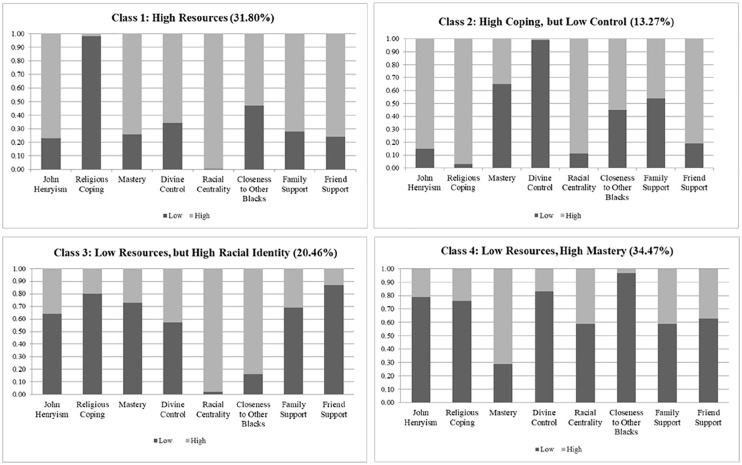
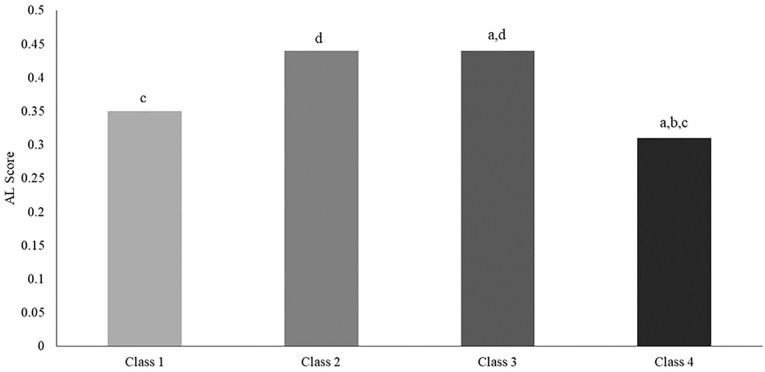
There is a well-established link between psychosocial risks and psychological health among African American (AA) men. Yet, the psychosocial sources and physical health consequences of resilience (i.e., the ability to maintain good health despite adversity) remain underexplored. Using data from 283 AA men in the Nashville Stress and Health Study, the present study investigated the links between psychosocial resilience and allostatic load (AL), a biological indicator of physiological dysregulation. Latent class analysis (LCA) identified distinct resilience profiles comprising eight psychosocial resources across four categories: coping strategies, sense of control, racial identity, and social support. Analysis of variance (ANOVA) tests determined significant class differences in men's AL scores. LCA results confirm a four-class model was the best fit: Class 1 (high resources, 32%), Class 2 (high coping but low control, 13%), Class 3 (low resources but high racial identity, 20%), and Class 4 (low resources but high mastery, 34%). Results reveal lower AL (better health) among Classes 1 ( = 0.35) and 4 ( = 0.31) and higher AL (worse health) among Classes 2 ( = 0.44) and 3 ( = 0.44). Findings indicate that the "quality" rather than the "quantity" of psychosocial resources matters for physical health among AA men, as positive health outcomes were observed among both low- and high-resource classes. Results suggest different resource combinations produce distinct patterns of resilience among AA men and underscore the need to further elucidate complex resilience processes among this population.
非裔美国男性(AA)的心理社会风险与心理健康之间存在着明确的联系。然而,韧性(即在逆境中保持良好健康的能力)的心理社会来源及其对身体健康的影响仍未得到充分探讨。本研究利用纳什维尔压力与健康研究中 283 名 AA 男性的数据,调查了心理社会韧性与全身适应综合征(AL)之间的关系,AL 是生理失调的生物学指标。潜在类别分析(LCA)确定了由四个类别中的八种心理社会资源组成的不同韧性特征:应对策略、控制感、种族认同和社会支持。方差分析(ANOVA)检验确定了男性 AL 评分的显著类别差异。LCA 结果证实,四类别模型拟合最好:类别 1(资源丰富,32%)、类别 2(应对能力高但控制感低,13%)、类别 3(资源少但种族认同高,20%)和类别 4(资源少但掌握能力高,34%)。结果表明,AL 较低(健康状况较好)的类别 1( = 0.35)和 4( = 0.31)和 AL 较高(健康状况较差)的类别 2( = 0.44)和 3( = 0.44)之间存在差异。研究结果表明,对于 AA 男性的身体健康而言,心理社会资源的“质量”而非“数量”更为重要,因为低资源和高资源类别都观察到了积极的健康结果。研究结果表明,不同的资源组合会产生 AA 男性不同的韧性模式,并强调需要进一步阐明该人群中复杂的韧性过程。