Department of Medicine (Cardiovascular Division), Beth Israel Deaconess Medical Center and Harvard Medical School, 330 Brookline Ave, Boston, MA, 02215, USA.
Cardiovascular Center, Tufts Medical Center, Boston, USA.
J Cardiovasc Magn Reson. 2022 Jun 27;24(1):40. doi: 10.1186/s12968-022-00869-x.
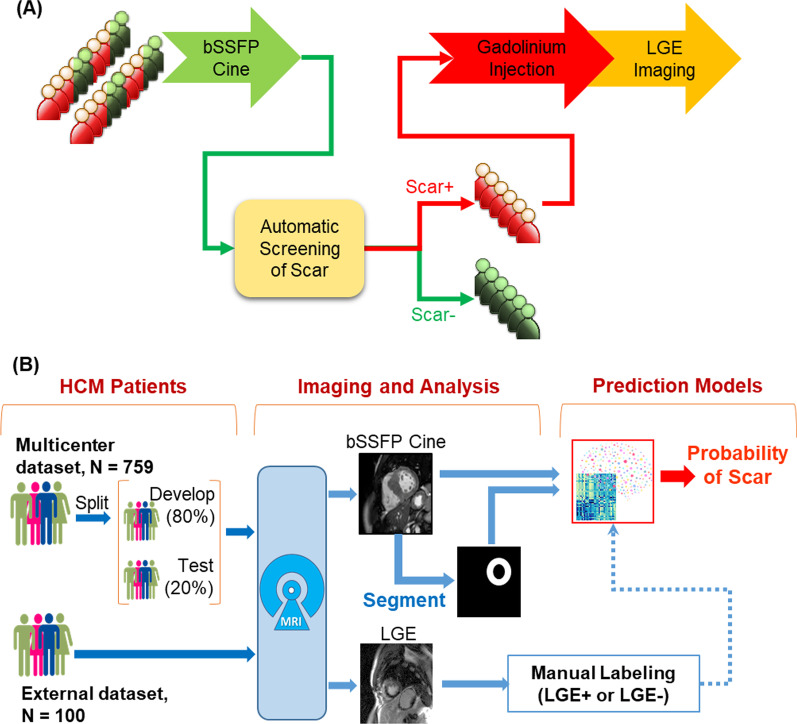
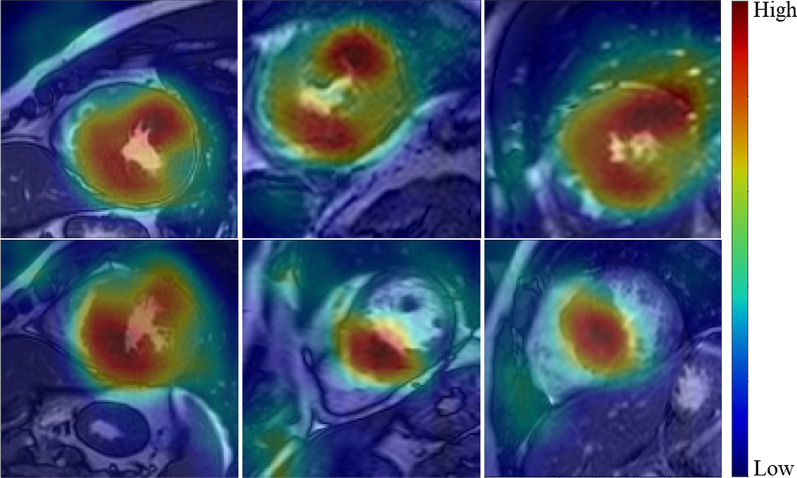
Myocardial scar burden quantified using late gadolinium enhancement (LGE) cardiovascular magnetic resonance (CMR), has important prognostic value in hypertrophic cardiomyopathy (HCM). However, nearly 50% of HCM patients have no scar but undergo repeated gadolinium-based CMR over their life span. We sought to develop an artificial intelligence (AI)-based screening model using radiomics and deep learning (DL) features extracted from balanced steady state free precession (bSSFP) cine sequences to identify HCM patients without scar.
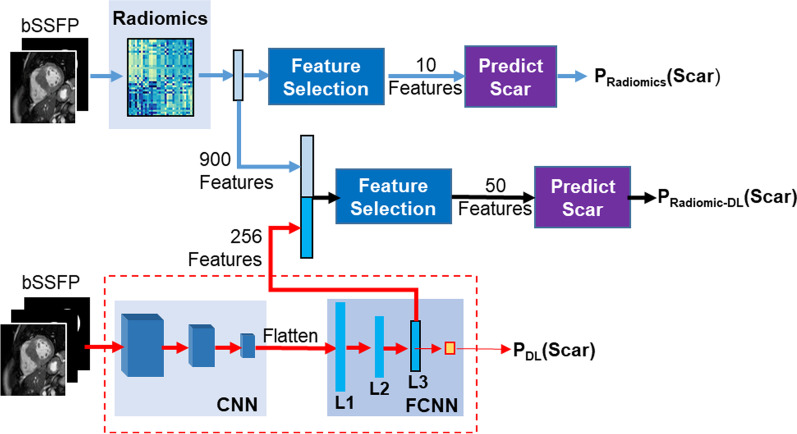
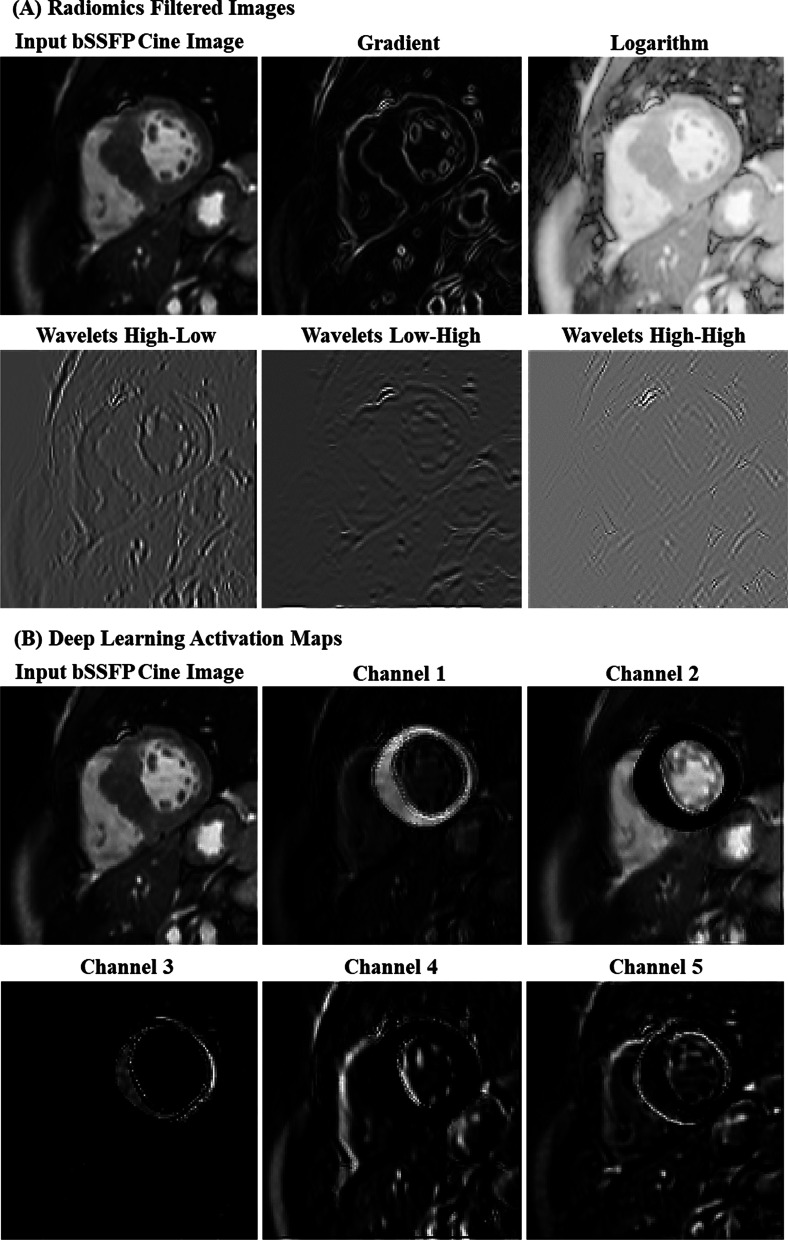
We evaluated three AI-based screening models using bSSFP cine image features extracted by radiomics, DL, or combined DL-Radiomics. Images for 759 HCM patients (50 ± 16 years, 66% men) in a multi-center/vendor study were used to develop and test model performance. An external dataset of 100 HCM patients (53 ± 14 years, 70% men) was used to assess model generalizability. Model performance was evaluated using area-under-receiver-operating curve (AUC).
The DL-Radiomics model demonstrated higher AUC compared to DL and Radiomics in the internal (0.83 vs 0.77, p = 0.006 and 0.78, p = 0.05; n = 159) and external (0.74 vs 0.64, p = 0.006 and 0.71, p = 0.27; n = 100) datasets. The DL-Radiomics model correctly identified 43% and 28% of patients without scar in the internal and external datasets compared to 42% and 16% by Radiomics model and 42% and 23% by DL model, respectively.
A DL-Radiomics AI model using bSSFP cine images outperforms DL or Radiomics models alone as a scar screening tool prior to gadolinium administration. Despite its potential, the clinical utility of the model remains limited and further investigation is needed to improve the accuracy and generalizability.
使用晚期钆增强(LGE)心血管磁共振(CMR)量化心肌瘢痕负担在肥厚型心肌病(HCM)中有重要的预后价值。然而,近 50%的 HCM 患者没有瘢痕,但在其一生中会进行多次基于钆的 CMR。我们试图开发一种基于人工智能(AI)的筛查模型,使用从平衡稳态自由进动(bSSFP)电影序列中提取的放射组学和深度学习(DL)特征来识别没有瘢痕的 HCM 患者。
我们使用 bSSFP 电影图像特征评估了三种基于 AI 的筛查模型,这些特征是通过放射组学、DL 或结合了 DL 和放射组学的方法提取的。多中心/多供应商研究中 759 例 HCM 患者(50±16 岁,66%为男性)的图像用于开发和测试模型性能。一个 100 例 HCM 患者(53±14 岁,70%为男性)的外部数据集用于评估模型的通用性。使用受试者工作特征曲线下面积(AUC)评估模型性能。
在内部(0.83 对 0.77,p=0.006 和 0.78,p=0.05;n=159)和外部(0.74 对 0.64,p=0.006 和 0.71,p=0.27;n=100)数据集,DL-Radiomics 模型的 AUC 明显高于 DL 和放射组学模型。与放射组学模型(分别为 43%和 28%)和 DL 模型(分别为 42%和 23%)相比,DL-Radiomics 模型在内部和外部数据集中正确识别出 43%和 28%无瘢痕患者。
与单独使用 DL 或放射组学模型相比,使用 bSSFP 电影图像的 DL-Radiomics AI 模型作为钆给药前的瘢痕筛查工具表现更好。尽管有其潜力,但该模型的临床实用性仍然有限,需要进一步研究以提高准确性和通用性。