• 文献检索
  • 文档翻译
  • 深度研究
  • 学术资讯
  • Suppr Zotero 插件Zotero 插件
  • 邀请有礼
  • 套餐&价格
  • 历史记录
应用&插件
Suppr Zotero 插件Zotero 插件浏览器插件Mac 客户端Windows 客户端微信小程序
定价
高级版会员购买积分包购买API积分包
服务
文献检索文档翻译深度研究API 文档MCP 服务
关于我们
关于 Suppr公司介绍联系我们用户协议隐私条款
关注我们

Suppr 超能文献

核心技术专利:CN118964589B侵权必究
粤ICP备2023148730 号-1Suppr @ 2026

文献检索

告别复杂PubMed语法,用中文像聊天一样搜索,搜遍4000万医学文献。AI智能推荐,让科研检索更轻松。

立即免费搜索

文件翻译

保留排版,准确专业,支持PDF/Word/PPT等文件格式,支持 12+语言互译。

免费翻译文档

深度研究

AI帮你快速写综述,25分钟生成高质量综述,智能提取关键信息,辅助科研写作。

立即免费体验

利用印度疾病传播数据驱动的流行病学参数对 COVID-19 流行模型进行数学分析

Mathematical Analysis of a COVID-19 Epidemic Model by Using Data Driven Epidemiological Parameters of Diseases Spread in India.

作者信息

Pal D, Ghosh D, Santra P K, Mahapatra G S

机构信息

Chandrahati Dilip Kumar High School, 712504 Chandrahati, West Bengal India.

Department of Mathematics, National Institute of Technology Puducherry, 609609 Karaikal, India.

出版信息

Biophysics (Oxf). 2022;67(2):231-244. doi: 10.1134/S0006350922020154. Epub 2022 Jun 29.

DOI:10.1134/S0006350922020154
PMID:35789554
原文链接:https://pmc.ncbi.nlm.nih.gov/articles/PMC9244063/
Abstract

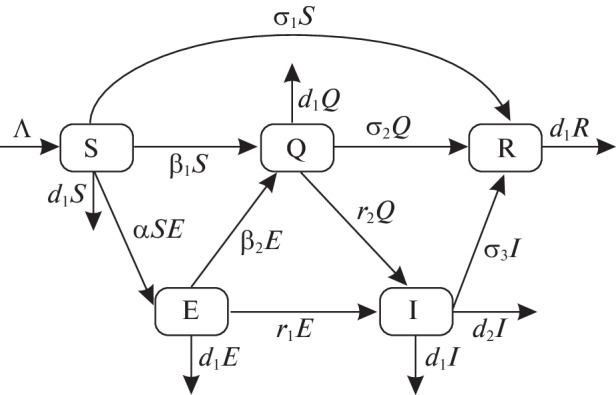
This paper attempts to describe the outbreak of Severe Acute Respiratory Syndrome Coronavirus 2 (COVID-19) via an epidemic model. This virus has dissimilar effects in different countries. The number of new active coronavirus cases is increasing gradually across the globe. India is now in the second stage of COVID-19 spreading, it will be an epidemic very quickly if proper protection is not undertaken based on the database of the transmission of the disease. This paper is using the current data of COVID-19 for the mathematical modeling and its dynamical analysis. We bring in a new representation to appraise and manage the outbreak of infectious disease COVID-19 through SEQIR pandemic model, which is based on the supposition that the infected but undetected by testing individuals are send to quarantine during the incubation period. During the incubation period if any individual be infected by COVID-19, then that confirmed infected individuals are isolated and the necessary treatments are arranged so that they cannot taint the other residents in the community. Dynamics of the SEQIR model is presented by basic reproduction number and the comprehensive stability analysis. Numerical results are depicted through apt graphical appearances using the data of five states and India.

摘要

本文试图通过一种流行病模型来描述严重急性呼吸综合征冠状病毒2(COVID-19)的爆发情况。这种病毒在不同国家有不同的影响。全球新型活跃冠状病毒病例数正在逐渐增加。印度目前正处于COVID-19传播的第二阶段,如果不根据该疾病传播的数据库采取适当的防护措施,很快就会成为一场流行病。本文利用COVID-19的当前数据进行数学建模及其动力学分析。我们引入一种新的表示方法,通过SEQIR大流行模型来评估和管理COVID-19传染病的爆发,该模型基于这样的假设:在潜伏期,检测呈阳性但未被检测出的感染者被送去隔离。在潜伏期,如果有任何个体感染了COVID-19,那么确诊的感染者将被隔离,并安排必要的治疗,以使他们不会感染社区中的其他居民。通过基本再生数和全面稳定性分析来呈现SEQIR模型的动力学。使用五个邦和印度的数据,通过适当的图形外观来描述数值结果。
https://cdn.ncbi.nlm.nih.gov/pmc/blobs/4624/9244063/1ee658b8bb76/11439_2022_9512_Fig16_HTML.jpg
https://cdn.ncbi.nlm.nih.gov/pmc/blobs/4624/9244063/42861d4a13f4/11439_2022_9512_Fig1_HTML.jpg
https://cdn.ncbi.nlm.nih.gov/pmc/blobs/4624/9244063/b2e535e1afd4/11439_2022_9512_Fig2_HTML.jpg
https://cdn.ncbi.nlm.nih.gov/pmc/blobs/4624/9244063/bd33f872f9ea/11439_2022_9512_Fig3_HTML.jpg
https://cdn.ncbi.nlm.nih.gov/pmc/blobs/4624/9244063/6dbca4572478/11439_2022_9512_Fig4_HTML.jpg
https://cdn.ncbi.nlm.nih.gov/pmc/blobs/4624/9244063/c8be2172ecf4/11439_2022_9512_Fig5_HTML.jpg
https://cdn.ncbi.nlm.nih.gov/pmc/blobs/4624/9244063/4561b3234fca/11439_2022_9512_Fig6_HTML.jpg
https://cdn.ncbi.nlm.nih.gov/pmc/blobs/4624/9244063/2142a5302e90/11439_2022_9512_Fig7_HTML.jpg
https://cdn.ncbi.nlm.nih.gov/pmc/blobs/4624/9244063/d93fab57faed/11439_2022_9512_Fig8_HTML.jpg
https://cdn.ncbi.nlm.nih.gov/pmc/blobs/4624/9244063/01069d3374aa/11439_2022_9512_Fig9_HTML.jpg
https://cdn.ncbi.nlm.nih.gov/pmc/blobs/4624/9244063/6bf17ce10ec1/11439_2022_9512_Fig10_HTML.jpg
https://cdn.ncbi.nlm.nih.gov/pmc/blobs/4624/9244063/ca3ce06067da/11439_2022_9512_Fig11_HTML.jpg
https://cdn.ncbi.nlm.nih.gov/pmc/blobs/4624/9244063/22c1dc7cdcd3/11439_2022_9512_Fig12_HTML.jpg
https://cdn.ncbi.nlm.nih.gov/pmc/blobs/4624/9244063/8ff47e840b47/11439_2022_9512_Fig13_HTML.jpg
https://cdn.ncbi.nlm.nih.gov/pmc/blobs/4624/9244063/1ff2f30abc7d/11439_2022_9512_Fig14_HTML.jpg
https://cdn.ncbi.nlm.nih.gov/pmc/blobs/4624/9244063/1dbf0b16dbd6/11439_2022_9512_Fig15_HTML.jpg
https://cdn.ncbi.nlm.nih.gov/pmc/blobs/4624/9244063/1ee658b8bb76/11439_2022_9512_Fig16_HTML.jpg
https://cdn.ncbi.nlm.nih.gov/pmc/blobs/4624/9244063/42861d4a13f4/11439_2022_9512_Fig1_HTML.jpg
https://cdn.ncbi.nlm.nih.gov/pmc/blobs/4624/9244063/b2e535e1afd4/11439_2022_9512_Fig2_HTML.jpg
https://cdn.ncbi.nlm.nih.gov/pmc/blobs/4624/9244063/bd33f872f9ea/11439_2022_9512_Fig3_HTML.jpg
https://cdn.ncbi.nlm.nih.gov/pmc/blobs/4624/9244063/6dbca4572478/11439_2022_9512_Fig4_HTML.jpg
https://cdn.ncbi.nlm.nih.gov/pmc/blobs/4624/9244063/c8be2172ecf4/11439_2022_9512_Fig5_HTML.jpg
https://cdn.ncbi.nlm.nih.gov/pmc/blobs/4624/9244063/4561b3234fca/11439_2022_9512_Fig6_HTML.jpg
https://cdn.ncbi.nlm.nih.gov/pmc/blobs/4624/9244063/2142a5302e90/11439_2022_9512_Fig7_HTML.jpg
https://cdn.ncbi.nlm.nih.gov/pmc/blobs/4624/9244063/d93fab57faed/11439_2022_9512_Fig8_HTML.jpg
https://cdn.ncbi.nlm.nih.gov/pmc/blobs/4624/9244063/01069d3374aa/11439_2022_9512_Fig9_HTML.jpg
https://cdn.ncbi.nlm.nih.gov/pmc/blobs/4624/9244063/6bf17ce10ec1/11439_2022_9512_Fig10_HTML.jpg
https://cdn.ncbi.nlm.nih.gov/pmc/blobs/4624/9244063/ca3ce06067da/11439_2022_9512_Fig11_HTML.jpg
https://cdn.ncbi.nlm.nih.gov/pmc/blobs/4624/9244063/22c1dc7cdcd3/11439_2022_9512_Fig12_HTML.jpg
https://cdn.ncbi.nlm.nih.gov/pmc/blobs/4624/9244063/8ff47e840b47/11439_2022_9512_Fig13_HTML.jpg
https://cdn.ncbi.nlm.nih.gov/pmc/blobs/4624/9244063/1ff2f30abc7d/11439_2022_9512_Fig14_HTML.jpg
https://cdn.ncbi.nlm.nih.gov/pmc/blobs/4624/9244063/1dbf0b16dbd6/11439_2022_9512_Fig15_HTML.jpg
https://cdn.ncbi.nlm.nih.gov/pmc/blobs/4624/9244063/1ee658b8bb76/11439_2022_9512_Fig16_HTML.jpg

相似文献

1
Mathematical Analysis of a COVID-19 Epidemic Model by Using Data Driven Epidemiological Parameters of Diseases Spread in India.利用印度疾病传播数据驱动的流行病学参数对 COVID-19 流行模型进行数学分析
Biophysics (Oxf). 2022;67(2):231-244. doi: 10.1134/S0006350922020154. Epub 2022 Jun 29.
2
Mathematical modeling of COVID-19 transmission: the roles of intervention strategies and lockdown.新冠病毒传播的数学建模:干预策略和封锁的作用。
Math Biosci Eng. 2020 Sep 10;17(5):5961-5986. doi: 10.3934/mbe.2020318.
3
Public healthcare system capacity during COVID-19: A computational case study of SARS-CoV-2.新冠疫情期间的公共医疗系统能力:一项关于严重急性呼吸综合征冠状病毒2的计算案例研究
Health Sci Rep. 2021 Jun 4;4(2):e305. doi: 10.1002/hsr2.305. eCollection 2021 Jun.
4
Modeling and tracking Covid-19 cases using Big Data analytics on HPCC system platformm.在惠普高性能计算集群(HPCC)系统平台上使用大数据分析对新冠病毒疾病(Covid-19)病例进行建模和追踪。
J Big Data. 2021;8(1):33. doi: 10.1186/s40537-021-00423-z. Epub 2021 Feb 15.
5
Mathematical modeling of COVID-19 pandemic in the context of sub-Saharan Africa: a short-term forecasting in Cameroon and Gabon.撒哈拉以南非洲地区 COVID-19 大流行的数学建模:喀麦隆和加蓬的短期预测。
Math Med Biol. 2022 Feb 22;39(1):1-48. doi: 10.1093/imammb/dqab020.
6
A mathematical model for COVID-19 transmission dynamics with a case study of India.一个关于COVID-19传播动力学的数学模型及印度的案例研究。
Chaos Solitons Fractals. 2020 Nov;140:110173. doi: 10.1016/j.chaos.2020.110173. Epub 2020 Aug 5.
7
Modelling COVID-19 epidemic with confirmed cases-driven contact tracing quarantine.基于确诊病例驱动的接触者追踪隔离对2019冠状病毒病疫情进行建模。
Infect Dis Model. 2023 Jun;8(2):415-426. doi: 10.1016/j.idm.2023.04.001. Epub 2023 Apr 14.
8
A new dynamical modeling SEIR with global analysis applied to the real data of spreading COVID-19 in Saudi Arabia.一种新的动力学 SEIR 模型与全球分析应用于沙特阿拉伯 COVID-19 传播的真实数据。
Math Biosci Eng. 2020 Oct 16;17(6):7018-7044. doi: 10.3934/mbe.2020362.
9
Dynamical Analysis of COVID-19 Model Incorporating Environmental Factors.纳入环境因素的新冠肺炎模型动力学分析
Iran J Sci Technol Trans A Sci. 2022;46(6):1651-1666. doi: 10.1007/s40995-022-01372-9. Epub 2022 Nov 28.
10
Modeling the impact of non-pharmaceutical interventions on the dynamics of novel coronavirus with optimal control analysis with a case study.通过案例研究,运用最优控制分析对非药物干预措施对新型冠状病毒动态的影响进行建模。
Chaos Solitons Fractals. 2020 Oct;139:110075. doi: 10.1016/j.chaos.2020.110075. Epub 2020 Jul 3.

引用本文的文献

1
Predictive modelling of the effectiveness of vaccines against COVID-19 in Bogotá: Methodological innovation involving different variants and computational optimisation efficiency.波哥大针对新冠病毒疫苗有效性的预测建模:涉及不同变体和计算优化效率的方法创新
Heliyon. 2024 Oct 23;10(21):e39725. doi: 10.1016/j.heliyon.2024.e39725. eCollection 2024 Nov 15.
2
Attention based parameter estimation and states forecasting of COVID-19 pandemic using modified SIQRD Model.基于注意力机制的新冠疫情参数估计及使用改进SIQRD模型的状态预测
Chaos Solitons Fractals. 2022 Dec;165:112818. doi: 10.1016/j.chaos.2022.112818. Epub 2022 Oct 31.
3

本文引用的文献

1
Novel coronavirus 2019-nCoV (COVID-19): early estimation of epidemiological parameters and epidemic size estimates.新型冠状病毒 2019-nCoV (COVID-19):流行病学参数和疫情规模的早期估计。
Philos Trans R Soc Lond B Biol Sci. 2021 Jul 19;376(1829):20200265. doi: 10.1098/rstb.2020.0265. Epub 2021 May 31.
2
A data driven time-dependent transmission rate for tracking an epidemic: a case study of 2019-nCoV.一种用于追踪疫情的基于数据的随时间变化的传播率:以2019新型冠状病毒为例
Sci Bull (Beijing). 2020 Mar 30;65(6):425-427. doi: 10.1016/j.scib.2020.02.005. Epub 2020 Feb 7.
3
2019 Novel coronavirus: where we are and what we know.
Mathematical Modeling and Control of COVID-19 Using Super Twisting Sliding Mode and Nonlinear Techniques.
利用超扭曲滑模和非线性技术对 COVID-19 的数学建模与控制。
Comput Intell Neurosci. 2022 Jun 30;2022:8539278. doi: 10.1155/2022/8539278. eCollection 2022.
4
A novel hybrid SEIQR model incorporating the effect of quarantine and lockdown regulations for COVID-19.一种新型混合 SEIQR 模型,纳入了 COVID-19 隔离和封锁措施的影响。
Sci Rep. 2021 Dec 15;11(1):24073. doi: 10.1038/s41598-021-03436-z.
5
Dynamical analysis of novel COVID-19 epidemic model with non-monotonic incidence function.具有非单调发病率函数的新型冠状病毒肺炎疫情模型的动力学分析
J Public Aff. 2021 Sep 2:e2754. doi: 10.1002/pa.2754.
6
Modeling the effects of the contaminated environments on COVID-19 transmission in India.模拟受污染环境对印度新冠病毒传播的影响。
Results Phys. 2021 Oct;29:104774. doi: 10.1016/j.rinp.2021.104774. Epub 2021 Sep 3.
7
Study on the SEIQR model and applying the epidemiological rates of COVID-19 epidemic spread in Saudi Arabia.沙特阿拉伯COVID-19疫情传播的流行病学比率的SEIQR模型及应用研究。
Infect Dis Model. 2021;6:678-692. doi: 10.1016/j.idm.2021.04.005. Epub 2021 Apr 18.
8
A study on the spread of COVID 19 outbreak by using mathematical modeling.一项关于使用数学模型研究新冠疫情传播情况的研究。
Results Phys. 2020 Dec;19:103605. doi: 10.1016/j.rinp.2020.103605. Epub 2020 Nov 23.
9
A SIQ mathematical model on COVID-19 investigating the lockdown effect.一个关于新冠疫情的SIQ数学模型,用于研究封锁措施的效果。
Infect Dis Model. 2021;6:244-257. doi: 10.1016/j.idm.2020.12.010. Epub 2021 Jan 7.
10
A modified SEIR model applied to the data of COVID-19 spread in Saudi Arabia.一种应用于沙特阿拉伯新冠病毒传播数据的改进型SEIR模型。
AIP Adv. 2020 Dec 4;10(12):125210. doi: 10.1063/5.0029698. eCollection 2020 Dec.
2019 新型冠状病毒:我们所处的位置和我们所了解的情况。
Infection. 2020 Apr;48(2):155-163. doi: 10.1007/s15010-020-01401-y. Epub 2020 Feb 18.
4
Nowcasting and forecasting the potential domestic and international spread of the 2019-nCoV outbreak originating in Wuhan, China: a modelling study.实时预测和预报源自中国武汉的 2019-nCoV 疫情在国内和国际的潜在传播:一项建模研究。
Lancet. 2020 Feb 29;395(10225):689-697. doi: 10.1016/S0140-6736(20)30260-9. Epub 2020 Jan 31.
5
Return of the Coronavirus: 2019-nCoV.冠状病毒再现:2019-nCoV。
Viruses. 2020 Jan 24;12(2):135. doi: 10.3390/v12020135.
6
Clinical features of patients infected with 2019 novel coronavirus in Wuhan, China.中国武汉地区 2019 年新型冠状病毒感染患者的临床特征。
Lancet. 2020 Feb 15;395(10223):497-506. doi: 10.1016/S0140-6736(20)30183-5. Epub 2020 Jan 24.
7
A familial cluster of pneumonia associated with the 2019 novel coronavirus indicating person-to-person transmission: a study of a family cluster.一个涉及 2019 年新型冠状病毒的家庭聚集性肺炎病例,提示存在人际传播:一项家庭聚集性研究。
Lancet. 2020 Feb 15;395(10223):514-523. doi: 10.1016/S0140-6736(20)30154-9. Epub 2020 Jan 24.
8
A Novel Coronavirus from Patients with Pneumonia in China, 2019.2019 年中国肺炎患者中的一种新型冠状病毒。
N Engl J Med. 2020 Feb 20;382(8):727-733. doi: 10.1056/NEJMoa2001017. Epub 2020 Jan 24.
9
Using "outbreak science" to strengthen the use of models during epidemics.利用“暴发科学”加强疫情期间模型的使用。
Nat Commun. 2019 Jul 15;10(1):3102. doi: 10.1038/s41467-019-11067-2.
10
SARS and MERS: recent insights into emerging coronaviruses.严重急性呼吸综合征和中东呼吸综合征:对新型冠状病毒的最新见解
Nat Rev Microbiol. 2016 Aug;14(8):523-34. doi: 10.1038/nrmicro.2016.81. Epub 2016 Jun 27.