Chen Bo, Zeng Jingjing, Qin Minghui, Xu Wenlei, Zhang Zhaoxia, Li Xiaying, Xu Shaoyong
Center for Clinical Evidence-Based and Translational Medicine, Xiangyang Central Hospital, Affiliated Hospital of Hubei University of Arts and Science, Xiangyang, China.
Department of Endocrinology, Xiangyang Central Hospital, Affiliated Hospital of Hubei University of Arts and Science, Xiangyang, China.
Front Nutr. 2022 Jun 20;9:881901. doi: 10.3389/fnut.2022.881901. eCollection 2022.
A wide range of health benefits are associated with consuming a diet high in plant-based foods. Diet quality can be accurately assessed using plant-based diet indices, however there is inadequate evidence that plant-based diet indices are linked to obesity, hypertension, and type 2 diabetes (T2D), especially in Chinese cultures who have traditionally consumed plant-rich foods.
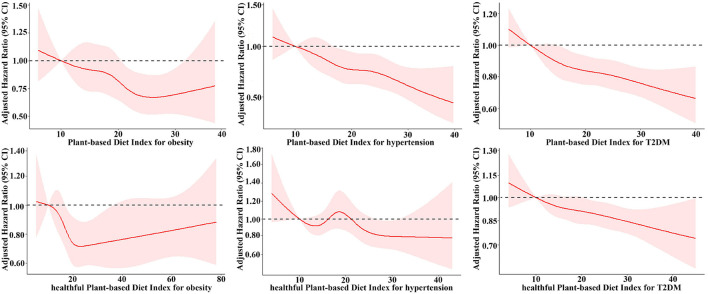
The data came from the China Nutrition and Health Survey. Overall, 11,580 adult participants were enrolled between 2004 and 2006 and followed up until 2009 or 2015 (follow-up rate: 73.4%). Dietary intake was assessed across three 24-h recalls, and two plant-based dietary indices [overall plant-based diet indice (PDI) and healthy plant-based diet indice (hPDI)] were calculated using China Food Composition Code and categorized into quintiles. The study's endpoints were overweight/obesity, hypertension, and T2D. The Hazard ratio (HR) and dose-response relationship were assessed using the Cox proportional risk model and restricted cubic splines. The areas under the curve of the receiver operating characteristic curve analyses were used to evaluate the predictive performance of the PDI and hPDI.
During the median follow-up period of more than 10 years, 1,270 (33.4%), 1,509 (31.6%), and 720 (11.5%) participants developed overweight / obesity, hypertension, and T2D, respectively. The higher PDI score was linked with a reduced risk of overweight/obesity [HR: 0.71 (95% CI: 0.55-0.93), -trend <0.001], hypertension [HR: 0.63 (95% CI: 0.51-0.79), -trend <0.001], and T2D [HR: 0.79 (95% CI: 0.72-0.87), -trend <0.001]. The hPDI score was inversely associated with overweight/obesity [HR: 0.79 (95% CI: 0.62-0.98), -trend = 0.02] and T2D [HR: 0.84 (95% CI: 0.75-0.93), -trend = 0.001]. In the aged <55-year-old group, subgroup analysis indicated a significant negative association between PDI/hPDI and overweight/obesity, hypertension, and T2D. There was no significant difference in the areas under the curve of the fully adjusted obesity, hypertension, and diabetes prediction models between PDI and hPDI.
The PDI and hPDI scores were very similar in application in Chinese populations, and our findings highlight that adherence to overall plant-based diet index helps to reduce the risk of T2D, obesity, and hypertension in Chinese adults who habitually consume plant-based foods, especially for those aged <55 year. Further understanding of how plant-based diet quality is associated with chronic disease will be needed in the future, which will help develop dietary strategies to prevent diabetes, hypertension, and related chronic diseases.
食用富含植物性食物的饮食与广泛的健康益处相关。使用基于植物性饮食的指数可以准确评估饮食质量,然而,没有足够的证据表明基于植物性饮食的指数与肥胖、高血压和2型糖尿病(T2D)有关,尤其是在传统上食用富含植物性食物的中国人群中。
数据来自中国营养与健康调查。总体而言,2004年至2006年期间招募了11580名成年参与者,并随访至2009年或2015年(随访率:73.4%)。通过三次24小时膳食回顾评估膳食摄入量,并使用中国食物成分编码计算两种基于植物性饮食的指数[总体植物性饮食指数(PDI)和健康植物性饮食指数(hPDI)],并分为五分位数。研究的终点是超重/肥胖、高血压和T2D。使用Cox比例风险模型和受限立方样条评估风险比(HR)和剂量反应关系。使用受试者工作特征曲线分析的曲线下面积来评估PDI和hPDI的预测性能。
在超过10年的中位随访期内,分别有1270名(33.4%)、1509名(31.6%)和720名(11.5%)参与者出现超重/肥胖、高血压和T2D。较高的PDI得分与超重/肥胖风险降低相关[HR:0.71(95%CI:0.55-0.93),-趋势<0.001]、高血压[HR:0.63(95%CI:0.51-0.79),-趋势<0.001]和T2D[HR:0.79(95%CI:0.72-0.87),-趋势<0.001]。hPDI得分与超重/肥胖[HR:0.79(95%CI:0.62-0.98),-趋势=0.02]和T2D[HR:0.84(95%CI:0.75-0.93),-趋势=0.001]呈负相关。在年龄<55岁的组中,亚组分析表明PDI/hPDI与超重/肥胖、高血压和T2D之间存在显著负相关。在完全调整的肥胖、高血压和糖尿病预测模型的曲线下面积方面,PDI和hPDI之间没有显著差异。
PDI和hPDI得分在中国人中的应用非常相似,我们的研究结果强调,坚持总体植物性饮食指数有助于降低习惯性食用植物性食物的中国成年人患T2D、肥胖和高血压的风险,尤其是对于年龄<55岁的人。未来需要进一步了解基于植物性饮食的质量与慢性病之间的关系,这将有助于制定预防糖尿病、高血压和相关慢性病的饮食策略。