Bhusal Khuma Kumari, Magar Saraddha Khasu, Thapa Ronika, Lamsal Ashish, Bhandari Sagar, Maharjan Rashmi, Shrestha Sami, Shrestha Jiban
Gokuleshwor Agriculture and Animal Science College, Tribhuvan University, Baitadi, Nepal.
Institute of Agriculture and Animal Science, Campus of Live Sciences, Dang, Nepal.
Heliyon. 2022 Jun 22;8(6):e09717. doi: 10.1016/j.heliyon.2022.e09717. eCollection 2022 Jun.
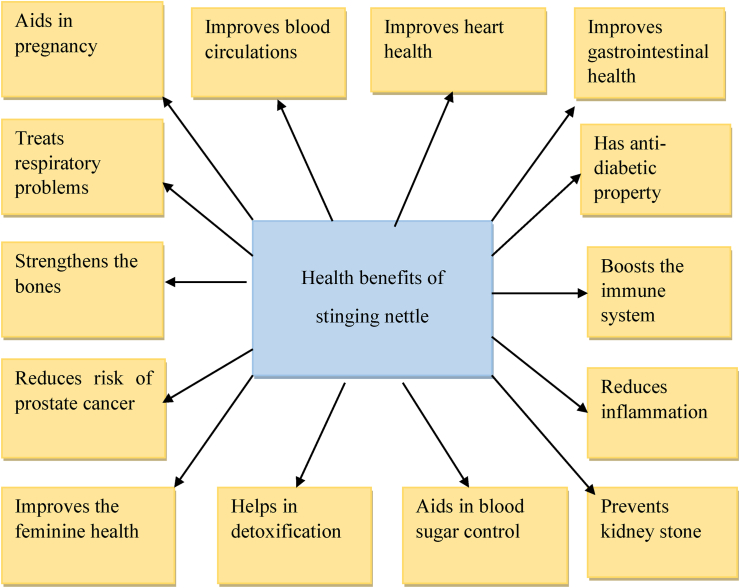
Stinging nettle ( L.) is a wild herbaceous perennial blooming plant that is commonly known as stinging nettle. It's a common, multi-purpose crop that's sometimes overlooked. Europe, Asia, North Africa, and North America are all home to stinging nettle. It is a plant that's edible and has nutritional and medicinal properties. Young leaves can be used to make curries, herb soups, and sour soups. The root of the stinging nettle is used to treat mictional difficulties associated with benign prostatic hyperplasia, while the leaves are used to treat arthritis, rheumatism, and allergic rhinitis. Its leaves are abundant in fiber, minerals, vitamins, and antioxidant compounds like polyphenols and carotenoids, as well as antioxidant compounds like polyphenols and carotenoids. Stinging nettle has antiproliferative, anti-inflammatory, antioxidant, analgesic, anti-infectious, hypotensive, and antiulcer characteristics, as well as the ability to prevent cardiovascular disease, in all parts of the plant (leaves, stems, roots, and seeds). Stinging nettle improves fish reproductive performance, making it a cost-effective aquaculture plant. Fertilizer and insecticides can be made from the plants. This review examines the nutritional and pharmacological aspects of stinging nettle, as well as its possible health advantages. Scientists, farmers, and academicians interested in stinging nettle collecting, cultivation, research, and development would find this review useful.
荨麻(L.)是一种野生多年生草本开花植物,通常被称为荨麻。它是一种常见的多用途作物,有时会被忽视。欧洲、亚洲、北非和北美都是荨麻的生长地。它是一种可食用的植物,具有营养和药用特性。嫩叶可用于制作咖喱、草药汤和酸汤。荨麻的根用于治疗与良性前列腺增生相关的排尿困难,而叶子则用于治疗关节炎、风湿病和过敏性鼻炎。它的叶子富含纤维、矿物质、维生素以及多酚和类胡萝卜素等抗氧化化合物。荨麻的所有部分(叶子、茎、根和种子)都具有抗增殖、抗炎、抗氧化、止痛、抗感染、降血压和抗溃疡特性,以及预防心血管疾病的能力。荨麻可提高鱼类繁殖性能,使其成为一种经济高效的水产养殖植物。这种植物还可用于制作肥料和杀虫剂。本综述探讨了荨麻的营养和药理学方面,以及其可能的健康益处。对荨麻采集、种植、研究和开发感兴趣的科学家、农民和学者会发现本综述很有用。