Center of Reproductive Medicine, Shanghai Key Laboratory of Embryo Original Diseases, International Peace Maternity and Child Health Hospital, School of Medicine, Shanghai Jiao Tong University, Shanghai, China.
Department of Obstetrics and Gynecology, PLA Rocket Force Characteristic Medical Center, Beijing, China.
Front Public Health. 2022 Jun 21;10:903183. doi: 10.3389/fpubh.2022.903183. eCollection 2022.
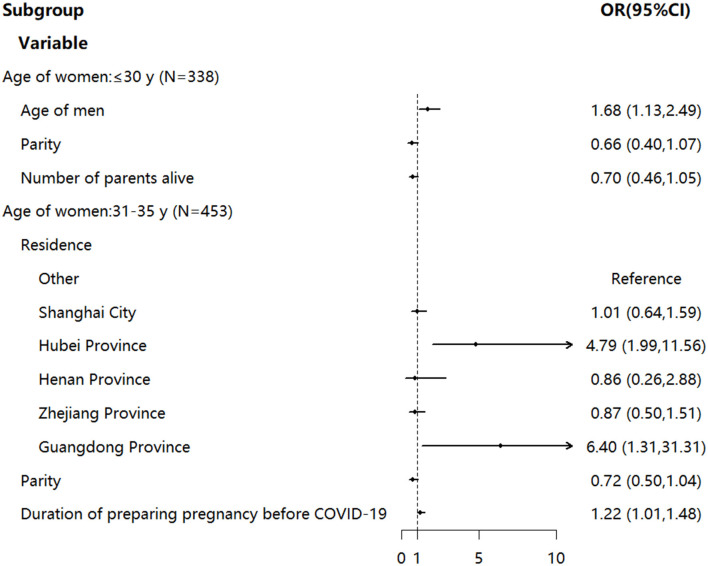
A decline in the fertility rate has been observed worldwide, which hampers social development severely. Given the impacts of COVID-19 on individuals and society, it is of great significance to investigate the fertility intention of reproductive couples under COVID-19. The convenience sampling method was used to obtain our study sample. The self-administered questionnaire included the following components: sociodemographic characteristics (age, residence, education, occupation, characteristics of the couples, and annual household income), reproductive history (parity, number of children, child gender, and duration of preparing pregnancy), and attitudes toward COVID-19, was distributed online an applet of WeChat. The results showed that among 4,133 valid questionnaires, 1,091 had fertility intention before COVID-19, whereas 3,042 did not, indicating a fertility intention rate of 26.4% among participating couples. Of the 1,091 couples who had fertility intention before COVID-19, 520 (47.7%) were affected by the outbreak, whereas 571 (52.3%) were not. By multivariable logistic regression analysis, we further found that couples living in Hubei Province, the epicenter in China (OR 2.20, 95% CI 1.35-3.60), and couples who prepared for pregnancy longer before COVID-19 (OR 1.19, 95% CI 1.06-1.33) were more likely to change their fertility intention under the pandemic. In addition, most of the participants reported their fertility intention was affected by the inconvenience of seeking medical service under COVID-19. Therefore, more forms of medical services to provide convenience for patients might be effective ways to reverse the declined fertility intention rate in facing COVID-19.
全球范围内生育率呈下降趋势,这严重阻碍了社会发展。鉴于 COVID-19 对个人和社会的影响,研究 COVID-19 下生殖夫妇的生育意愿具有重要意义。本研究采用便利抽样法获取研究样本。自填式问卷包括以下内容:社会人口学特征(年龄、居住地、教育程度、职业、夫妇特征和家庭年收入)、生育史(胎次、子女数量、子女性别和备孕时间)和对 COVID-19 的态度,通过微信小程序在线发放。结果显示,在 4133 份有效问卷中,1091 人在 COVID-19 前有生育意愿,3042 人没有,表明参与夫妇的生育意愿率为 26.4%。在 1091 对有生育意愿的夫妇中,520 对(47.7%)受到疫情影响,而 571 对(52.3%)没有。通过多变量逻辑回归分析,我们进一步发现,居住在中国湖北省(疫情中心)的夫妇(OR 2.20,95%CI 1.35-3.60)和在 COVID-19 前准备怀孕时间更长的夫妇(OR 1.19,95%CI 1.06-1.33)更有可能在大流行期间改变生育意愿。此外,大多数参与者报告说,他们的生育意愿受到 COVID-19 下就医不便的影响。因此,提供更多形式的医疗服务为患者提供便利可能是面对 COVID-19 时扭转生育意愿率下降的有效途径。