Chen Wanyue, Yang Yichu, Fu Ke, Zhang Dewei, Wang Zhang
College of Pharmacy, Chengdu University of Traditional Chinese Medicine, Chengdu, China.
State Key Laboratory of Southwestern Chinese Medicine Resources, Chengdu University of Traditional Chinese Medicine, Chengdu, China.
Front Pharmacol. 2022 Jun 28;13:891273. doi: 10.3389/fphar.2022.891273. eCollection 2022.
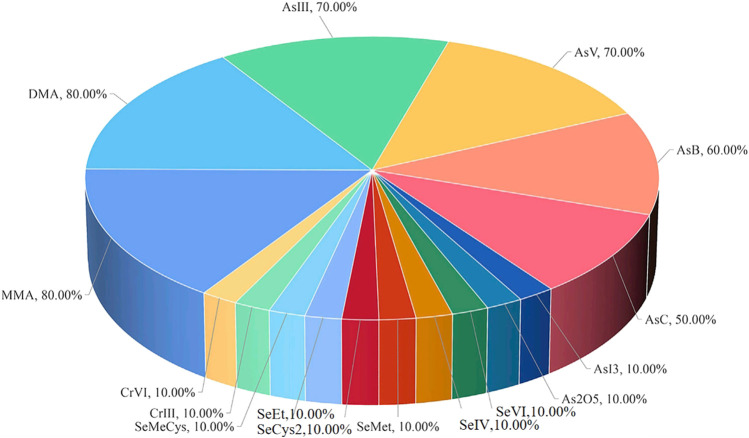
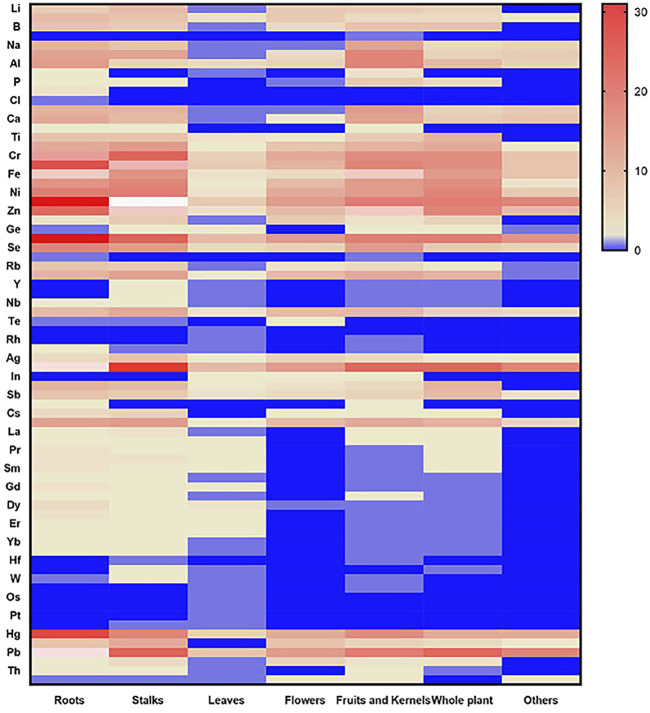
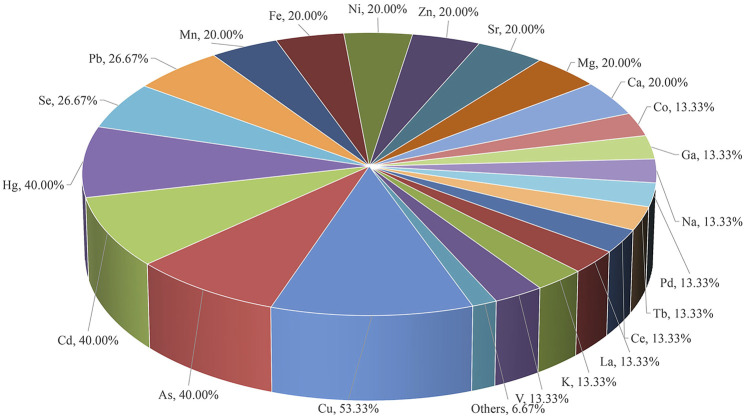
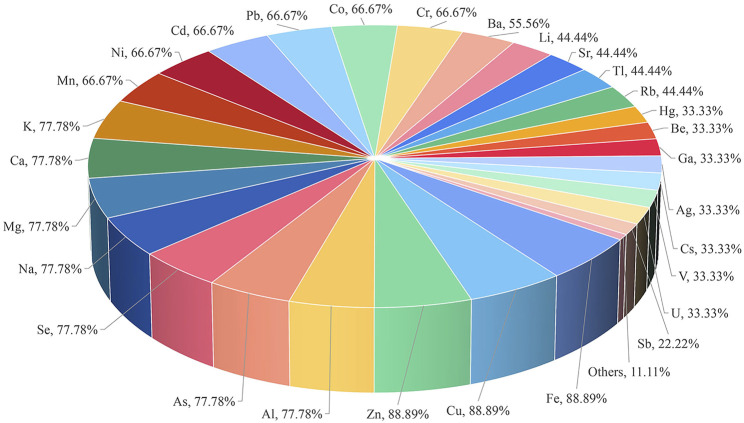
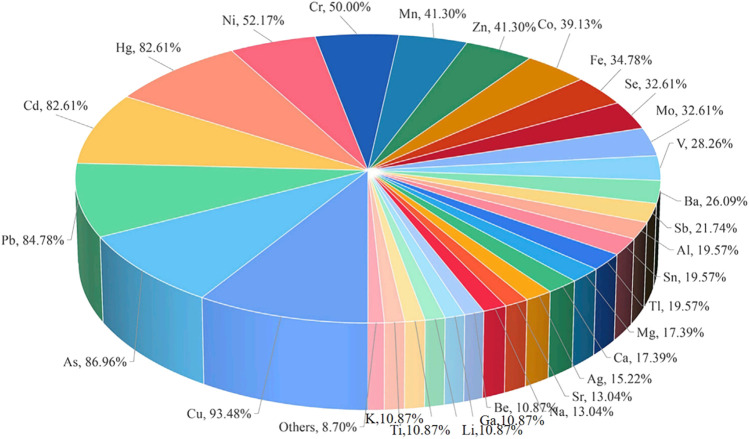
This study systematically reviewed the application of ICP-MS and its combined technology in the determination of mineral and heavy metal elements in medicinal materials derived from plants, animals, minerals and their preparations (Chinese patent medicine), and biological products. It provides a reference for improving the quality standard of traditional medicine and exploring the effective components, toxic components, and action mechanism of traditional medicine. A total of 234 articles related to the determination of mineral and heavy metal elements in medicinal materials derived from plants, animals, and minerals and their preparations (Chinese patent medicine) were collected from PubMed, CNKI, Web of Science, VIP, and other databases. They were classified and sorted by the inductively coupled plasma-mass-spectrometry (ICP-MS) method. Of the 234 articles, 154 were about medicinal materials derived from plants, 15 about medicinal materials derived from animals, 9 about medicinal materials derived from minerals, 46 about Chinese patent medicine, 10 about combined technology application, and 3 about drugs being tested after entering the body. From the 154 articles on medicinal materials derived from plants, 76 elements, including Cu, Cd, Pb, As, Cr, Mn, and Hg, were determined, of which the determination of Cu was the most, with 129 articles. Medicinal materials derived from the roots, stems, leaves, flowers, and fruits and seeds of plants accounted for 25.97%, 18.18%, 7.14%, 7.79%, and 14.94%, respectively. Moreover, medicinal materials derived from the whole plants accounted for 14.94%, and other medicinal materials derived from plants and soil accounted for 11.04%. A total of 137 of the tested medicinal materials were from traditional Chinese medicine, accounting for 88.96%, 12 were from Arabic medicine (including Unani), accounting for 7.79%, 2 were from Tibetan medicine of China, and 1 was from Mongolian medicine of China, 1 was from Miao medicine of China, and 1 was from Zhuang medicine of China. In the 15 articles on medicinal materials derived from animals, 49 elements such as Cu, As, Cd, Hg, Se, Pb, and Mn were determined, of which Cu was the most. All the tested medicinal materials belong to traditional Chinese medicine. From the nine articles on medicinal materials derived from minerals, 70 elements such as Fe, Cu, Zn, Al, As, Se, and Na were determined, of which Fe, Cu, and Zn were the most. The tested medicinal materials all belong to traditional Chinese medicine. From the 46 articles on Chinese patent medicine, 62 elements such as Cu, As, Pb, Cd, Hg, Ni, and Cr were determined, of which Cu was the most. Regarding the tested Chinese patent medicine, 38 articles belong to traditional Chinese medicine, 6 to Tibetan medicine, and 2 to Mongolian medicine of China. Three articles determine the content of metal elements in biological samples such as animal hepatic venous blood, abdominal aortic blood, brain, liver, kidney, urine, and feces, and one article determines the content of metal elements in human lung and serum. From the 10 articles combined with liquid chromatography and gas chromatography, 16 elements such as MMA, DMA, AsIII, AsV, AsB, AsC, and AsI were determined, of which MMA and DMA were the most. It can realize elemental morphology and isotope analysis. The tested medicinal materials and Chinese patent medicine belong to traditional Chinese medicine. ICP-MS was applied the most in traditional Chinese medicine, followed by Arabic medicine. ICP-MS was used to determine more medicinal materials derived from plants, and Cu was determined the most. The characteristic inorganic element spectrum of medicinal materials can also be established. ICP-MS and its combined technology are widely used in Chinese patent medicine, but the test of biological samples is the least. The information provided in this article can provide a reference for improving the quality standard of traditional medicines and exploring the active ingredients and toxic ingredients and their mechanism of action.
本研究系统综述了电感耦合等离子体质谱(ICP-MS)及其联用技术在植物、动物、矿物来源的药材及其制剂(中成药)和生物制品中矿物及重金属元素测定中的应用。为提高传统医药质量标准,探索传统医药有效成分、毒性成分及作用机制提供参考。从PubMed、CNKI、Web of Science、维普等数据库收集了234篇有关植物、动物、矿物来源的药材及其制剂(中成药)中矿物及重金属元素测定的文章。按照电感耦合等离子体质谱(ICP-MS)法进行分类整理。这234篇文章中,154篇关于植物来源药材,15篇关于动物来源药材,9篇关于矿物来源药材,46篇关于中成药,10篇关于联用技术应用,3篇关于药物进入体内后的检测。在154篇关于植物来源药材的文章中,测定了包括铜(Cu)、镉(Cd)、铅(Pb)、砷(As)、铬(Cr)、锰(Mn)、汞(Hg)等76种元素,其中铜的测定最多,有129篇文章。植物根、茎、叶、花、果实及种子来源的药材分别占25.97%、18.18%、7.14%、7.79%、14.94%。此外,全草类药材占14.94%,其他植物及土壤来源药材占11.04%。所测药材中137种来自中药,占88.96%,12种来自阿拉伯医学(包括尤那尼医学),占7.79%,2种来自中国藏药,1种来自中国蒙药,1种来自中国苗药,1种来自中国壮药。在15篇关于动物来源药材的文章中,测定了铜、砷、镉、汞、硒、铅、锰等49种元素,其中铜的测定最多。所测药材均属于中药。在9篇关于矿物来源药材的文章中,测定了铁(Fe)、铜、锌(Zn)、铝(Al)、砷、硒、钠(Na)等70种元素,其中铁、铜、锌的测定最多。所测药材均属于中药。在46篇关于中成药的文章中,测定了铜、砷、铅、镉、汞、镍、铬等62种元素,其中铜的测定最多。所测中成药中,38篇属于中药,6篇属于藏药,2篇属于中国蒙药。3篇文章测定了动物肝静脉血、腹主动脉血、脑、肝、肾、尿液、粪便等生物样品中金属元素含量,1篇文章测定了人肺及血清中金属元素含量。在10篇液相色谱和气相色谱联用文章中,测定了一甲基砷(MMA)、二甲基砷(DMA)、亚砷酸(AsIII)、砷酸(AsV)、砷甜菜碱(AsB)、砷胆碱(AsC)、砷离子(AsI)等16种元素,其中MMA和DMA的测定最多。可实现元素形态及同位素分析。所测药材及中成药均属于中药。ICP-MS在中药中的应用最多,其次是阿拉伯医学。ICP-MS用于测定植物来源药材较多,其中铜的测定最多。还可建立药材特征无机元素谱。ICP-MS及其联用技术在中成药中应用广泛,但生物样品检测最少。本文提供的信息可为提高传统医药质量标准,探索活性成分、毒性成分及其作用机制提供参考。