Madaan Sparsh, Talwar Dhruv, Jaiswal Arpita, Kumar Sunil, Acharya Neema, Acharya Sourya, Dewani Deepika
Department of Obstetrics and Gynaecology, Jawaharlal Nehru Medical College, Datta Meghe Institute of Medical Sciences (Deemed to be University), Wardha, Maharashtra, India.
Department of Medicine, Jawaharlal Nehru Medical College, Datta Meghe Institute of Medical Sciences (Deemed to be University), Wardha, Maharashtra, India.
J Educ Health Promot. 2022 Jun 11;11:170. doi: 10.4103/jehp.jehp_1200_21. eCollection 2022.
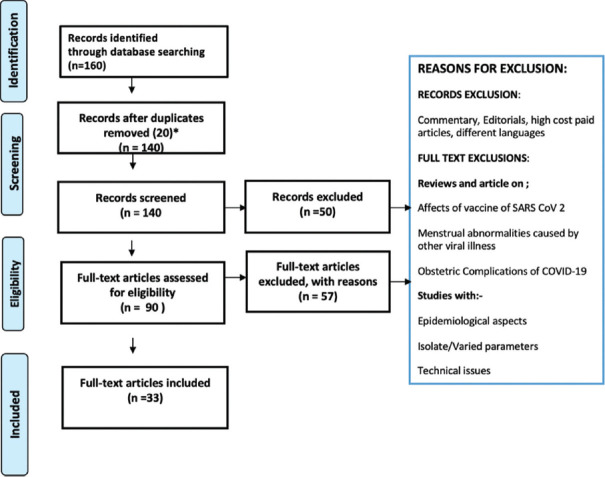
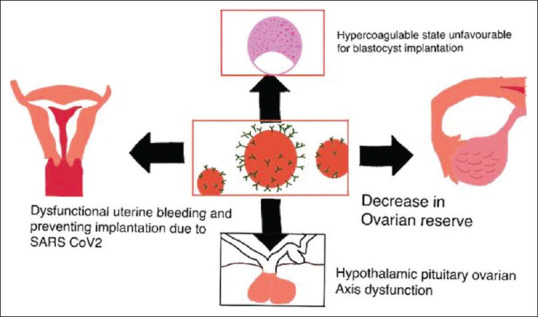
While battling the life-threatening complications of COVID-19, its effect on the menstrual cycle and infertility has been somewhat ignored. This brief review aims on highlighting the importance of menstrual abnormalities being experienced during the post-COVID period and to make the clinicians aware about what to expect in regard of menstrual abnormalities by learning from various studies that have been conducted worldwide. This review article was written with systematic literature review with the help of data search machine such as PubMed, Scopus, Web of Sciences, and Google Scholar. A search strategy leads to the extraction of 160 related articles that after the removal of inappropriate and duplicate articles, 33 articles were selected for the review. To find other potentially relevant articles, the references of the extracted articles were thoroughly examined. The search was carried out using keywords including "COVID-19," "Menstrual abnormalities," and "Infertility." Using OR and AND, the keywords mentioned above were combined and then utilized in the search box of the databases. Articles published from January 2020 to September 2021 were included in this study. It includes worldwide data ranging from studies done in China, India, Ireland, Turkey, Jordan, and Germany. During the post-COVID period, there is a significant alteration in the sex hormones of females infected by COVID-19 which may manifest as menstrual cycle abnormalities such as decreased cycle length or prolonged menstrual cycle bleeding. It may also manifest as infertility due to ovarian failure due to suppression of ovarian function COVID-19 a novel coronavirus which is presently a pandemic has affected the world in manner reminding the world of 1918 Spanish flu. However, while battling the deadly pandemic, the clinicians should also be aware of the repercussions of the effect this infection has on multiple organs such as ovarian suppression leading to infertility, oligomenorrhea, or menorrhagia.
在对抗新冠病毒肺炎危及生命的并发症时,其对月经周期和不孕不育的影响在一定程度上被忽视了。这篇简短的综述旨在强调新冠康复期出现月经异常的重要性,并通过借鉴全球开展的各类研究,让临床医生了解月经异常的情况。这篇综述文章是借助数据搜索工具(如PubMed、Scopus、科学网和谷歌学术)进行系统文献综述后撰写而成的。一种搜索策略得出了160篇相关文章,在剔除不合适和重复的文章后,挑选了33篇文章进行综述。为了找到其他潜在相关文章,对提取文章的参考文献进行了全面审查。搜索使用的关键词包括“新冠病毒肺炎”“月经异常”和“不孕不育”。使用“或”和“与”将上述关键词组合起来,然后在数据库的搜索框中使用。本研究纳入了2020年1月至2021年9月发表的文章。它涵盖了来自中国、印度、爱尔兰、土耳其、约旦和德国等地的全球数据。在新冠康复期,感染新冠病毒肺炎的女性性激素会发生显著变化,这可能表现为月经周期异常,如周期长度缩短或经期延长。它也可能表现为由于新冠病毒肺炎抑制卵巢功能导致卵巢衰竭而引起的不孕不育。新冠病毒这种新型冠状病毒目前正在全球大流行,其影响方式让人想起1918年的西班牙流感。然而,在对抗这场致命的大流行时,临床医生也应该意识到这种感染对多个器官的影响所带来的后果,比如卵巢抑制导致不孕不育、月经过少或月经过多。