Laboratory of Human Pathologies Biology, Faculty of Sciences, Mohammed V University in Rabat, Morocco.
National Influenza Center, Virology department, National Institute of Hygiene, Ministry of Health, Morocco.
J Glob Health. 2022 Jul 23;12:04062. doi: 10.7189/jogh.12.04062.
There is a scarcity of information on the viral aetiology of influenza-like illness (ILI) and severe acute respiratory infection (SARI) among patients in Morocco.
From September 2014 to December 2016, we prospectively enrolled inpatients and outpatients from all age groups meeting the World Health Organization (WHO) case definition for ILI and SARI from 59 sentinel sites. The specimens were tested using real-time monoplex reverse-transcription polymerase chain reaction method for detecting 16 relevant respiratory viruses.
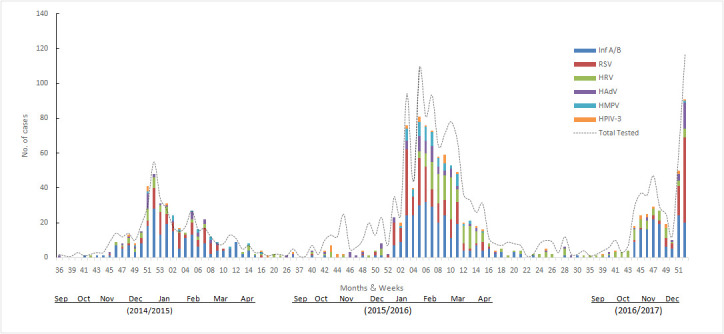
At least one respiratory virus was detected in 1423 (70.8%) of 2009 specimens. Influenza viruses were the most common, detected in 612 (30.4%) of processed samples, followed by respiratory syncytial virus (RSV) in 359 (17.9%), human rhinovirus (HRV) in 263 (13.1%), adenovirus (HAdV) in 124 (6.2%), parainfluenza viruses (HPIV) in 107 (5.3%), coronaviruses (HCoV) in 94 (4.7%), human bocavirus (HBoV) in 92 (4.6%), and human metapneumovirus (HMPV) in 74 (3.7%). From 770 samples from children under 5 years old, RSV (288, 36.6%), influenza viruses (106, 13.8%), HRV (96, 12.5%) and HAdV (91, 11.8%) were most prevalent. Among 955 samples from adults, Influenza viruses (506, 53.0%), and HRV (167, 17.5%) were most often detected. Co-infections were found in 268 (18.8%) of 1423 positive specimens, and most (60.4%) were in children under 5 years of age. While influenza viruses, RSV, and HMPV had a defined period of circulation, the other viruses did not display clear seasonal patterns.
We found that RSV was predominant among SARI cases in Morocco, particularly in children under 5 years of age. Our results are in line with reported data from other parts of the world, stating that RSV is the leading cause of lower respiratory tract infections in infants and young children.
摩洛哥缺乏关于流感样疾病(ILI)和严重急性呼吸道感染(SARI)患者病毒病因的信息。
从 2014 年 9 月至 2016 年 12 月,我们从 59 个哨点前瞻性纳入符合世界卫生组织(WHO)ILI 和 SARI 病例定义的所有年龄段的住院和门诊患者。使用实时单重逆转录聚合酶链反应方法检测 16 种相关呼吸道病毒。
在 2009 份标本中,至少有 1 种呼吸道病毒在 1423 份(70.8%)标本中被检出。流感病毒最为常见,在 612 份处理样本中检出(30.4%),其次是呼吸道合胞病毒(RSV)在 359 份(17.9%),人鼻病毒(HRV)在 263 份(13.1%),腺病毒(HAdV)在 124 份(6.2%),副流感病毒(HPIV)在 107 份(5.3%),冠状病毒(HCoV)在 94 份(4.7%),人博卡病毒(HBoV)在 92 份(4.6%),人偏肺病毒(HMPV)在 74 份(3.7%)。在 770 份来自 5 岁以下儿童的样本中,RSV(288,36.6%)、流感病毒(106,13.8%)、HRV(96,12.5%)和 HAdV(91,11.8%)最为常见。在 955 份成人样本中,流感病毒(506,53.0%)和 HRV(167,17.5%)最常被检出。在 1423 份阳性标本中发现了 268 份(18.8%)合并感染,其中大多数(60.4%)发生在 5 岁以下儿童中。虽然流感病毒、RSV 和 HMPV 有明确的流行期,但其他病毒没有明显的季节性模式。
我们发现 RSV 是摩洛哥 SARI 病例的主要病原体,尤其是 5 岁以下儿童。我们的结果与来自世界其他地区的报告数据一致,表明 RSV 是婴儿和幼儿下呼吸道感染的主要原因。