Calvo-Lerma Joaquim, Selma-Royo Marta, Hervas David, Yang Baoru, Intonen Linda, González Sonia, Martínez-Costa Cecilia, Linderborg Kaisa M, Collado Maria Carmen
Institute of Agrochemistry and Food Technology (IATA-CSIC), Valencia, Spain.
Department of Applied Statistics and Operations Research, and Quality, Universitat Politècnica de València, Valencia, Spain.
Front Nutr. 2022 Jul 6;9:854786. doi: 10.3389/fnut.2022.854786. eCollection 2022.
The fatty acid (FA) composition of breast milk is a relevant aspect related to the development of the lactating infant. The present study aimed at exploring correlations between dietary intake of macro- and micronutrients with the FA profile in breast milk, and the possible implication for infants' growth.
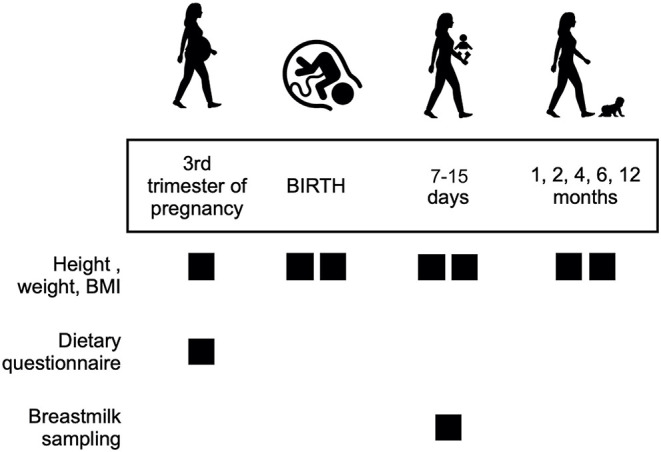
Breast milk samples from a cohort of lactating women were collected 7-15 days postpartum. The FA profiles in triacylglycerol (TAG) and phospholipid (PL)-rich fractions were analyzed by gas chromatography. Diet was registered during the third trimester of pregnancy by means of a food frequency questionnaire (FFQ). In addition, anthropometric measurements of infants were collected from gestation and up to 12 months postpartum.
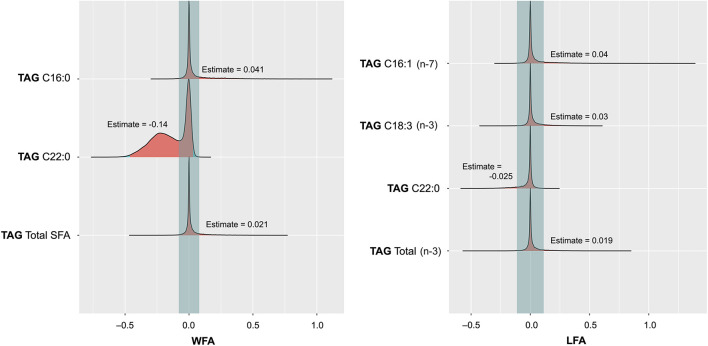
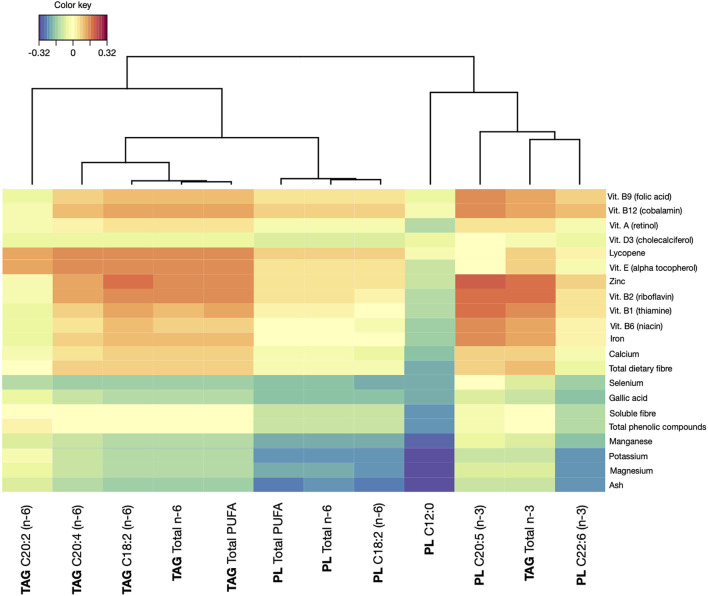
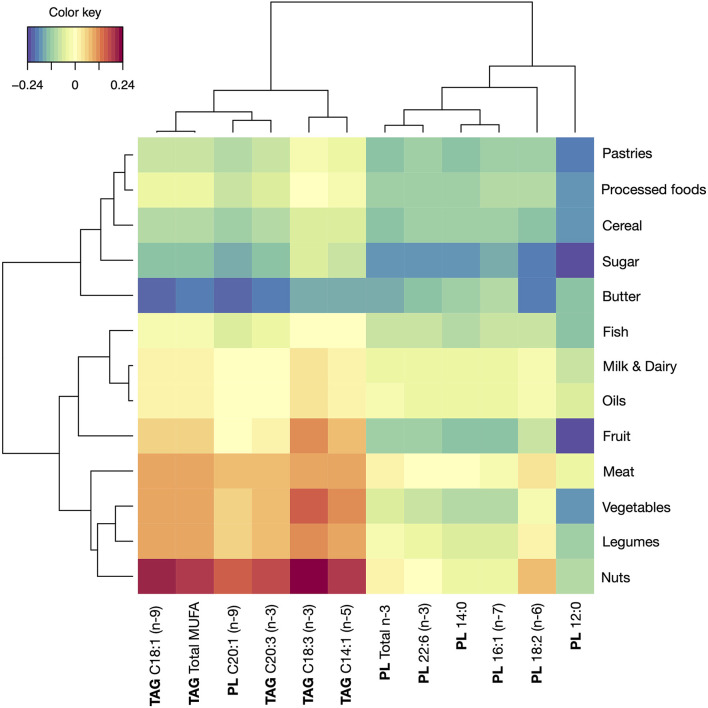
The FA profile in breast milk was characterized by a median of 37.4, 41.3 and 16.8% of saturated, monounsaturated, and polyunsaturated FAs, respectively. From the dietary components, zinc, iron, and B group vitamins were correlated positively with the proportion of total n-3 FAs in TAG and C20:5 n-3 in PL. Lycopene, vitamin E, zinc, and vitamin B2 showed a similar correlation with total polyunsaturated fatty acid (PUFA), total n-6 FAs, C20:4 n-6, and C18:2 n-6 in TAG. Regarding food groups, nuts showed the strongest association with several PUFA both in TAG and PL, while the vegetable group was also positively associated with C18:3 n-3. Furthermore, the concentration of linolenic acid (C18:3 n-3) and palmitic acid (C16:0) were positively associated with increased length for age (LFA) and weight for age (WFA) at 12 months compared with birth [ΔLFA -0.16 (-0.85, 0.37); ΔWFA -0.26 (-0.77, 0.21)].
Mothers' intake of nuts, dietary sources of zinc, iron, and B group vitamins were identified as potential predictors of a high-unsaturated FA profile in breast milk. In addition, linolenic and palmitic acids in breast milk were positively associated with infants' growth in the first year of life.
母乳中的脂肪酸(FA)组成是与哺乳期婴儿发育相关的一个重要方面。本研究旨在探讨常量营养素和微量营养素的膳食摄入量与母乳中FA谱之间的相关性,以及对婴儿生长的可能影响。
收集一组哺乳期妇女产后7 - 15天的母乳样本。通过气相色谱法分析三酰甘油(TAG)和富含磷脂(PL)部分的FA谱。在妊娠晚期通过食物频率问卷(FFQ)记录饮食情况。此外,收集婴儿从妊娠到产后12个月的人体测量数据。
母乳中的FA谱特征为饱和脂肪酸、单不饱和脂肪酸和多不饱和脂肪酸的中位数分别为37.4%、41.3%和16.8%。在膳食成分中,锌、铁和B族维生素与TAG中总n - 3脂肪酸的比例以及PL中C20:5 n - 3呈正相关。番茄红素、维生素E、锌和维生素B2与TAG中的总多不饱和脂肪酸(PUFA)、总n - 6脂肪酸、C20:4 n - 6和C18:2 n - 6呈相似的相关性。关于食物类别,坚果与TAG和PL中的几种PUFA关联最强,而蔬菜组也与C18:3 n - 3呈正相关。此外,与出生时相比,12个月时亚麻酸(C18:3 n - 3)和棕榈酸(C16:0)的浓度与年龄别身长(LFA)和年龄别体重(WFA)增加呈正相关[ΔLFA -0.16(-0.85, 0.37);ΔWFA -0.26(-0.77, 0.21)]。
母亲摄入坚果、锌、铁和B族维生素的膳食来源被确定为母乳中高不饱和FA谱的潜在预测因素。此外,母乳中的亚麻酸和棕榈酸与婴儿出生后第一年的生长呈正相关。