de Ruiter Marleen C, van Loon Anne F
Institute for Environmental Studies (IVM), Vrije Universiteit Amsterdam, Amsterdam, the Netherlands.
iScience. 2022 Jul 4;25(8):104720. doi: 10.1016/j.isci.2022.104720. eCollection 2022 Aug 19.
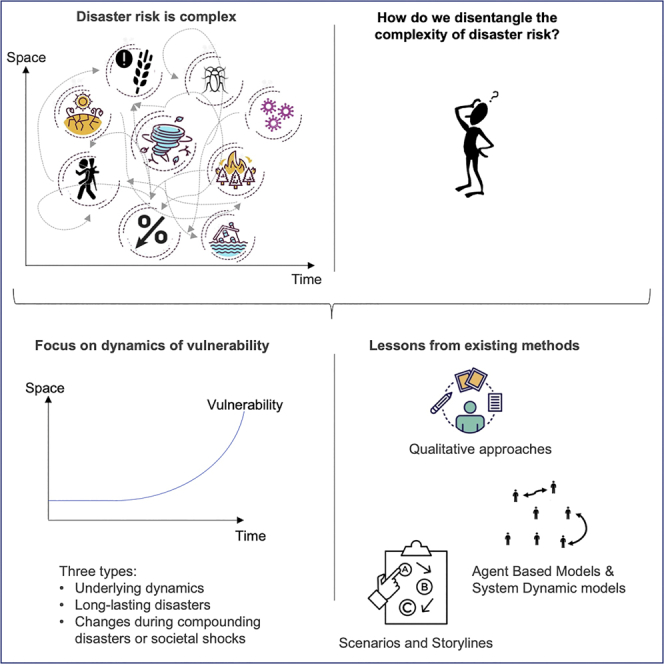
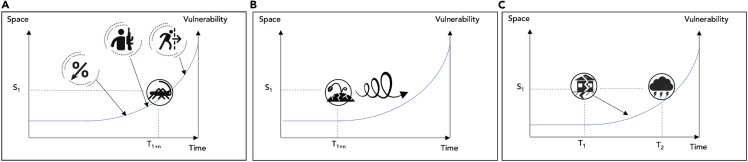
Recent disasters have demonstrated the challenges faced by society as a result of the increasing complexity of disaster risk. In this perspective article, we discuss the complex interactions between hazards and vulnerability and suggest methodological approaches to assess and include dynamics of vulnerability in our risk assessments, learning from the compound and multi-hazard, socio-hydrology, and socio-ecological research communities. We argue for a changed perspective, starting with the circumstances that determine dynamic vulnerability. We identify three types of dynamics of vulnerability: (1) the underlying dynamics of vulnerability, (2) changes in vulnerability during long-lasting disasters, and (3) changes in vulnerability during compounding disasters and societal shocks. We conclude that there is great potential to capture the dynamics of vulnerability using qualitative and model-based methods, both for reproducing historic and projecting future dynamics of vulnerability. We provide examples using narratives, agent-based models, and system dynamics.
近期的灾害表明,由于灾害风险日益复杂,社会面临着诸多挑战。在这篇观点文章中,我们讨论了灾害与脆弱性之间的复杂相互作用,并借鉴复合灾害与多灾害、社会水文学以及社会生态学研究领域的经验,提出了评估脆弱性动态并将其纳入风险评估的方法。我们主张转变视角,从决定动态脆弱性的环境入手。我们确定了三种脆弱性动态类型:(1)脆弱性的潜在动态;(2)长期灾害期间脆弱性的变化;(3)复合灾害和社会冲击期间脆弱性的变化。我们得出结论,利用定性方法和基于模型的方法来捕捉脆弱性动态具有巨大潜力,这两种方法都可用于再现历史上的脆弱性动态并预测未来的脆弱性动态。我们提供了基于叙事、主体模型和系统动力学的示例。