• 文献检索
  • 文档翻译
  • 深度研究
  • 学术资讯
  • Suppr Zotero 插件Zotero 插件
  • 邀请有礼
  • 套餐&价格
  • 历史记录
应用&插件
Suppr Zotero 插件Zotero 插件浏览器插件Mac 客户端Windows 客户端微信小程序
定价
高级版会员购买积分包购买API积分包
服务
文献检索文档翻译深度研究API 文档MCP 服务
关于我们
关于 Suppr公司介绍联系我们用户协议隐私条款
关注我们

Suppr 超能文献

核心技术专利:CN118964589B侵权必究
粤ICP备2023148730 号-1Suppr @ 2026

文献检索

告别复杂PubMed语法,用中文像聊天一样搜索,搜遍4000万医学文献。AI智能推荐,让科研检索更轻松。

立即免费搜索

文件翻译

保留排版,准确专业,支持PDF/Word/PPT等文件格式,支持 12+语言互译。

免费翻译文档

深度研究

AI帮你快速写综述,25分钟生成高质量综述,智能提取关键信息,辅助科研写作。

立即免费体验

基于机器学习的 3D 打印微针特征预测。

Machine Learning-Enabled Prediction of 3D-Printed Microneedle Features.

机构信息

Graduate School of Sciences & Engineering, Koç University, Istanbul 34450, Turkey.

Boğaziçi Institute of Biomedical Engineering, Boğaziçi University, Istanbul 34684, Turkey.

出版信息

Biosensors (Basel). 2022 Jul 6;12(7):491. doi: 10.3390/bios12070491.

DOI:10.3390/bios12070491
PMID:35884294
原文链接:https://pmc.ncbi.nlm.nih.gov/articles/PMC9313436/
Abstract

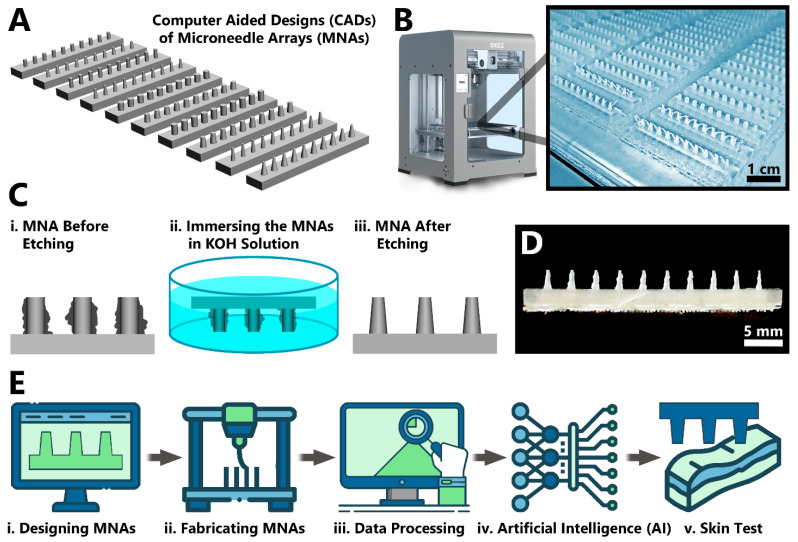
Microneedles (MNs) introduced a novel injection alternative to conventional needles, offering a decreased administration pain and phobia along with more efficient transdermal and intradermal drug delivery/sample collecting. 3D printing methods have emerged in the field of MNs for their time- and cost-efficient manufacturing. Tuning 3D printing parameters with artificial intelligence (AI), including machine learning (ML) and deep learning (DL), is an emerging multidisciplinary field for optimization of manufacturing biomedical devices. Herein, we presented an AI framework to assess and predict 3D-printed MN features. Biodegradable MNs were fabricated using fused deposition modeling (FDM) 3D printing technology followed by chemical etching to enhance their geometrical precision. DL was used for quality control and anomaly detection in the fabricated MNAs. Ten different MN designs and various etching exposure doses were used create a data library to train ML models for extraction of similarity metrics in order to predict new fabrication outcomes when the mentioned parameters were adjusted. The integration of AI-enabled prediction with 3D printed MNs will facilitate the development of new healthcare systems and advancement of MNs' biomedical applications.

摘要

微针 (MNs) 作为一种新型注射方法,替代了传统的针具,具有降低给药疼痛和恐惧的优点,同时能够更有效地进行经皮和皮内药物输送/样本采集。3D 打印技术在 MNs 领域得到了广泛应用,因为它可以节省时间和成本。通过人工智能(AI),包括机器学习(ML)和深度学习(DL),对 3D 打印参数进行调整,是优化制造生物医学设备的新兴多学科领域。本文提出了一种人工智能框架,用于评估和预测 3D 打印 MN 的特征。采用熔融沉积建模 (FDM) 3D 打印技术制造可生物降解的 MNs,然后进行化学蚀刻,以提高其几何精度。DL 用于制造的 MNAs 的质量控制和异常检测。使用十种不同的 MN 设计和不同的蚀刻暴露剂量来创建一个数据库,以训练 ML 模型来提取相似性度量,以便在调整上述参数时预测新的制造结果。将 AI 预测与 3D 打印 MN 相结合,将有助于开发新的医疗保健系统和推进 MN 的生物医学应用。
https://cdn.ncbi.nlm.nih.gov/pmc/blobs/0327/9313436/09e83c6c3b6b/biosensors-12-00491-g005.jpg
https://cdn.ncbi.nlm.nih.gov/pmc/blobs/0327/9313436/c701a808aa82/biosensors-12-00491-g001.jpg
https://cdn.ncbi.nlm.nih.gov/pmc/blobs/0327/9313436/47535e926fa2/biosensors-12-00491-g002.jpg
https://cdn.ncbi.nlm.nih.gov/pmc/blobs/0327/9313436/d0a3f719a78a/biosensors-12-00491-g003.jpg
https://cdn.ncbi.nlm.nih.gov/pmc/blobs/0327/9313436/5d8027a22acd/biosensors-12-00491-g004.jpg
https://cdn.ncbi.nlm.nih.gov/pmc/blobs/0327/9313436/09e83c6c3b6b/biosensors-12-00491-g005.jpg
https://cdn.ncbi.nlm.nih.gov/pmc/blobs/0327/9313436/c701a808aa82/biosensors-12-00491-g001.jpg
https://cdn.ncbi.nlm.nih.gov/pmc/blobs/0327/9313436/47535e926fa2/biosensors-12-00491-g002.jpg
https://cdn.ncbi.nlm.nih.gov/pmc/blobs/0327/9313436/d0a3f719a78a/biosensors-12-00491-g003.jpg
https://cdn.ncbi.nlm.nih.gov/pmc/blobs/0327/9313436/5d8027a22acd/biosensors-12-00491-g004.jpg
https://cdn.ncbi.nlm.nih.gov/pmc/blobs/0327/9313436/09e83c6c3b6b/biosensors-12-00491-g005.jpg

相似文献

1
Machine Learning-Enabled Prediction of 3D-Printed Microneedle Features.基于机器学习的 3D 打印微针特征预测。
Biosensors (Basel). 2022 Jul 6;12(7):491. doi: 10.3390/bios12070491.
2
Advancements in microneedle fabrication techniques: artificial intelligence assisted 3D-printing technology.微针制造技术的进展:人工智能辅助 3D 打印技术。
Drug Deliv Transl Res. 2024 Jun;14(6):1458-1479. doi: 10.1007/s13346-023-01510-9. Epub 2024 Jan 13.
3
The Role of 3D Printing Technology in Microengineering of Microneedles.3D 打印技术在微针微工程中的作用。
Small. 2022 May;18(18):e2106392. doi: 10.1002/smll.202106392. Epub 2022 Mar 31.
4
Optimization of the fused deposition modeling-based fabrication process for polylactic acid microneedles.基于熔融沉积成型的聚乳酸微针制造工艺优化
Microsyst Nanoeng. 2021 Aug 2;7:58. doi: 10.1038/s41378-021-00284-9. eCollection 2021.
5
Biodegradable 3D printed polymer microneedles for transdermal drug delivery.可生物降解的 3D 打印聚合物微针用于透皮药物输送。
Lab Chip. 2018 Apr 17;18(8):1223-1230. doi: 10.1039/c8lc00098k.
6
Biphasic burst and sustained transdermal delivery in vivo using an AI-optimized 3D-printed MN patch.采用经人工智能优化的 3D 打印 MN 贴片进行双相爆发式和持续经皮递药的体内研究。
Int J Pharm. 2023 Apr 5;636:122647. doi: 10.1016/j.ijpharm.2023.122647. Epub 2023 Feb 6.
7
Preparation and characterization of 3D printed PLA microneedle arrays for prolonged transdermal drug delivery of estradiol valerate.制备和表征用于戊酸雌二醇经皮给药的 3D 打印 PLA 微针阵列。
Drug Deliv Transl Res. 2022 May;12(5):1195-1208. doi: 10.1007/s13346-021-01006-4. Epub 2021 May 22.
8
3D printed microneedles for transdermal drug delivery: A brief review of two decades.3D 打印微针用于透皮给药:二十年简要回顾。
Int J Pharm. 2021 Mar 15;597:120301. doi: 10.1016/j.ijpharm.2021.120301. Epub 2021 Feb 1.
9
3D printing redefines microneedle fabrication for transdermal drug delivery.3D打印重新定义了用于透皮给药的微针制造。
Biomed Eng Lett. 2024 Mar 29;14(4):737-746. doi: 10.1007/s13534-024-00368-1. eCollection 2024 Jul.
10
Additive manufacturing of microneedles for sensing and drug delivery.用于传感和药物输送的微针增材制造。
Expert Opin Drug Deliv. 2024 Jul;21(7):1053-1068. doi: 10.1080/17425247.2024.2384696. Epub 2024 Jul 26.

引用本文的文献

1
Designing Multifunctional Microneedles in Biomedical Engineering: Materials, Methods, and Applications.生物医学工程中多功能微针的设计:材料、方法及应用
Int J Nanomedicine. 2025 Jul 4;20:8693-8728. doi: 10.2147/IJN.S531898. eCollection 2025.
2
Investigation of Thermomechanical Properties of Hollow Glass Microballoon-Filled Composite Materials Developed by Additive Manufacturing with Machine Learning Validation.通过增材制造开发的空心玻璃微球填充复合材料的热机械性能研究及机器学习验证
Polymers (Basel). 2025 May 28;17(11):1495. doi: 10.3390/polym17111495.
3
The Future of Alopecia Treatment: Plant Extracts, Nanocarriers, and 3D Bioprinting in Focus.

本文引用的文献

1
Magnetic levitation for space exploration.磁悬浮技术在太空探索中的应用。
Trends Biotechnol. 2022 Aug;40(8):915-917. doi: 10.1016/j.tibtech.2022.03.010. Epub 2022 Apr 21.
2
Microneedle-Based Natural Polysaccharide for Drug Delivery Systems (DDS): Progress and Challenges.用于药物递送系统(DDS)的基于微针的天然多糖:进展与挑战
Pharmaceuticals (Basel). 2022 Feb 3;15(2):190. doi: 10.3390/ph15020190.
3
Toilet-based continuous health monitoring using urine.基于厕所的尿液连续健康监测。
脱发治疗的未来:聚焦植物提取物、纳米载体和3D生物打印
Pharmaceutics. 2025 Apr 29;17(5):584. doi: 10.3390/pharmaceutics17050584.
4
Use of Computational Intelligence in Customizing Drug Release from 3D-Printed Products: A Comprehensive Review.计算智能在定制3D打印产品药物释放中的应用:全面综述
Pharmaceutics. 2025 Apr 23;17(5):551. doi: 10.3390/pharmaceutics17050551.
5
Advances in Digital Light Processing (DLP) Bioprinting: A Review of Biomaterials and Its Applications, Innovations, Challenges, and Future Perspectives.数字光处理(DLP)生物打印技术进展:生物材料及其应用、创新、挑战与未来展望综述
Polymers (Basel). 2025 May 7;17(9):1287. doi: 10.3390/polym17091287.
6
Advancements in vaccine delivery: harnessing 3D printing for microneedle patch technology.疫苗递送的进展:利用3D打印技术实现微针贴片技术
Ann Med Surg (Lond). 2025 Mar 27;87(4):2059-2067. doi: 10.1097/MS9.0000000000003060. eCollection 2025 Apr.
7
Optimizing Solid Microneedle Design: A Comprehensive ML-Augmented DOE Approach.优化固体微针设计:一种全面的机器学习增强的实验设计方法。
ACS Meas Sci Au. 2024 Aug 6;4(5):504-514. doi: 10.1021/acsmeasuresciau.4c00021. eCollection 2024 Oct 16.
8
Machine Learning Assists in the Design and Application of Microneedles.机器学习助力微针的设计与应用。
Biomimetics (Basel). 2024 Aug 2;9(8):469. doi: 10.3390/biomimetics9080469.
9
Recent advances and applications of artificial intelligence in 3D bioprinting.人工智能在3D生物打印中的最新进展与应用
Biophys Rev (Melville). 2024 Jul 19;5(3):031301. doi: 10.1063/5.0190208. eCollection 2024 Sep.
10
AI-Based Metamaterial Design.基于人工智能的超材料设计。
ACS Appl Mater Interfaces. 2024 Jun 12;16(23):29547-29569. doi: 10.1021/acsami.4c04486. Epub 2024 May 29.
Nat Rev Urol. 2022 Apr;19(4):219-230. doi: 10.1038/s41585-021-00558-x. Epub 2022 Jan 21.
4
Microneedle arrays integrated with living organisms for smart biomedical applications.微针阵列与生物体集成用于智能生物医学应用。
Theranostics. 2021 Oct 25;11(20):10012-10029. doi: 10.7150/thno.66478. eCollection 2021.
5
The effects of molecular weight of hyaluronic acid on transdermal delivery efficiencies of dissolving microneedles.透明质酸分子量对溶解微针经皮给药效率的影响。
Eur J Pharm Sci. 2022 Jan 1;168:106075. doi: 10.1016/j.ejps.2021.106075. Epub 2021 Nov 20.
6
Machine Learning-Based and Experimentally Validated Optimal Adhesive Fibril Designs.基于机器学习和实验验证的最优纤维蛋白原设计。
Small. 2021 Oct;17(39):e2102867. doi: 10.1002/smll.202102867. Epub 2021 Aug 19.
7
Machine learning predicts 3D printing performance of over 900 drug delivery systems.机器学习预测 900 多种药物输送系统的 3D 打印性能。
J Control Release. 2021 Sep 10;337:530-545. doi: 10.1016/j.jconrel.2021.07.046. Epub 2021 Jul 30.
8
Engineering Microneedle Patches for Improved Penetration: Analysis, Skin Models and Factors Affecting Needle Insertion.用于改善穿透性的工程微针贴片:分析、皮肤模型及影响针头插入的因素
Nanomicro Lett. 2021 Mar 16;13(1):93. doi: 10.1007/s40820-021-00611-9.
9
3D-printed microneedles in biomedical applications.生物医学应用中的3D打印微针
iScience. 2020 Dec 31;24(1):102012. doi: 10.1016/j.isci.2020.102012. eCollection 2021 Jan 22.
10
Biomedical optical fibers.生物医学光纤
Lab Chip. 2021 Feb 23;21(4):627-640. doi: 10.1039/d0lc01155j.