Wu Libo, Park Jongho, Kamaki Yuto, Kim Beomjoon
Institute of Industrial Science, The University of Tokyo, 4-6-1 Komaba, Meguro-ku, Tokyo, 153-8505 Japan.
Microsyst Nanoeng. 2021 Aug 2;7:58. doi: 10.1038/s41378-021-00284-9. eCollection 2021.
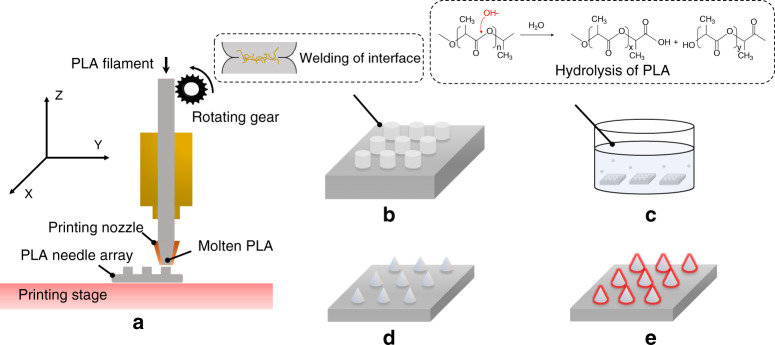
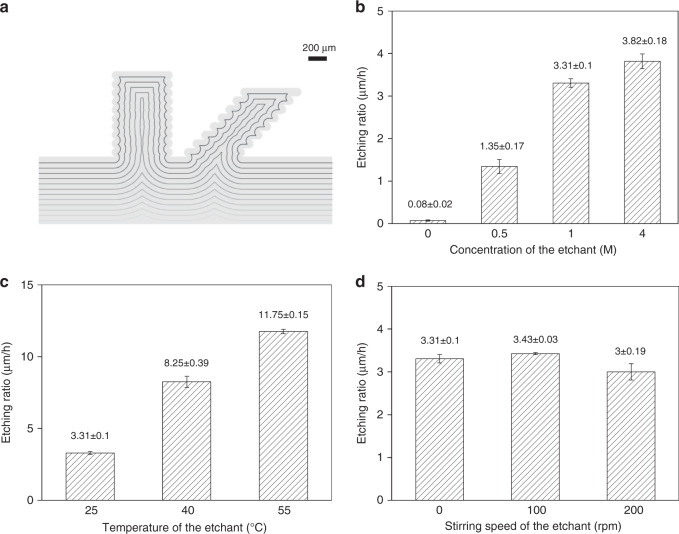
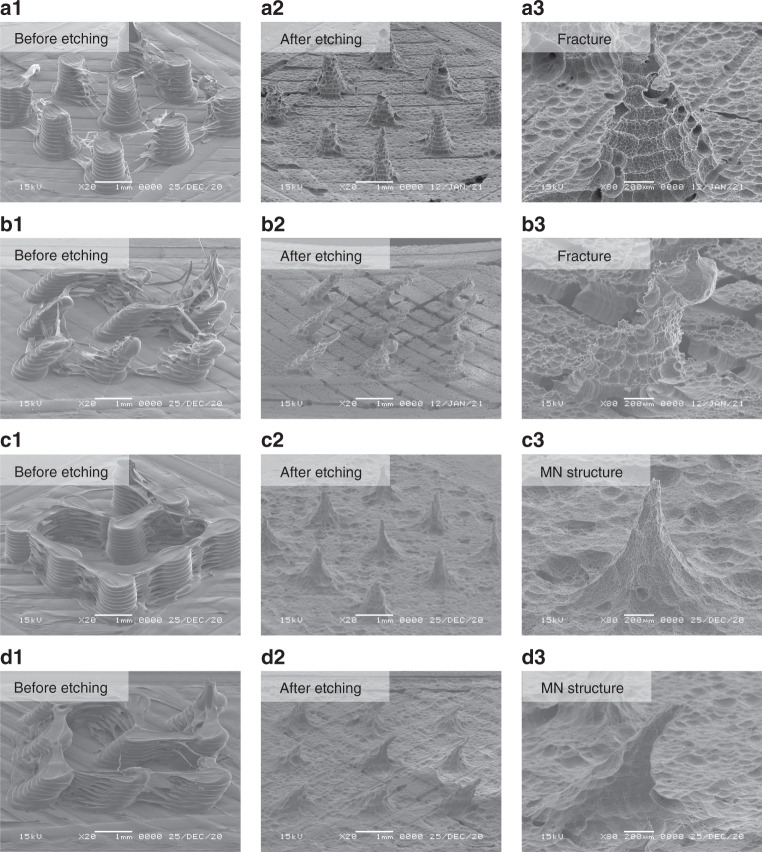
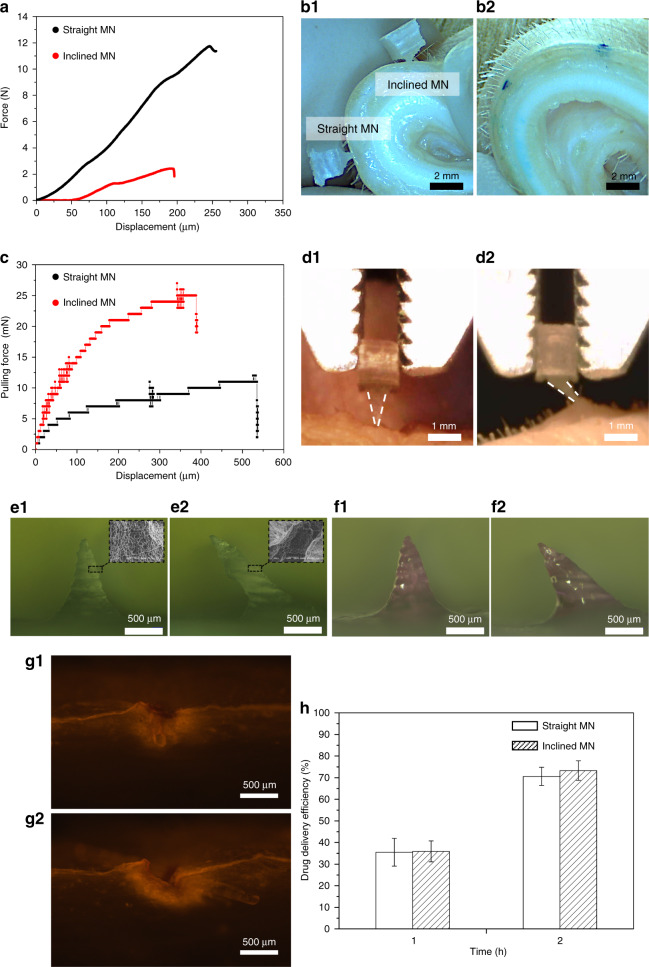
A microneedle (MN) array is a novel biomedical device adopted in medical applications to pierce through the stratum corneum while targeting the viable epidermis and dermis layers of the skin. Owing to their micron-scale dimensions, MNs can minimize stimulations of the sensory nerve fibers in the dermis layer. For medical applications, such as wound healing, biosensing, and drug delivery, the structure of MNs significantly influences their mechanical properties. Among the various microfabrication methods for MNs, fused deposition modeling (FDM), a commercial 3D printing method, shows potential in terms of the biocompatibility of the printed material (polylactic acid (PLA)) and preprogrammable arbitrary shapes. Owing to the current limitations of FDM printer resolution, conventional micron-scale MN structures cannot be fabricated without a post-fabrication process. Hydrolysis in an alkaline solution is a feasible approach for reducing the size of PLA needles printed via FDM. Moreover, weak bonding between PLA layers during additive manufacturing triggers the detachment of PLA needles before etching to the expected sizes. Furthermore, various parameters for the fabrication of PLA MNs with FDM have yet to be sufficiently optimized. In this study, the thermal parameters of the FDM printing process, including the nozzle and printing stage temperatures, were investigated to bolster the interfacial bonding between PLA layers. Reinforced bonding was demonstrated to address the detachment challenges faced by PLA MNs during the chemical etching process. Furthermore, chemical etching parameters, including the etchant concentration, environmental temperature, and stirring speed of the etchant, were studied to determine the optimal etching ratio. To develop a universal methodology for the batch fabrication of biodegradable MNs, this study is expected to optimize the conditions of the FDM-based fabrication process. Additive manufacturing was employed to produce MNs with preprogrammed structures. Inclined MNs were successfully fabricated by FDM printing with chemical etching. This geometrical structure can be adopted to enhance adhesion to the skin layer. Our study provides a useful method for fabricating MN structures for various biomedical applications.
微针(MN)阵列是一种新型生物医学装置,用于医疗应用中穿透角质层,同时靶向皮肤的活表皮和真皮层。由于其微米级尺寸,微针可将对真皮层中感觉神经纤维的刺激降至最低。对于伤口愈合、生物传感和药物递送等医疗应用,微针的结构显著影响其机械性能。在微针的各种微制造方法中,熔融沉积建模(FDM)作为一种商业3D打印方法,在打印材料(聚乳酸(PLA))的生物相容性和可预编程的任意形状方面显示出潜力。由于FDM打印机分辨率的当前限制,在没有后处理工艺的情况下无法制造传统的微米级微针结构。在碱性溶液中水解是减小通过FDM打印的PLA针尺寸的可行方法。此外,增材制造过程中PLA层之间的弱结合会导致PLA针在蚀刻到预期尺寸之前脱落。此外,用FDM制造PLA微针的各种参数尚未得到充分优化。在本研究中,研究了FDM打印过程的热参数,包括喷嘴温度和打印台温度,以加强PLA层之间的界面结合。结果表明,增强的结合解决了PLA微针在化学蚀刻过程中面临的脱落挑战。此外,还研究了化学蚀刻参数,包括蚀刻剂浓度、环境温度和蚀刻剂的搅拌速度,以确定最佳蚀刻率。为了开发一种用于批量制造可生物降解微针的通用方法,本研究有望优化基于FDM的制造工艺条件。采用增材制造来生产具有预编程结构的微针。通过FDM打印和化学蚀刻成功制造了倾斜微针。这种几何结构可用于增强对皮肤层的粘附力。我们的研究为制造用于各种生物医学应用的微针结构提供了一种有用的方法。