Zhai Mingfeng, Cao Shugang, Lu Jinghong, Xu Hui, Xia Mingwu, Li Zongyou
The Affiliated Fuyang People's Hospital of Anhui Medical University, Fuyang, China.
The Affiliated Hefei Hospital of Anhui Medical University, Hefei, China.
Clin Appl Thromb Hemost. 2022 Jan-Dec;28:10760296211067260. doi: 10.1177/10760296211067260.
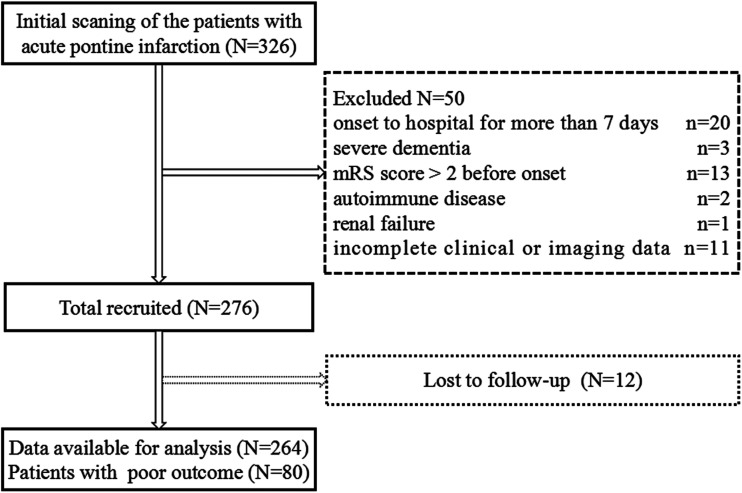
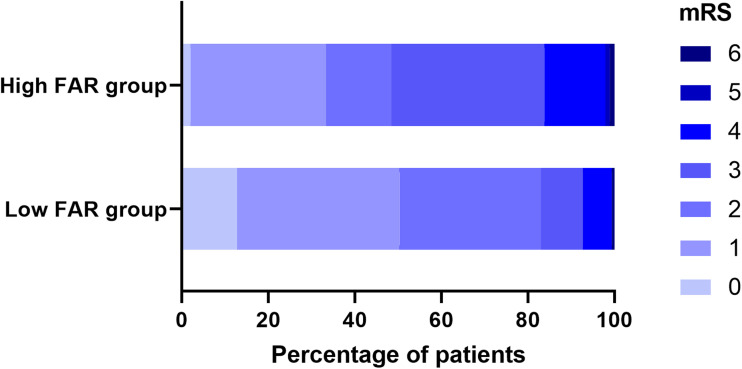
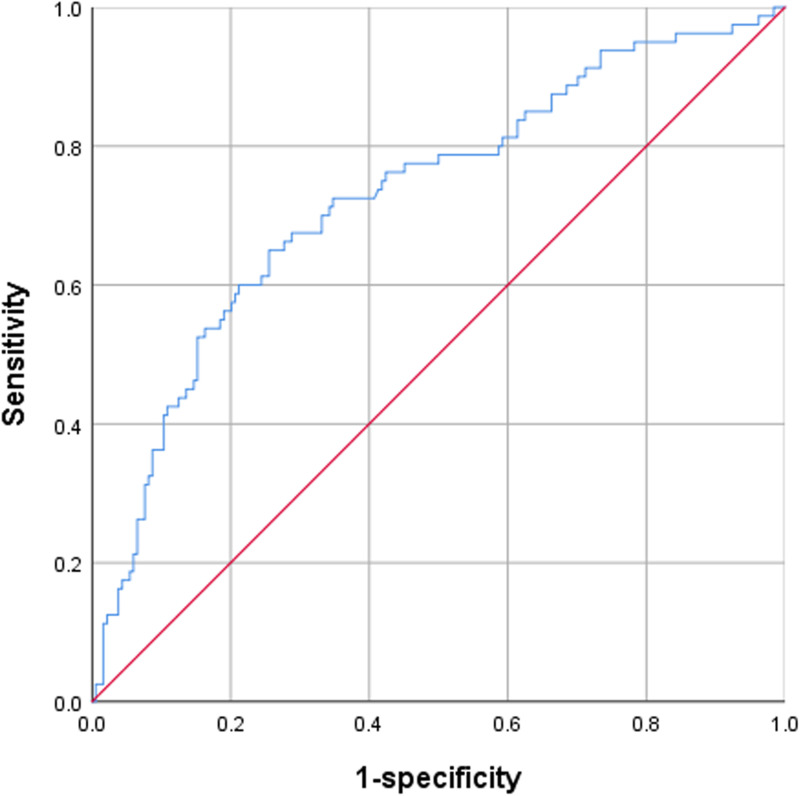
Previous studies have indicated that fibrinogen and low serum albumin levels are associated with poor outcomes of acute ischemic stroke. The role of the fibrinogen-to-albumin ratio (FAR) as a novel inflammatory and thrombotic biomarker in acute ischemic stroke is unclear. This study aims to investigate the relationship between the FAR and 3-month outcomes of acute pontine infarction. : Patients with acute pontine infarction were consecutively included. All patients were followed up at 3 months after onset, and the 3-month outcome was evaluated using modified Rankin Scale (mRS) scores. A score of 0 to 2 was defined as a good outcome, and a score ≥ 3 was defined as a poor outcome. Receiver operating curve (ROC) analysis was used to calculate the optimal cutoff values for patients with acute pontine infarction. Then, a binary logistic regression model was used to evaluate the risk factors for a poor outcome after acute pontine infarction. A total of 264 patients with acute pontine infarction were included. Eighty (30.3%) patients were included in the poor outcome group. The optimal cutoff value of the FAR for predicting the 3-month outcome of acute pontine infarction was 8.199. The FAR was independently associated with a poor outcome at 3 months in patients with acute pontine infarction (odds ratio [OR] = 1.293, 95% confidence interval [CI]: 1.150-1.453). We found that a high FAR predicted poor 3-month outcomes in patients with acute pontine infarction.
既往研究表明,纤维蛋白原和低血清白蛋白水平与急性缺血性卒中的不良预后相关。纤维蛋白原与白蛋白比值(FAR)作为急性缺血性卒中一种新的炎症和血栓形成生物标志物的作用尚不清楚。本研究旨在探讨FAR与急性脑桥梗死3个月预后之间的关系。连续纳入急性脑桥梗死患者。所有患者在发病后3个月进行随访,并使用改良Rankin量表(mRS)评分评估3个月的预后。0至2分被定义为良好预后,≥3分被定义为不良预后。采用受试者工作特征曲线(ROC)分析计算急性脑桥梗死患者的最佳截断值。然后,使用二元逻辑回归模型评估急性脑桥梗死后不良预后的危险因素。共纳入264例急性脑桥梗死患者。80例(30.3%)患者被纳入不良预后组。预测急性脑桥梗死3个月预后的FAR最佳截断值为8.199。FAR与急性脑桥梗死患者3个月时的不良预后独立相关(比值比[OR]=1.293,95%置信区间[CI]:1.150-1.453)。我们发现,高FAR预示急性脑桥梗死患者3个月预后不良。