Tang Yuchao, Liu Yijie, Luo Kang, Xu Leifeng, Yang Panpan, Ming Jun
Institute of Vegetables and Flowers, Chinese Academy of Agricultural Sciences, Beijing 100081, China.
College of Landscape Architecture and Forestry, Qingdao Agricultural University, Qingdao 266109, China.
Antioxidants (Basel). 2022 Jul 27;11(8):1458. doi: 10.3390/antiox11081458.
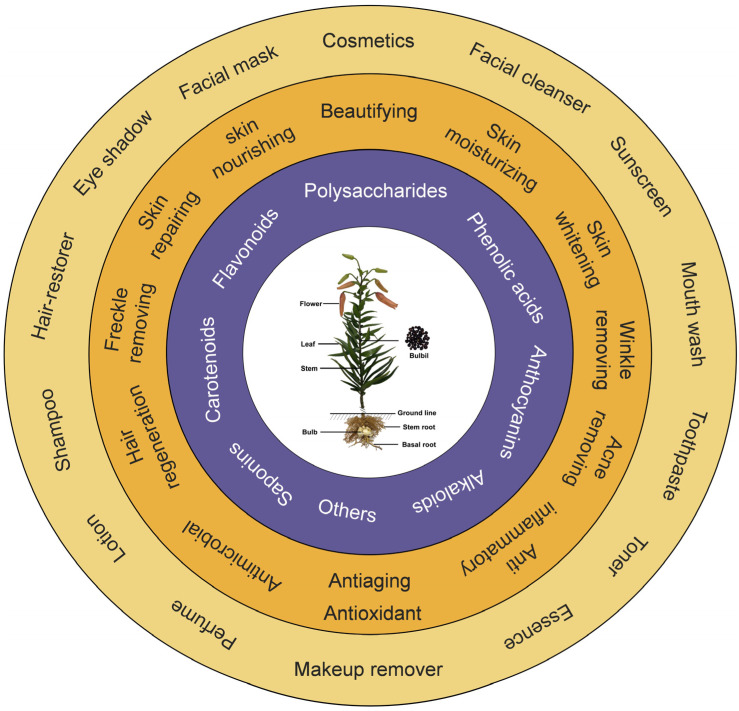
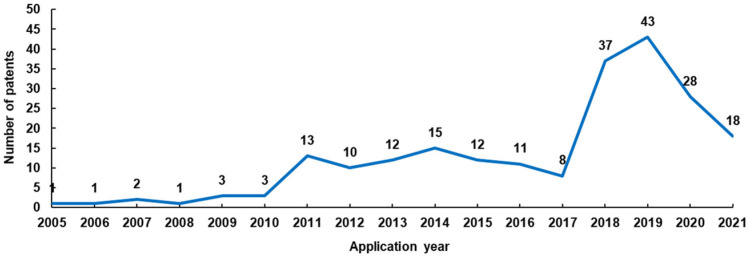
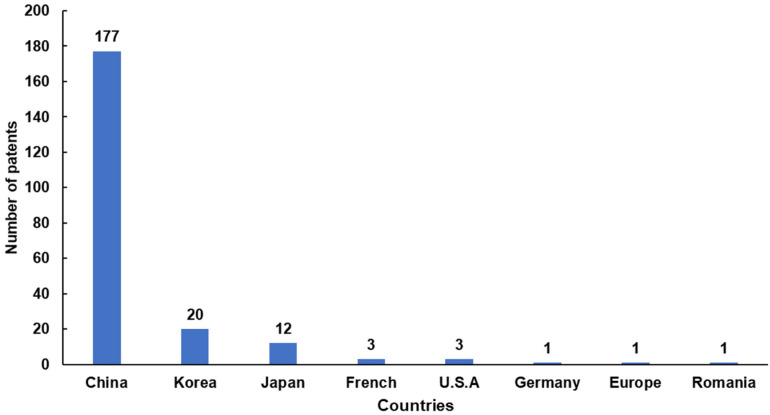
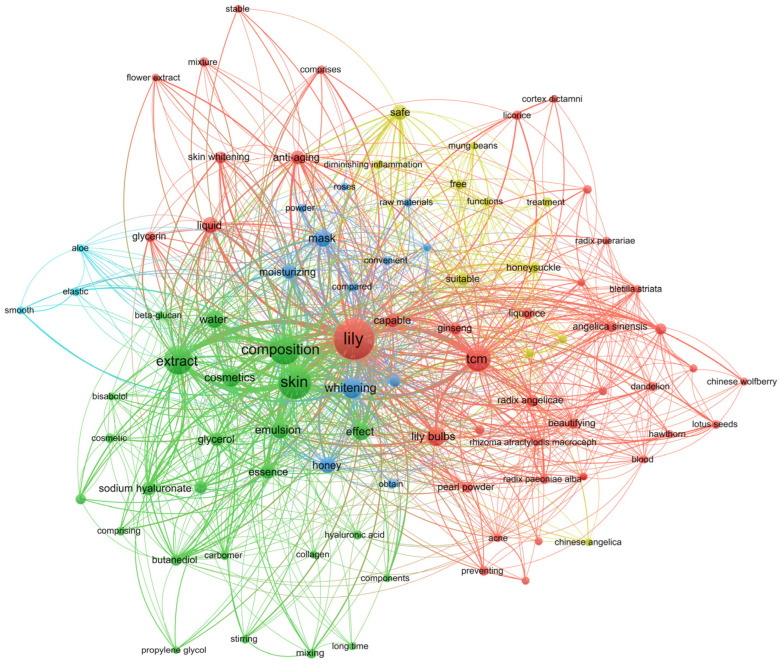
The application of cosmetics is indispensable in our current society. In recent years, with an increasing awareness of the long-term health benefits of naturally sourced ingredients, plant-based cosmetic products have gained increasing attention. belongs to the Liliaceae family, which is one of the main plant families used in cosmetics for skin care treatment. A large number of studies have shown that plants are rich in components such as phenolic acids, flavonoids, and polysaccharides, with high potential for cosmetic applications. However, the application of lilies in cosmetics has not been systematically reported. This knowledge gap can easily lead to the neglect of its application in cosmetics because lilies are most familiar as ornamental plants. Integrating academic papers and patent publications, we analyzed the potential cosmetic application ingredients in lily, as well as their applications in cosmetics and related efficacy. Patent analysis showed that applications for lily-related cosmetic patents are mainly concentrated in East Asia, including China, Korea, and Japan. The application of lilies involves all aspects of cosmetics, such as sunscreens, facial cleansers, facial masks, conditioners, and so on. Its functions are also rich and diverse, including antiaging, radiation protective, whitening, moisturizing, freckle removal, acne treatment, and hair regeneration promotion. In addition, lilies are compatible with the application of other herbs. Moreover, with a change in people's consumption concepts and the consideration of long-term health benefits, lily-based food and medicine innovation with health care and beautification effects may be a promising direction.
在当今社会,化妆品的使用不可或缺。近年来,随着人们对天然来源成分长期健康益处的认识不断提高,植物基化妆品越来越受到关注。[此处原文缺失植物名称]属于百合科,是用于皮肤护理的主要植物科之一。大量研究表明,[此处原文缺失植物名称]植物富含酚酸、黄酮类化合物和多糖等成分,在化妆品应用方面具有很高的潜力。然而,百合在化妆品中的应用尚未得到系统报道。由于百合作为观赏植物最为人熟知,这一知识空白很容易导致其在化妆品应用中被忽视。综合学术论文和专利出版物,我们分析了百合中潜在的化妆品应用成分,以及它们在化妆品中的应用和相关功效。专利分析表明,与百合相关的化妆品专利申请主要集中在东亚,包括中国、韩国和日本。百合的应用涉及化妆品的各个方面,如防晒霜、洗面奶、面膜、护发素等。其功能也丰富多样,包括抗衰老、防辐射、美白、保湿、祛斑、治疗痤疮和促进头发生长等。此外,百合与其他草药的应用具有相容性。而且,随着人们消费观念的转变以及对长期健康益处的考虑,具有保健和美容效果的百合基食品和药物创新可能是一个有前景的方向。