Department of Emergency and Critical Care Medicine, Chiba University Graduate School of Medicine, 1-8-1 Inohana, Chuo-ku, Chiba, Chiba, 260-8677, Japan.
Smart 119 Inc., 7th floor, Chiba Chuo Twin Building No. 2, 2-5-1 Chuo, Chiba, Japan.
Sci Rep. 2022 Jul 28;12(1):12912. doi: 10.1038/s41598-022-17091-5.
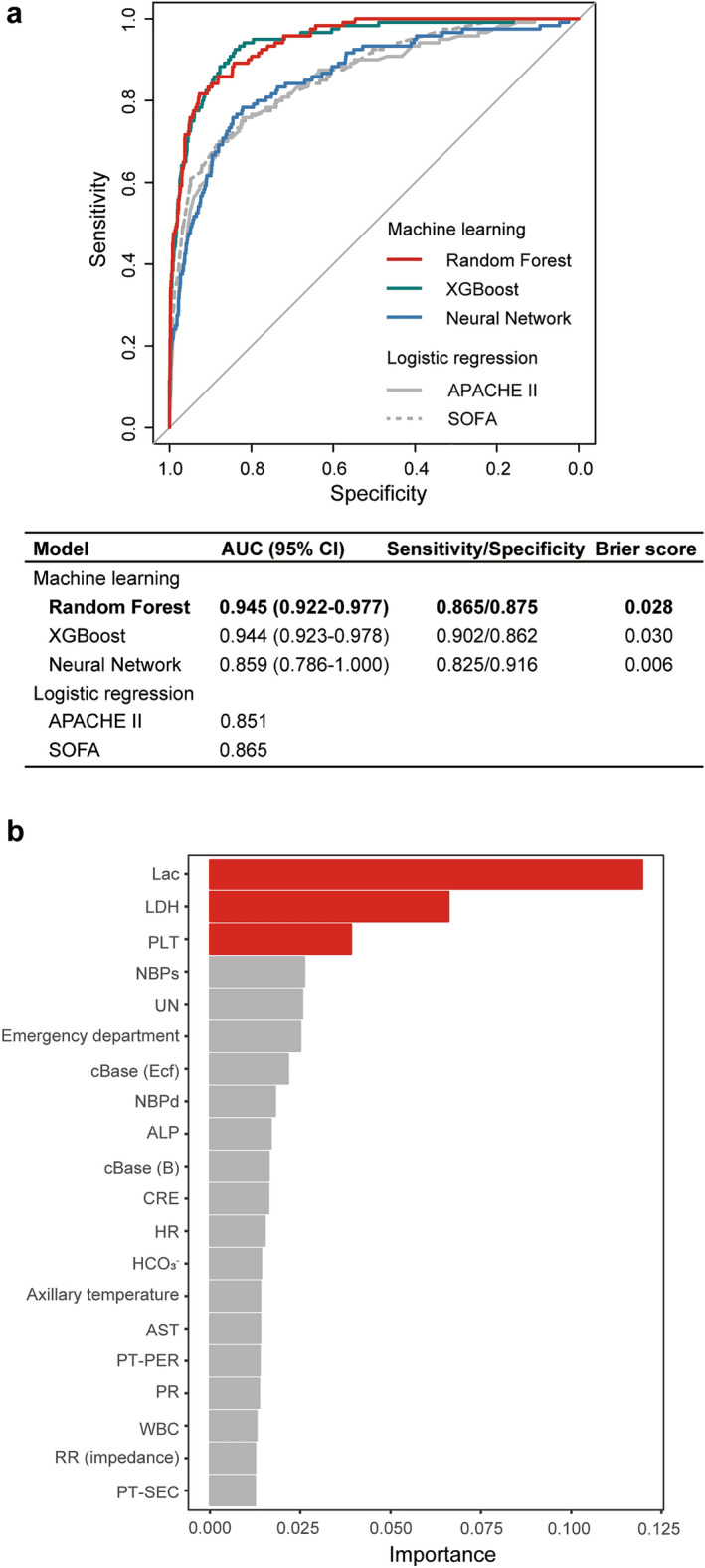
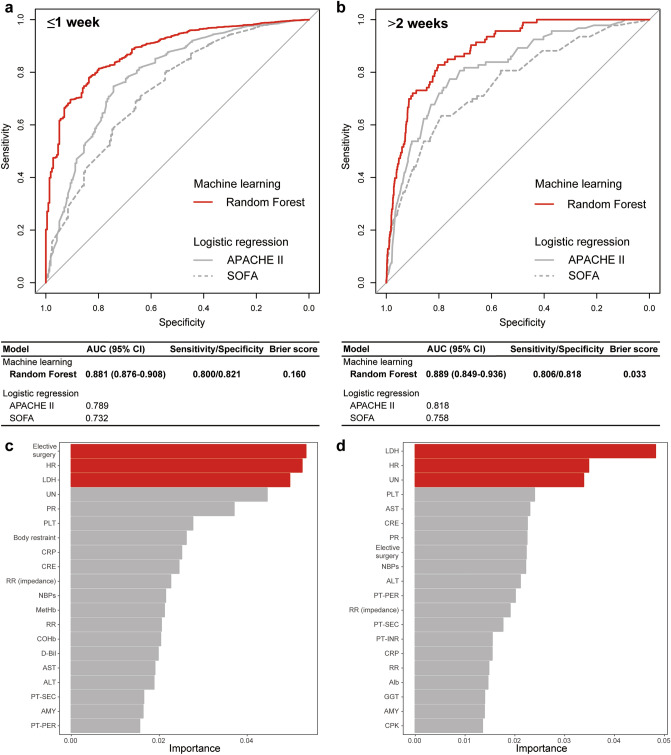
Machine learning can predict outcomes and determine variables contributing to precise prediction, and can thus classify patients with different risk factors of outcomes. This study aimed to investigate the predictive accuracy for mortality and length of stay in intensive care unit (ICU) patients using machine learning, and to identify the variables contributing to the precise prediction or classification of patients. Patients (n = 12,747) admitted to the ICU at Chiba University Hospital were randomly assigned to the training and test cohorts. After learning using the variables on admission in the training cohort, the area under the curve (AUC) was analyzed in the test cohort to evaluate the predictive accuracy of the supervised machine learning classifiers, including random forest (RF) for outcomes (primary outcome, mortality; secondary outcome, length of ICU stay). The rank of the variables that contributed to the machine learning prediction was confirmed, and cluster analysis of the patients with risk factors of mortality was performed to identify the important variables associated with patient outcomes. Machine learning using RF revealed a high predictive value for mortality, with an AUC of 0.945 (95% confidence interval [CI] 0.922-0.977). In addition, RF showed high predictive value for short and long ICU stays, with AUCs of 0.881 (95% CI 0.876-0.908) and 0.889 (95% CI 0.849-0.936), respectively. Lactate dehydrogenase (LDH) was identified as a variable contributing to the precise prediction in machine learning for both mortality and length of ICU stay. LDH was also identified as a contributing variable to classify patients into sub-populations based on different risk factors of mortality. The machine learning algorithm could predict mortality and length of stay in ICU patients with high accuracy. LDH was identified as a contributing variable in mortality and length of ICU stay prediction and could be used to classify patients based on mortality risk.
机器学习可以预测结果并确定导致精准预测的变量,从而对具有不同结果风险因素的患者进行分类。本研究旨在利用机器学习研究死亡率和重症监护病房(ICU)患者住院时间的预测准确性,并确定导致患者精准预测或分类的变量。将千叶大学医院 ICU 收治的患者(n=12747)随机分配到训练和测试队列中。在使用训练队列入院时的变量进行学习后,在测试队列中分析曲线下面积(AUC),以评估监督机器学习分类器的预测准确性,包括随机森林(RF)对结局(主要结局:死亡率;次要结局:ICU 住院时间)的预测。确认了对机器学习预测有贡献的变量的排名,并对具有死亡风险因素的患者进行聚类分析,以确定与患者结局相关的重要变量。使用 RF 的机器学习显示出对死亡率的高预测价值,AUC 为 0.945(95%置信区间 [CI] 0.922-0.977)。此外,RF 对短和长 ICU 住院时间也显示出较高的预测价值,AUC 分别为 0.881(95%CI 0.876-0.908)和 0.889(95%CI 0.849-0.936)。乳酸脱氢酶(LDH)被确定为在死亡率和 ICU 住院时间预测的机器学习中有助于精准预测的变量。LDH 也被确定为根据死亡率的不同风险因素对患者进行分类的变量。机器学习算法可以高精度预测 ICU 患者的死亡率和住院时间。LDH 被确定为死亡率和 ICU 住院时间预测的贡献变量,并可用于根据死亡率风险对患者进行分类。