Manwar Rayyan, Saint-Martin Loїc, Avanaki Kamran
Richard and Loan Hill Department of Bioengineering, University of Illinois at Chicago, Chicago, IL 60607, USA;
Department of Dermatology, University of Illinois at Chicago, Chicago, IL 60607, USA.
Chemosensors (Basel). 2022 May 9;10(5):181. doi: 10.3390/chemosensors10050181. eCollection 2022 May.
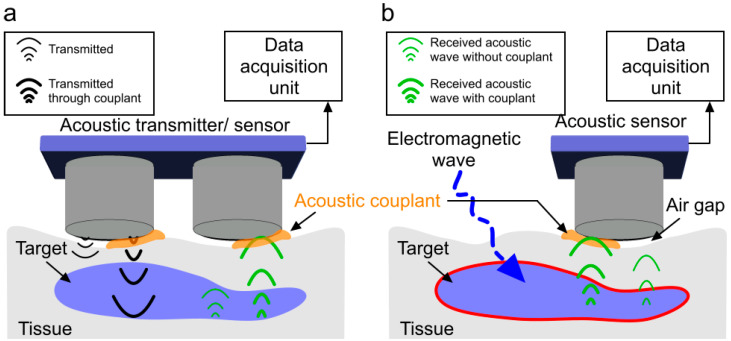
Acoustic biosensors are widely used in physical, chemical, and biosensing applications. One of the major concerns in acoustic biosensing is the delicacy of the medium through which acoustic waves propagate and reach acoustic sensors. Even a small airgap diminishes acoustic signal strengths due to high acoustic impedance mismatch. Therefore, the presence of a coupling medium to create a pathway for an efficient propagation of acoustic waves is essential. Here, we have reviewed the chemical, physical, and acoustic characteristics of various coupling material (liquid, gel-based, semi-dry, and dry) and present a guide to determine a suitable application-specific coupling medium.
声学生物传感器广泛应用于物理、化学和生物传感领域。声学生物传感中的一个主要问题是声波传播并到达声学传感器所经过的介质很敏感。由于高声阻抗失配,即使是很小的气隙也会削弱声信号强度。因此,存在一种耦合介质以创建声波有效传播的路径至关重要。在此,我们综述了各种耦合材料(液体、凝胶基、半干和干)的化学、物理和声学特性,并给出了确定适合特定应用的耦合介质的指南。