Loloi Justin, Babar Mustufa, Davies Kelvin P, Suadicani Sylvia O
Department of Urology, Albert Einstein College of Medicine and Montefiore Medical Center, Bronx, NY, USA.
Department of Urology, Albert Einstein College of Medicine and Montefiore Medical Center, Bronx, NY 10461, USA.
Ther Adv Urol. 2022 Jul 26;14:17562872221109023. doi: 10.1177/17562872221109023. eCollection 2022 Jan-Dec.
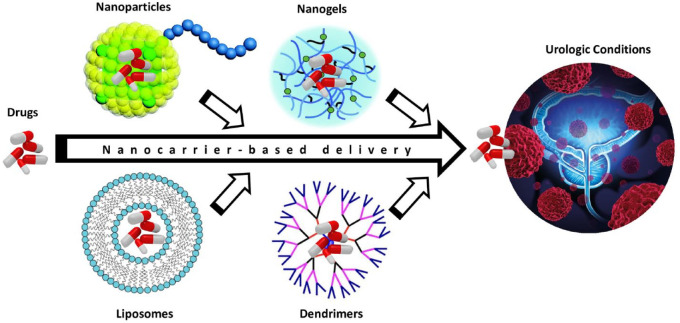
Nanotechnology represents an expanding area of research and innovation in almost every field of science, including Medicine, where nanomaterial-based products have been developed for diagnostic and therapeutic applications. Because of their small, nanoscale size, these materials exhibit unique physical and chemical properties that differ from those of each component when considered in bulk. In Nanomedicine, there is an increasing interest in harnessing these unique properties to engineer nanocarriers for the delivery of therapeutic agents. Nano-based drug delivery platforms have many advantages over conventional drug administration routes as this technology allows for local and transdermal applications of therapeutics that can bypass the first-pass metabolism, improves drug efficacy through encapsulation of hydrophobic drugs, and allows for a sustained and controlled release of encapsulated agents. In Urology, nano-based drug delivery platforms have been extensively investigated and implemented for cancer treatment. However, there is also great potential for use of nanotechnology to treat non-oncologic urogenital diseases. We provide an update on research that is paving the way for clinical translation of nanotechnology in the areas of erectile dysfunction (ED), overactive bladder (OAB), interstitial cystitis/bladder pain syndrome (IC/BPS), and catheter-associated urinary tract infections (CAUTIs). Overall, preclinical and clinical studies have proven the utility of nanomaterials both as vehicles for transdermal and intravesical delivery of therapeutic agents and for urinary catheter formulation with antimicrobial agents to treat non-oncologic urogenital diseases. Although clinical translation will be dependent on overcoming regulatory challenges, it is inevitable before there is universal adoption of this technology to treat non-oncologic urogenital diseases.
纳米技术是几乎在每一个科学领域都不断扩展的研究与创新领域,包括医学领域,在该领域已开发出基于纳米材料的产品用于诊断和治疗应用。由于这些材料具有纳米级的微小尺寸,它们展现出独特的物理和化学性质,这些性质与各组分以大块形式存在时有所不同。在纳米医学中,利用这些独特性质来设计用于递送治疗剂的纳米载体的兴趣日益浓厚。基于纳米的药物递送平台相较于传统给药途径具有许多优势,因为该技术允许治疗剂进行局部和经皮应用,可绕过首过代谢,通过包封疏水药物提高药物疗效,并允许包封剂持续和可控释放。在泌尿外科领域,基于纳米的药物递送平台已被广泛研究并应用于癌症治疗。然而,纳米技术在治疗非肿瘤性泌尿生殖系统疾病方面也具有巨大潜力。我们提供了关于纳米技术在勃起功能障碍(ED)、膀胱过度活动症(OAB)、间质性膀胱炎/膀胱疼痛综合征(IC/BPS)以及导管相关尿路感染(CAUTIs)等领域临床转化研究进展的最新情况。总体而言,临床前和临床研究已证明纳米材料作为治疗剂经皮和膀胱内递送的载体以及用于含抗菌剂的导尿管配方以治疗非肿瘤性泌尿生殖系统疾病的效用。尽管临床转化将取决于克服监管方面的挑战,但在该技术被普遍用于治疗非肿瘤性泌尿生殖系统疾病之前这是不可避免的。