Exercise Intervention for Health Research Group (EXINH-RG), Department of Physiotherapy, University of Valencia, Valencia, Spain.
Department of Physiotherapy, Faculty of Health Sciences, European University of Valencia, Valencia, Spain.
Scand J Med Sci Sports. 2022 Nov;32(11):1522-1549. doi: 10.1111/sms.14223. Epub 2022 Aug 13.
To assess the available evidence on the effectiveness of high-intensity interval training (HIIT) in addition to first-choice cancer treatment on cardiorespiratory fitness (CRF), quality of life (QoL), adherence, and adverse effects of HIIT in patients with cancer or cancer survivors.
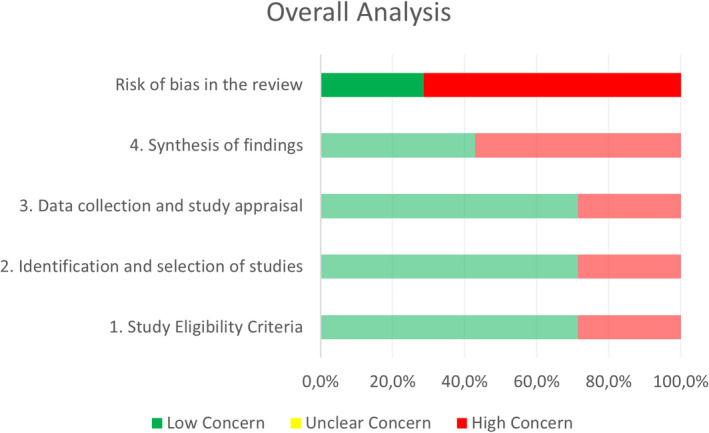
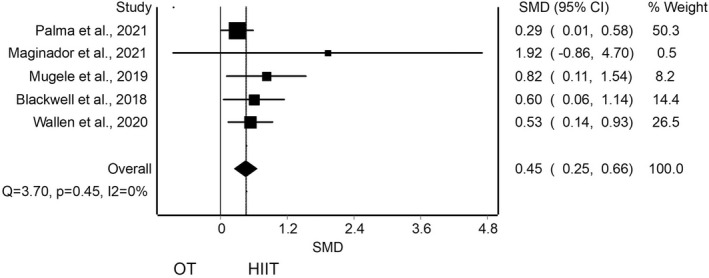
An umbrella review and meta-meta-analysis (MMA) was performed. A systematic search was conducted in MEDLINE, EMBASE, Cochrane Database, CINAHL, Scopus, SPORTDiscus, and Web of Science until August 2021. Article selection, quality assessment, and risk of bias assessment were performed by two independent reviewers. The MMA were performed with a random-effects model and the summary statistics were presented in the form of forest plot with a weighted compilation of all standardized mean differences (SMD) and corresponding 95% confidence interval (CI).
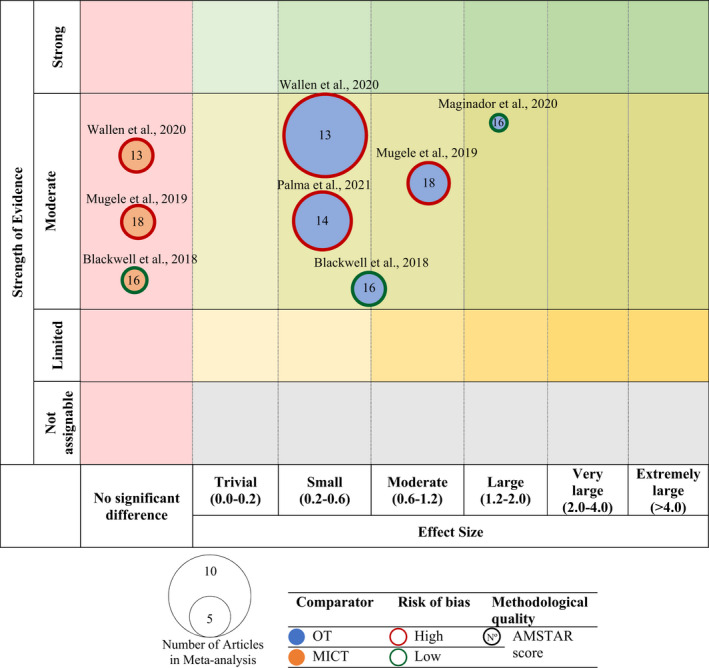
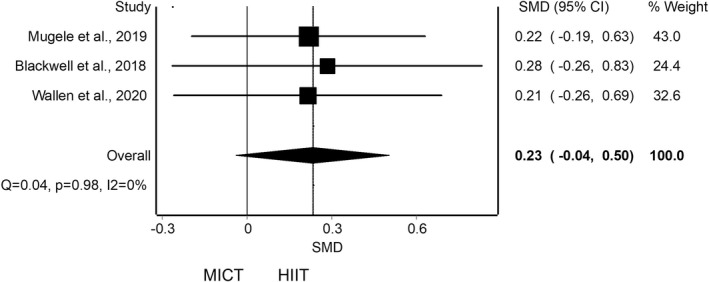
Seven systematic reviews were included. Regarding CRF, the addition of HIIT to cancer treatment showed statistically significant differences with a small clinical effect, compared with adding other treatments (SMD = 0.45; 95% CI 0.24 to 0.65). There was no significant difference when compared with adding moderate-intensity continuous training (MICT) (SMD = 0.23; 95% CI -0.04 to 0.50). QoL showed positive results although with some controversy. Adherence to HIIT intervention was high, ranging from 54% to 100%. Regarding adverse effects, most of the systematic reviews reported none, and in the cases in which they occurred, they were mild.
In conjunction with first-choice cancer treatment, HIIT has been shown to be an effective intervention in terms of CRF and QoL, as well as having optimal adherence rate. In addition, the implementation of HIIT in patients with cancer or cancer survivors is safe as it showed no or few adverse effects.
评估高强度间歇训练(HIIT)联合癌症首选治疗方案对癌症患者或癌症幸存者心肺功能(CRF)、生活质量(QoL)、依从性及 HIIT 不良反应的有效性。
进行了一项伞状评价和荟萃元分析(MMA)。对 MEDLINE、EMBASE、Cochrane 数据库、CINAHL、Scopus、SPORTDiscus 和 Web of Science 进行了系统检索,检索时间截至 2021 年 8 月。两名独立审查员进行了文章选择、质量评估和偏倚风险评估。MMA 采用随机效应模型进行,汇总统计数据以森林图的形式呈现,所有标准化均数差(SMD)及其相应 95%置信区间(CI)以加权方式组合。
纳入了 7 项系统评价。关于 CRF,与添加其他治疗方法相比,HIIT 联合癌症治疗方案显示出具有统计学意义的差异,且具有较小的临床效果(SMD=0.45;95%CI 0.24 至 0.65)。与添加中等强度持续训练(MICT)相比,差异无统计学意义(SMD=0.23;95%CI-0.04 至 0.50)。QoL 结果呈阳性,尽管存在一些争议。HIIT 干预的依从性较高,范围为 54%至 100%。关于不良反应,大多数系统评价报告无不良反应,在发生不良反应的情况下,不良反应为轻度。
HIIT 联合癌症首选治疗方案,在 CRF 和 QoL 方面具有显著的有效性,同时具有较高的依从率。此外,在癌症患者或癌症幸存者中实施 HIIT 是安全的,因为它没有或只有很少的不良反应。