Human Computer Interaction Laboratory (HCILab), Department of Informatics and Telecommunications, University of Ioannina, Kostakioi, 47100 Arta, Greece.
Faculty of Medicine, University of Ioannina, 45110 Ioannina, Greece.
Sensors (Basel). 2022 Aug 3;22(15):5792. doi: 10.3390/s22155792.
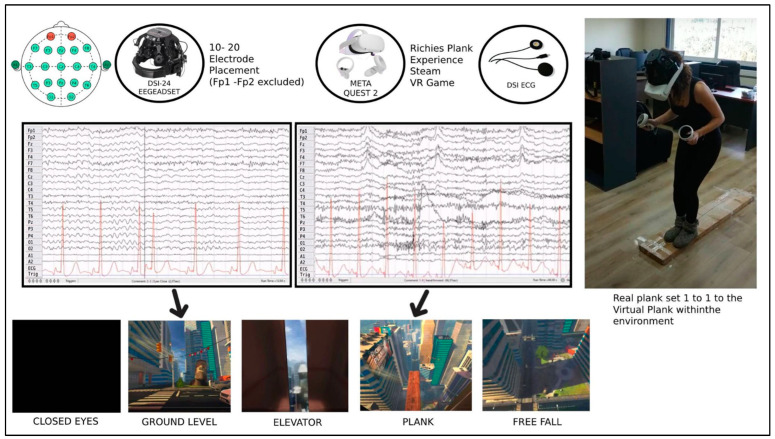
Over the last decade, virtual reality (VR) has become an increasingly accessible commodity. Head-mounted display (HMD) immersive technologies allow researchers to simulate experimental scenarios that would be unfeasible or risky in real life. An example is extreme heights exposure simulations, which can be utilized in research on stress system mobilization. Until recently, electroencephalography (EEG)-related research was focused on mental stress prompted by social or mathematical challenges, with only a few studies employing HMD VR techniques to induce stress. In this study, we combine a state-of-the-art EEG wearable device and an electrocardiography (ECG) sensor with a VR headset to provoke stress in a high-altitude scenarios while monitoring EEG and ECG biomarkers in real time. A robust pipeline for signal clearing is implemented to preprocess the noise-infiltrated (due to movement) EEG data. Statistical and correlation analysis is employed to explore the relationship between these biomarkers with stress. The participant pool is divided into two groups based on their heart rate increase, where statistically important EEG biomarker differences emerged between them. Finally, the occipital-region band power changes and occipital asymmetry alterations were found to be associated with height-related stress and brain activation in beta and gamma bands, which correlates with the results of the self-reported Perceived Stress Scale questionnaire.
在过去的十年中,虚拟现实(VR)已经成为一种越来越容易获得的商品。头戴式显示(HMD)沉浸式技术使研究人员能够模拟在现实生活中不可行或有风险的实验场景。例如,极端高度暴露模拟可以用于研究应激系统动员。直到最近,脑电图(EEG)相关研究才专注于由社会或数学挑战引起的精神压力,只有少数研究采用 HMD VR 技术来诱发压力。在这项研究中,我们结合了最先进的脑电图可穿戴设备和心电图(ECG)传感器与 VR 耳机,以在高海拔场景中引发压力,同时实时监测脑电图和心电图生物标志物。实施了一个强大的信号清理管道,以预处理受噪声干扰(由于运动)的脑电图数据。采用统计和相关分析来探索这些生物标志物与压力之间的关系。根据心率增加,将参与者分为两组,他们之间出现了统计学上重要的脑电图生物标志物差异。最后,发现枕部区域的波段功率变化和枕部不对称改变与与高度相关的压力和大脑在β和γ波段的激活有关,这与自我报告的应激量表问卷的结果相关。