Department of Mechanical Engineering, College of Engineering, Universiti Tenaga Nasional, Jalan IKRAM-UNITEN, Kajang 43000, Selangor, Malaysia.
Department of Mechanical and Mechatronic Engineering, Faculty of Engineering, Sohar University, Sohar P.C 311, Oman.
Sensors (Basel). 2022 Aug 3;22(15):5793. doi: 10.3390/s22155793.
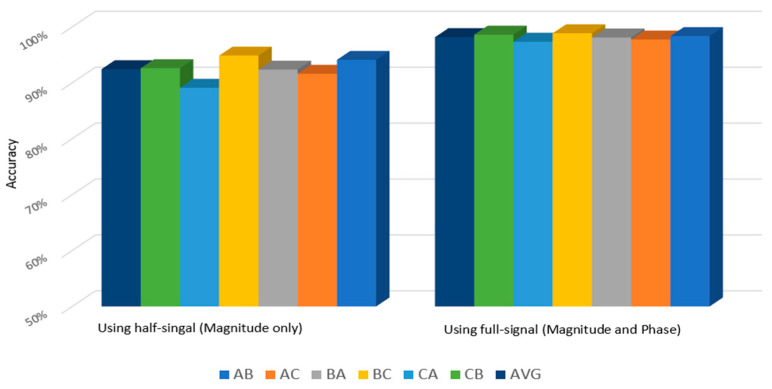
The massive environmental noise interference and insufficient effective sample degradation data of the intelligent fault diagnosis performance methods pose an extremely concerning issue. Realising the challenge of developing a facile and straightforward model that resolves these problems, this study proposed the One-Dimensional Convolutional Neural Network (1D-CNN) based on frequency-domain signal processing. The Fast Fourier Transform (FFT) analysis is initially utilised to transform the signals from the time domain to the frequency domain; the data was represented using a phasor notation, which separates magnitude and phase and then fed to the 1D-CNN. Subsequently, the model is trained with White Gaussian Noise (WGN) to improve its robustness and resilience to noise. Based on the findings, the proposed model successfully achieved 100% classification accuracy from clean signals and simultaneously achieved considerable robustness to noise and exceptional domain adaptation ability. The diagnosis accuracy retained up to 97.37%, which was higher than the accuracy of the CNN without training under noisy conditions at only 43.75%. Furthermore, the model achieved an accuracy of up to 98.1% under different working conditions, which was superior to other reported models. In addition, the proposed model outperformed the state-of-art methods as the Signal-to-Noise Ratio (SNR) was lowered to -10 dB achieving 97.37% accuracy. In short, the proposed 1D-CNN model is a promising effective rolling bearing fault diagnosis.
智能故障诊断性能方法面临着巨大的环境噪声干扰和有效样本降解数据不足的问题。为了解决这些问题,开发一个简单直接的模型具有极大的挑战性,因此本研究提出了基于频域信号处理的一维卷积神经网络(1D-CNN)。该方法首先利用快速傅里叶变换(FFT)将信号从时域转换到频域;使用相量表示法表示数据,分离幅度和相位,然后将其输入到 1D-CNN 中。随后,使用白高斯噪声(WGN)对模型进行训练,以提高其对噪声的鲁棒性和适应性。基于这些发现,该模型成功地实现了清洁信号的 100%分类准确率,同时对噪声具有相当的鲁棒性和出色的域适应能力。诊断准确率保持在 97.37%,高于在噪声条件下未经训练的 CNN 的准确率(仅为 43.75%)。此外,该模型在不同工作条件下的准确率高达 98.1%,优于其他报道的模型。此外,当信噪比(SNR)降低到-10dB 时,该模型的准确率仍高达 97.37%,优于现有的先进方法。总之,所提出的 1D-CNN 模型是一种很有前途的有效的滚动轴承故障诊断方法。