Jiawei Sun, Zhi Chen, Kewei Tian, Xiaoping Li
Shulan International Medical College, Zhejiang Shuren College, Hangzhou, China.
Zhejiang University School of Medicine, Hangzhou, China.
Front Bioeng Biotechnol. 2022 Aug 16;10:942077. doi: 10.3389/fbioe.2022.942077. eCollection 2022.
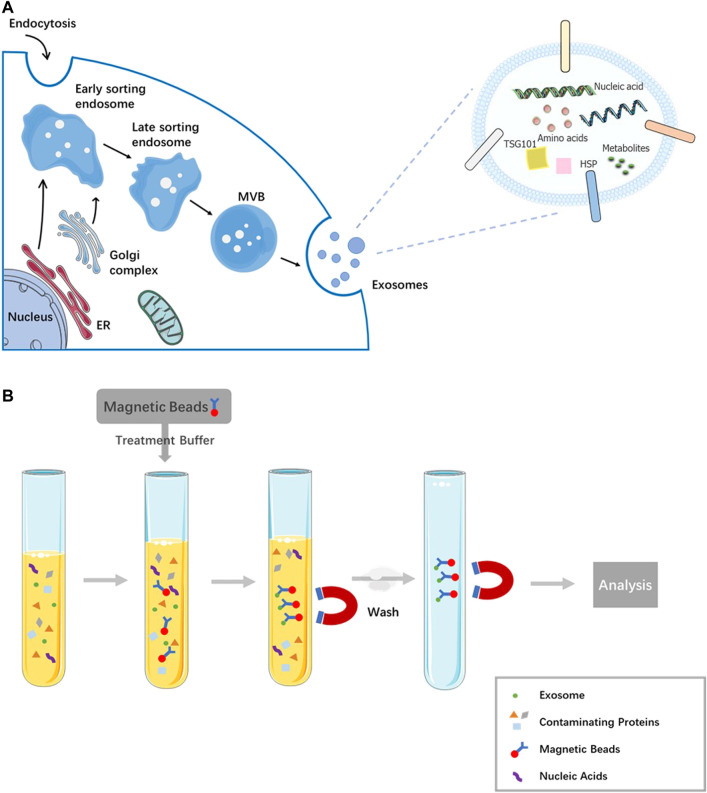
Exosomes, one type of extracellular vesicle (EV) secreted by cells, participate in intercellular communication and other biological processes as carriers of lipids, functional proteins, mRNAs, miRNAs, lncRNAs, and DNA fragments. Their presence in biofluids makes them attractive candidates as innovative clinical diagnostic tools. However, the conventional isolation and analysis of high-purity exosomes in clinical application is challenging, with traditional methods facing a number of shortcomings, including low yield or purity, long periods of processing, high cost, and difficulties in standardization. In this study, we provide an overview of commonly used exosome isolation approaches with a focus on magnetic bead-based capture, an ideal methodology with high purity and integrality of exosomes. The current challenges on exosome isolation methods are also described to highlight areas for future research and development.
外泌体是细胞分泌的一种细胞外囊泡(EV),作为脂质、功能蛋白、mRNA、miRNA、lncRNA和DNA片段的载体,参与细胞间通讯和其他生物学过程。它们在生物流体中的存在使其成为极具吸引力的创新临床诊断工具候选物。然而,在临床应用中常规分离和分析高纯度外泌体具有挑战性,传统方法存在许多缺点,包括产量或纯度低、处理时间长、成本高以及标准化困难。在本研究中,我们概述了常用的外泌体分离方法,重点是基于磁珠的捕获,这是一种能获得高纯度和完整性外泌体的理想方法。还描述了外泌体分离方法目前面临的挑战,以突出未来研究和开发的领域。