Toro-Huamanchumo C J, Hilario-Gomez M M, Pinedo-Castillo L, Zumarán-Nuñez C J, Espinoza-Gonzales F, Caballero-Alvarado J, Rodriguez-Morales A J, Barboza J J
Universidad César Vallejo, Trujillo, Peru.
Sociedad científica de San Fernando, Universidad Nacional Mayor de San Marcos, Lima, Peru.
New Microbes New Infect. 2022 Jul;48:101021. doi: 10.1016/j.nmni.2022.101021. Epub 2022 Aug 28.
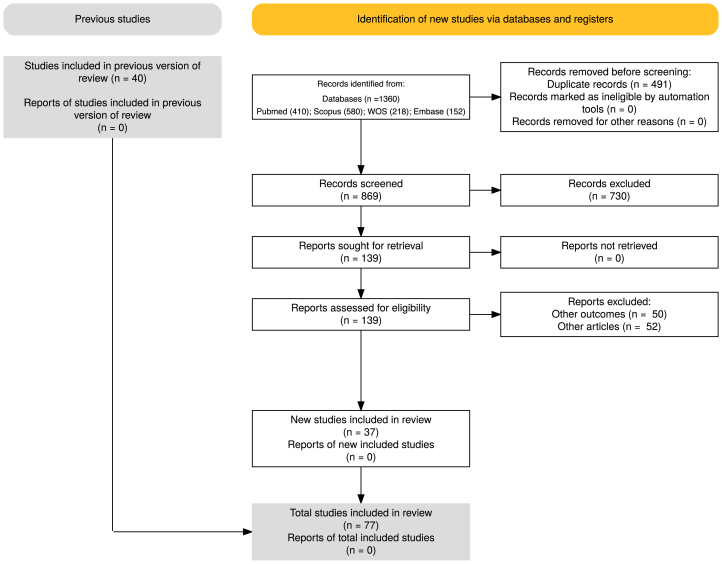
Recurrent positivity in a patient with COVID-19 may be due to various reasons, not necessarily reinfection. There is concern about the occurrence frequency of reinfection. Five databases and a preprint/preprint repository were searched. All case reports, case series, and observational studies were included. Bias was assessed for each study with the Newcastle-Ottawa Scale tool and reported according to the preferred reporting items for systematic reviews and meta-analyses (PRISMA-2020). After eligibility, 77 studies were included for qualitative synthesis (52 case reports, 21 case series, and four case-controls; 1131 patients included). Of these, 16 studies described a second contact with the SARS-CoV-2 positive case, five studies described healthcare profession-related infection, ten studies described that the source of reinfection was likely to be from the community, one study described travel-related infection, nine studies described vulnerability-related infection due to comorbidity. The mean number of days from discharge or negative test to reinfection ranged from 23.3 to 57.6 days across the different included studies. The risk of bias for all case report/series studies was moderate/high. For observational studies, the risk of bias was low. Reinfection of patients with COVID-19 occurs between the first and second month after the first infection, but beyond, and 90 days have been proposed as a point to begin to consider it. The main factor for reinfection is contact with COVID-19 positive cases.
新型冠状病毒肺炎(COVID-19)患者反复出现阳性可能有多种原因,不一定是再次感染。人们对再次感染的发生频率感到担忧。检索了五个数据库和一个预印本/预印本储存库。纳入了所有病例报告、病例系列和观察性研究。使用纽卡斯尔-渥太华量表工具对每项研究的偏倚进行评估,并根据系统评价和Meta分析的首选报告项目(PRISMA-2020)进行报告。在符合纳入标准后,纳入77项研究进行定性综合分析(52项病例报告、21项病例系列和4项病例对照研究;共纳入1131例患者)。其中,16项研究描述了与严重急性呼吸综合征冠状病毒2(SARS-CoV-2)阳性病例的二次接触,5项研究描述了与医疗职业相关的感染,10项研究描述再次感染的来源可能来自社区,1项研究描述了与旅行相关的感染,9项研究描述了由于合并症导致的与易感性相关的感染。在不同的纳入研究中,从出院或检测阴性到再次感染的平均天数为23.3至57.6天。所有病例报告/系列研究的偏倚风险为中度/高度。对于观察性研究,偏倚风险较低。COVID-19患者的再次感染发生在首次感染后的第一个月至第二个月之间,但也可能在之后发生,有人提出90天作为开始考虑再次感染的时间点。再次感染的主要因素是接触COVID-19阳性病例。